It’s weird that the press keeps discussing rare earths as a strange one-of-a-kind issue. As we noted here before that problem wasn’t an act of God—it was the Chinese figuring out something we didn’t. We as a country were structurally incapable of planning for the future. And we’re still that way. We haven’t always been quite so bad, but with the Republican private-sector orthodoxy and now Trump’s “intuitions” that’s where we are.
In that last piece I talked about slashed support for scientific research as a reason why we’re just waiting for the next such example to pop up. But I should have been even more emphatic; there is an obvious example right now—our electrical infrastructure. We’ve mentioned that issue before in the context of climate change, but the impact goes further.
The US electric power network is antiquated, disorganized, and insecure. The Chinese could put it out of service any time they really wanted to. It needs major investment so that it can act as a resource for the economic development of the country. This isn’t just a matter of tweaks—there is every reason to believe that that the electrical network is going to drive much more of the economy in the future than it does today. That has to do with new power sources (e.g. fusion or other nuclear), new application areas (datacenters are just a first example), and also (whether we like it or not) climate change. The network has to enable all kinds of new uses involving higher levels of electric power wherever it is needed. China is already making huge investments, employing some higher-capacity technologies than we have here.
What are we doing? We have to make major new investments to power the tremendous energy needs of the coming gigawatt datacenters. But we aren’t even thinking about what that means for upgrades to our electrical network—we’re making it exclusively a matter for the datacenters themselves. And we’re prohibiting use of wind and solar in those datacenter projects—even though those are used in 90% of new electricity projects worldwide. There is no national project for development of a secure and capable electrical power infrastructure. We’re going to build and power all of those datacenters and then figure out that hodge-podge of point solutions is no good for high-speed car charging (for example) or for other applications that will come out of China but not here. So we’ll just have to declare another emergency for the years it will take for the infrastructure to catch up.
We refuse to think beyond the immediate needs of today’s businesses. And that matters. Same as for rare earths.
Suppose the Iran war somehow reaches a conclusion, and we have a good, rational, democratically-elected regime in Tehran. What would be a first act of such a regime? In today’s world they’d need to start a nuclear weapons program as an absolute requirement to maintain sovereignty.
And what would happen after that? The clear answer to that question shows what is really on the table. Trump would decide. His Board of Peace is no sideshow–Trump wants to run the world. That may sound great to a US audience, but only until the story collapses. We can see what that means now.
Trump is not worried that the world he has called into being is really chaotic and dangerous. Since he is THE universal genius, he’ll just take care of it. But in the Iran war we see how little grasp he has on reality. The two-day surgical intervention is out of control in all directions. We’re not always going to be in charge and not always even going to know where our actions will lead. Who knows where we’ll be after a Presidential version of Trump’s six bankruptcies.
The only way we know to control major wars is a system for international governance where war is to the greatest extent possible off the table. Competing spheres of influence don’t work. International governance isn’t easy either, but we’re all lucky to have lived through such a period. For all the flaws it mostly worked for peace. We’re now in an era where many players now think they need nuclear weapons, and the restraints on acts of war are weakening. Thus far no one has used those weapons, but it’s hard to avoid the feeling we’re getting closer to the brink.
There are other factors too. Computer-controlled drones have clearly changed the rules for warfare in ways we are only beginning to understand. They have already overturned traditional measures of military strength in both Ukraine and Iran. They’re cheap, readily available, and we can’t even protect our own radar systems from them. AI is another destabilizer at an even earlier stage of understanding. Uncertainty and volitily in national assessments of strength or weakness risk wars of overconfidence or paranoia–with weapons of horrendous power. More than ever we need to restore a framework for stability.
There are really only two ways to do that: stability is either imposed by dictatorial fiat or assembled by common effort. The first is Trmp’s vision, but it simply doesn’t match reality. The second is something we have to make work. For that everyone needs a stake in the game. There is a base of common interest from both climate change and the obvious risks for war, but the common effort takes more than that–a commitment to international well-being. Obama was able to do something of the sort with the unanimity he achieved around climate change, but it was unstable. There was too much to be gained in the short term by cheating, and once cheating became respectable, it was hard to fight. Now we’ve got Trump’s sabotage instead.
That doesn’t say the effort was wrong or naive, just hard. Reality won’t wait, and the risks are only increasing. It’s worth noting that there are other success stories for cooperation among nations. The US itself is one–individual states had to decide (with some difficulty) to give up sovereignty for the union to succeed. The EU–despite its bad press–is another one, with prosperity after centuries of bitter wars. Shared prosperity can work, but it requires national governments to make sure benefits reach their populations. In addition here in the US people need to realize that an international order isn’t selling out our national self-interest—in fact we’re doing that today as an unreliable partner in any enterprise.
At some point climate change will become too serious to pretend away. However, as has been noted many times, by then it may well be too late. Similarly for war. We don’t have a choice. We have to recognize what is at stake now. We can’t let Trump’s ego wreck the one marvelous world we’ve been granted.
We all know about the huge US trade deficit with the rest of the world. Most of us know this is just about trade in goods, so that it does not include the trade surplus in services—which historically compensates for roughly 40% of the total deficit. So services are large and growing but nowhere near the size of the problem. What’s less obvious is just how wildly incomplete this story is.
It’s straightforward to see why. Look at the iPhone. iPhones imported into the US are a significant (but of course not decisive) contributor to the deficit. It’s an expensive item and we get lots of them. However what’s imported is the hardware—which is what counts for the balance of payments. But great majority of the profit goes to Apple, because most of the product value is from the software written here. The balance of payments calculation is backwards—it’s a win recorded as a loss.
It’s worth noting a historical parallel. Early in the Industrial Revolution the British insisted that India only export raw cotton to Britain, so that all the value-added would be captured there. All parties recognized this as an example of colonial exploitation. We’re in exactly the same position, and we’re worried about the balance of trade!
We can even go a step farther. Consider an iPhone made in India and sold in Korea. It shows up nowhere in balance of payments calculations, despite the profits earned by Apple on every such sale. There is no reality to the balance of payments statistics at all.
And this isn’t a one-off. Here is a list of the top ten US companies by market valuation.
🏆 Top 10 U.S. Companies by Market Capitalization (2026 estimates)
JPMorgan Chase & Co. – ~$0.6–0.7 trillion (approximate, rounding into the top decade range)
The #1 is now Nvidia. Perhaps surprisingly it’s just like Apple. They don’t make the hardware either. What they provide is another kind of software—detailed specifications embedded in a form for transfer to TSMC for fabrication. The high-value contribution is made by developers in the US, which is where the profit is realized as well. (It’s interesting to compare Nvidia with TSMC. Both companies have monopoly positions in their markets, but Nvidia avoids the huge capital expenses of hardware, and makes much more money by being on top of the production stack.) There is something more than a little disturbing about national policies based on numbers that are completely off-base for the two biggest companies in the world.
The problem here is that the goods versus services distinction doesn’t mean what we think it does. We want to think about that distinction as somehow capturing hardware versus software, but it doesn’t work that way. More and more software is getting embedded in products, so it’s counted wrong. It’s more correct to think about software (broadly-defined) as highly-skilled manufacture. The same kind of thing happens with pharmaceuticals. More and more of the value creation is not in building the product hardware, but in defining content. So the value-added enabled by the imports is not captured anywhere in trade statistics.
And the software business is great—fewer capital requirements and you’re on top of the heap for revenue. There is also a strong trend to monopoly from network effects and software’s built-in economies of scale. Most of the businesses on the top 10 list—one way or another—are software businesses and many are effective monopolies in their sectors. It’s not surprising our economy has evolved in that way, and the top 10 list is anything but a sign we don’t know how to make money. However since the statistics have not kept pace, we end up deluding ourselves about both the present and what matters for the future.
We can put some numbers on that. What are the actual revenue impacts of the balance of payments deficits? For Apple and Nvida the calculation is straightforward from available product costs. For the iPhone the ratio of enabled revenue to the balance of payments deficit contribution is 5 to 1. For Nvidia the ratio is 6 to 1. Those are big wins, and perhaps less exceptional than you might think. It’s harder to get numbers for US companies overall, but arguing from both S&P 500 foreign sales numbers and OECD value-added statistics gets the ratio of aggregate revenue linked to trade to the deficit at about 4 to 1. (The argument is not complicated. Both approaches yield US foreign sales of about $5.5T which means $2.3T of foreign revenue above all reported exports, both goods and services. That’s real value not captured by the trade stats. Further as a conservative estimate we can assume that same uncaptured value for US domestic revenue by the same companies. That’s now $4.6T of revenue linked to international trade. Divide by the goods deficit of $1.2T and you get 3.8, and the more correct goods + services deficit of .9T gives 5.1). Our true global trade balances are a resounding plus.
So what do we conclude about the balance of payments deficit? First of all it’s NOT a problem. It’s a reflection of the way our economy works, and that’s a proven productive direction. The unbalance is not because we are losing out but because the trade statistics don’t see where we make money. Furthermore this is not a picture of everyone taking advantage of us; on the contrary we have much of the world competing with lower-margin items to supply us in our higher-margin activities.
That’s not to say there are no issues—we obviously need to talk about jobs and security of the supply chains. Jobs are the more pressing item. However the only reason jobs are in this discussion is the assumption that people are hurting because other countries are stealing our prosperity through trade. That story is false. People are not poor because we as a nation are not making money—we are–they’re poor because the distribution of wealth in our society has left them behind. The idea that we’re going to solve that problem by having our people substitute for the workers in the low-margin industries that feed our companies is so ridiculous it’s hard to know where to begin. Those aren’t manual labor jobs, and they can only be good wage jobs in this country if the government basically pays their wages. There’s no other way they are going to meet the price targets for the final products. Even then it’s hard to imagine anything practical about these half-governmental uncompetitive companies. What we should do for disadvantaged populations is part of a bigger story about government responsibilities—we’ll return to that later. But this story—solving poverty by bringing low-margin, low-wage factories here—was never more than populist gloss. No one ever cared enough to work it out at all.
As for supply chain security, the argument seems to be that we need to bring all of these supporting activities in-house to make sure that supply chains are under control. That argument is also false. Bringing supply chains in-house is no guarantee. During Covid the CDC had a contract to provide M95 face masks prior to the pandemic. However, the contracting company got acquired, and the bigger company noticed there was no health emergency and no real business. So they spent their money elsewhere and no single mask was ever delivered. Running an artificial, uncompetitive business for reasons of security is anything but a sure thing, and providing a second such business for redundancy is even worse. And again if the business is to be price competitive lots of money needs to be pumped in. It’s an expensive bad solution. Instead what is most useful is real multi-sourcing. We need diversified supply chains with production spread across Taiwan, South Korea, India, Vietnam, and Mexico, so that no single disruption can choke off supply entirely. Instead of competing with those real, productive companies, our interest is in making sure they keep it up.
Just about everything involved with the balance of payments discussion is out of touch with the realities of US economic strength and the needs of the population. Thus far it’s too early to see the full dangers of the mismatch of policy and reality: The final tariffs were significantly lower than originally proposed, so that supply chains have been able to adapt, but multiple studies have shown that the tariffs for more than 90% are paid by us (regressively). And there has been only pain—not benefits—to the people Trump is nominally saving; it’s the billionaires cleaning up left and right. (But at least today we can celebrate the Supreme Court’s blocking Trump’s ill-conceived and illegal tariffs!)
However the future is the main story, which is where we need to go now.
For that we need to recognize just how dynamic the world economy is becoming. There is every reason to believe the trends we discussed for the top 10 list—software (broadly-defined) and monopoly—will continue and even accelerate. AI makes it ever easier to build software that interworks with all kinds of products. And robotics in particular can be revolutionary. As robots become software platforms, rather than individual products, a greater range of businesses can be imagined primarily as software applications. That way the iPhone business model can extend to all kinds of physical devices. AI has already made it possible for small teams to do things that used to require many more people with distinct specialties. We’ve already seen companies come from nowhere in a very few years—there will be more and faster.
How do we prepare for success in that future? The balance of payments view of the world doesn’t help, because it is static and already out of touch with the present. Fixing that gets us nowhere. Further Trump’s rhetoric about bringing back the good old days of factory jobs mixes up corporate value-added with imagined low-skill job creation—for jobs that largely no longer exist! He may want to think about people standing in front drill presses all day, but we had better not take him too seriously. We have to deal with the future as we see it coming
To begin we need to talk just about business competitiveness. If we’re going to succeed in the kind of business environment just described we need three things:
We need innovative types able to start the new businesses which will make up the rapidly evolving landscape we just described
We need people who will provide the kind of value-added needed by such businesses
We need government to support innovation. In practice that means not choosing winners and losers and protecting innovators from the powers that be.
Those are absolute requirements. Before we can talk about anything else, we have to satisfy those. At the same time however we need to provide for the well-being of the population and the national security of the country. Those two types of requirements seem distinct, but as we’ll see they are closely linked.
On the innovation side we have traditionally been well-positioned here. The single most legitimately-true feature of American exceptionalism has been our openness to enable people from anywhere and with any background to find a home where they can thrive and fit in. We have been the place for the best and brightest from everywhere to come and build success. Immigrants and children of immigrants have been prominent for Nobel prizes, in founding companies, and more generally in staffing the high-tech companies driving the US economy. It’s true for AI today. And the strong network of research universities and government labs has meant that the latest technologies could be counted on to be supportable for new businesses.
US openness has been perceived as unique worldwide—which matters for all of us. Because we draw from the whole world, the US achieves levels of technological dominance and wealth that are hard to match. China may be big, but the whole world is a lot bigger—and so are we. It matters in every domain. That not everyone experiences that wealth is a different issue—a political problem (as we’ll discuss later) not a national wealth problem.
The bottom line is that the overall well-being of the population is not just a matter of decency—it’s intrinsic for national success. Our dominance is in a very basic way a reflection of what we as a nation represent.
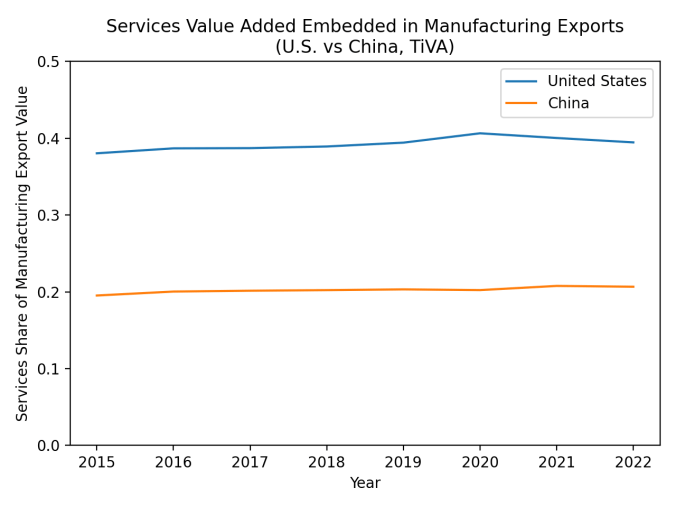
It’s interesting that China is a kind of opposite pole from us—a huge inwardly-focused country whose export businesses are primarily in hardware with hard-won price advantages. That’s not to say they can’t move in our direction, but thus far their focus has been different, with less emphasis on software value added. As the following chart indicates, China’s exports have been considerably less oriented toward added services than ours. If we’re worried about competition we have to recognize and play to our strengths. Our big world of economic as well as political allies has been of major importance. As in the discussion of imported inputs for Apple and Nvidia, they do their jobs for us better than we would do for ourselves.
All of that is why it is so serious that we have recently decided to relinquish many of those traditional advantages in a burst of self-destructive nationalism. We now have overt hostility to foreigners, attacks on universities, and cancelled research money. We’ll throw lots of money into today’s hottest development item—the current version of AI—but we have chosen to be deliberately blind to whatever comes next. In addition we’ve decided to choose winners and losers in technology based entirely on “intuition”. Since climate change is now officially non-existent, all technologies associated with it are removed from our national consciousness. Unless some of this is reversed we will be like the British after World War II, living in past and lost grandeur.
Beyond competitiveness, we need to talk about national security and population well-being. For both the most important message is a simple one: there are a great many important problems that the private sector will not solve by itself. That may seem obvious (it was to Adam Smith) but it’s contrary to the endlessly restated ideology of the last decades: that the unfettered private sector just needs to be left alone to work its magic. I’ll start with security. We need to be clear—we’re talking about national security here, not the reliability of value chains as before.
Government needs the professional competence to decide what actions have to be taken in the economy for reasons of national security. That includes what products and capabilities we need to have here and what needs to be done proactively to prevent the kind of dependencies we have with rare earth elements today. We have to be able to think ahead in a way that the private sector won’t. So government needs professional competence protected from political persecution. After all, the Chinese clearly were able to think ahead; a primary reason we couldn’t was the ever-present private sector mantra just mentioned. We were too smart to think about government telling businesses what to do.
In addition government needs to think more broadly about security. As we noted earlier we will never be able to take everything in-house, and even domestic suppliers have their own interests. So complete self-sufficiency is a chimera, and security is intrinsically concerned with international relations and the world order overall. That’s a big subject worth discussing but out of scope here.
Returning finally to the well-being of the population, the most important thing to say is that the businesses that form the basis of US economic strength won’t necessarily fix it. They’re not going to employ everybody. To some extent the overall wealth of the country will translate to general prosperity in the domestic economy (e.g. entertainment, home services)—but there’s no way, particularly with AI, that will be enough. It isn’t enough now, which is why we get Trump’s fairy tale with 1950’s jobs. Government will need to be involved with things like an adequate minimum wage as well as a bigger role in infrastructure of all kinds. There is no shortage of work that needs to be done—in physical infrastructure or healthcare for example. Also climate change will require significant near-term modifications all over the country.
That takes money, but national wealth is not the issue. The companies in our top ten list aren’t low-margin businesses even if they’re happy to get tax cuts. And going forward, we’re talking about sector-dominant software companies for even more of the same. The challenge instead will be to restore the idea that shared prosperity is ultimately for everyone’s benefit, so that progress can happen.
It’s a truism that we have to grow the economy and ensure that wealth is broadly shared. But it’s important to recognize the two aren’t the same thing, and we need both to make the economy work. (Stephen Miller’s much-repeated slogan—getting rid of immigrants means more of the pot for all the rest of us—is a good way to fail at both.) This isn’t easy, but it’s not as if we haven’t done it before. Trump talks about the good old days of the 1950’s, but he doesn’t talk about how we got there. That broad-based prosperity was most assuredly not achieved by liberating the miracles of the unfettered private sector; it was by doing what we’re talking about here.
Last time we had to go through the Depression and two world wars to get there. This time we need to do better—both the risks and rewards are too great not to.
It goes with the territory. Fascist leaders are convinced they are always right and therefore empowered to make correct judgments about anything that comes their way. As often noted, for Hitler that meant denial of most of 20th century physics, especially relativity and quantum mechanics, as Jewish physics. There was a direct line from that to the Germans’ inability to mount any significant challenge to allied development of nuclear weapons. In the end the Germans were defeated without such weapons, but it was only a matter of luck that it happened in time. Hitler in effect defeated the entire German war machine, because he was always right.
The parallels to climate change are exact. Climate change is real, and the technological underpinning for the rest of the world is being built about combatting it. We’re either part of that future or we’re not. It affects not only how energy is generated and distributed but also how major applications use it. We sit around talking about how to “win” our competition with China when we have ceded all of that to them.
In our own power network the situation is beyond ridiculous. The many new mega-datacenters demand vast increases in electrical power to run them. We could use that opportunity to upgrade our (outdated and insecure) electrical infrastructure nationwide in a way that would serve the datacenters, the public, and the evolution to new energy sources. That would buy benefits for the datacenters themselves, and would certainly improve public attitudes about their construction–and that’s in addition to the benefits as we address climate change and new energy sources come online. (See what China is doing here.) In fact we have refused to do any such thing, leaving the implementation as a bunch of point solutions based primarily on fossil fuels and an outright prohibition on wind and solar. When you’re never wrong, there’s no limit to how badly you can mess up.
We the human race may or may not succeed in avoiding real climate disaster, but any successes we achieve will be despite Trump’s sabotage. Whatever international order comes out of it all will reflect the interests of those who build it. And the status of the US will recognize that Trump’s sabotage was in literal terms a crime against humanity.
During the Covid crisis the Trump people carried on a campaign of blatant immorality that never got the attention it deserved. They got themselves vaccinated, but encouraged their supporters not to. Not getting vaccinated was an act of resistence to Biden, a gesture for freedom in the face of government overreach, and would be just fine. They killed supporters for their benefit.
That was handy for the campaign. It was a smokescreen for their botched handling of the early stages of the epidemic. So many people died from the anti-vax campaign that they could repeat their bottom line over and over again: “More people died from Covid under Biden than under Trump.”
Now cut to the present. As with Covid, it’s not an accident that Trump’s supporters are the ones hurt most by today’s Trump economy: the tariffs, the instability, the cuts to public services including medicare and social security. It’s certainly not the billionaires (or Trump himself) who are getting hurt. They’ve got their tax cuts, which is to say all those supposed savings from DOGE and other budget cuts went to them. The MAGA people–like the unvaccinated–are sacrificed to the program.
It’s the same internationally–who is getting hurt? Not Russia or China. He’s buddy-buddy with them. They’re all on board with the idea of spheres of influence, the idea that big powerful countries should be able to take what they can get. It’s US allies who trusted us. They’re easy targets, because they were on our side. They represented the first line of our defense against the USSR and now Russia. They didn’t have defenses against us (although they’re now learning).
It’s time to recognize that’s what Trump is. It’s easier to fleece people who considered themselves your friends than to fight enemies. He’s the ultimate confidence man. He’s enormously skilled in insinuating himself with people who are ambitious or have problems, and absolutely ruthless in taking advantage of those who have the misfortune to trust him. Whether he sees himself that way or not, that’s what he is.
There’s no arguing that the MAGA people, among others, have seen the prosperity of the country pass them by. There are real problems with the top-heavy distribution of wealth in this country. But Trump has sold them a story worthy of his talents: that poor immigrants and our foreign allies are the ones making them poor, while the billionaires who command real money and used their political power to create the wealth distribution are their friends! This amazing switch of responsibility is sold as free market economics, but it comes down to something as old as time–that the rich deserve all they can get and certainly should not be saddled with the needs of their inferiors. Unsurprisingly those billionaires are now cashing-in left and right while the others are standing hat-in-hand waiting for the ever-distant golden future.
The ultimate confidence man has delivered the ultimate win.
The takeover of Venezuela has made us a colonial power. Trump is now the dictator of Venezuela for the indefinite future. It has also led to new rhetorical heights about spheres of influence and how we should be able to use our superpower status to take whatever we want from anyone. So seizing Greenland from a NATO member is our perogative by right.
We’re telling all nations of the Americas that their independence is only for as long as we like it. Outside the Americas we’re threatening NATO’s existence by seizing territory. More generally we’re legitimizing the use of military force by anyone with the power to do it. History shows where that goes.
And what we’re getting for all that is oil. Oil that for the most part is not going to become available without billions of dollars of investment and years of development. Even without climate change that’s a shaky prospect; with the reality of climate change it’s nuts.
Climate change denial is not just a matter of sabotaging the Paris agreement and killing research funding.; it’s fundamental to everything they do. The rest of the world is continuing without us. It has to, since there is no other choice. China may be a dictatorship, but it values competence. Europe has kept its act together despite US pressure. Others are already seeing climate impacts. We’re off in our very own never-never land farther and farther from reality.
We’re going nowhere. The only question is whose sphere of influence gets us.
As an indication of where the economy is going, someone should calculate permanent jobs created per dollar of capital expenditure for all the new datacenter construction. That’s probably a new low for expenditures of this magnitude. It’s more complicated to predict the effect on jobs in the rest of the economy, but that’s most probably negative.
It’s hard for me to think this doesn’t say something about the world we’re going toward. It’s not so much that there will be a shortage of jobs overall as of good jobs. What is it that we are going to use to bargain with employers? Traditional education is about knowledge and capability. In our familiar world it takes years to put together the package that an employable person represents, and there are many distinct niches that need to be filled. In the new world, knowledge is more readily accessible, the capabilities required are more generic, and staffing levels may be reduced by efficiencies. We’re only beginning to see how that will shake out.
As we noted last time, the private sector is not good at managing effects of radical change—on people and on the environment. On the other hand, we’re talking about really significant productivity improvements, so in principle that should be a good thing. But that’s not going to happen by itself. It sure didn’t happen at the start of the industrial revolution—for most of humanity that meant misery and war.
In this anniversary of the American Revolution there is a relevant quote from the signing of the Declaration of Independence: “We must, indeed, all hang together, or, most assuredly, we shall all hang separately.” That’s now true worldwide. In this time of economic ferment, climate change, and nuclear weapons we had better learn to work together for global well-being or there may be nothing left at all.
The Rare Earth affair tells us a very important simple truth: contrary to the endlessly-repeated Republican message, the unfettered private sector (AKA the “free market”) does NOT solve all problems. The private sector by itself is not sensitive to national security concerns and isn’t terribly worried about single sourcing so long as the price is right. After all there has never been a problem. Tough luck.
This isn’t some strange outlier issue—it’s the main story. The business community serves its own interest and generally with a short-term focus. No one gets promoted for wasting money on what isn’t going to happen, which includes low probability events and any significantly different futures. The private sector is good at optimizing its own operation. It’s not good at providing for the population, the environment, or even the conditions for its own long-term success. There is no “free market” magic to make that happen. If the government doesn’t do it, it won’t get done. And that is terrible for the future of the country. We’re going to get one Rare Earth problem after another (and not just for security reasons), because we’re making sure not to look out for them.
We should be very clear about what we have today. Trump wants to run everything, but that doesn’t mean we have government doing its job. On the contrary what we have is business capture of government, so government is making sure that what business wants and nothing else gets done. That’s why we can’t have government-sponsored basic research or any consideration of consequences of climate change. Instead we have a whole bunch of protectionist tariffs and business tax cuts—just what business always wants. There’s a juicy story of golden futures for everyone, but that comes cheap. There’s no serious logic behind it, just what businessmen always want to believe. Trump wants to mess with the business environment, but he hasn’t taken his businessman’s hat off. He just thinks he’s such a genius he can tell all those big shot execs how to run things. Even the H1B affair fits here—there’s no strategic issue, since those pointy-headed engineers are a dime a dozen.
You don’t have to be a PhD economist to understand this. Adam Smith understood it in 1776. I won’t give the usual long quote. We just need a shorter one: “The government of an exclusive company of merchants is, perhaps, the worst of all governments for any country whatever.” — Book IV, Ch. VII
 on the outside