The Failed Triumph of Privilege

A few weeks ago I did a piece on making democracy work.  It strikes me now that I need a broader context for this—about governance generally.

The point of departure for any such discussion is the role for the powers-that-be, the rich and powerful in society.  That group has built-in power by virtue of its economic clout, as well as a conviction that it is superior and ought to rule.  However it also has built-in limitations for such a role.  Generally speaking:

– It is uninterested in the well-being of the population (its inferiors).  On the contrary these are defenders of privilege.

– It wants to protect itself through monopolies, tariffs, corruption, and the like.

– It discounts the future in pursuit of immediate profit.

– It assumes all knowledge or issues outside its purview are worthless.

All of these sound familiar, but it is important to recognize they aren’t just for Trump. We’re talking about privilege.

For that reason one of the most fundamental problems of national governance is managing relations with the rich and powerful class.  It will always want to govern and must be kept healthy but in check—a difficult balancing act.  And the issue is not just for sake of the less fortunate.  The short-term and generally myopic focus mean that this group will not provide even for its own longer-term success.  Adam Smith himself understood all of that perfectly.

The prior piece on democracy was mostly about the first point.  The other points are different, about institutional competence and recognition of the jobs that government must do.  That’s worth emphasizing—if government doesn’t do those jobs, they won’t get done.  Government has to take responsibility for the success of the country.  The private sector will not do it.

That work cannot happen without the institutional competence to get it done. That’s why it was an enormous step forward when this country created a civil service with agencies protected from politics.  The alternative, as was understood then and as we are relearning now, is failure and corruption.

Successful balancing delivered the huge success of this country.  We were technology innovators, looking for new ways to expand the economy.   We educated all our people to a degree unheard-of before.  We funded universities and pure research.  We strengthened our military and economic position through alliances.  (It is worth stating explicitly that NATO is and was always a vehicle to defend us—with multiple forces always under US command.)  We developed the interstate highway system and other internal infrastructure second to none.  We protected our health and resources. 

That successful role of government was established here following the recovery from the depression and then World War II.  No one then was arguing about the role for government.  And that attitude persisted through the postwar success.  At that time we were united as a middle class society with what we felt were common goals.

The widely-agreed turning point was the Reagan administration, when the powers-that-be realized that they could buy elections and win. It’s no accident that Reagan repealed the so-called “fairness doctrine” for TV political coverage, removing constraints on what money could buy as propaganda.  Plato (in his “Republic”) warned that democracy provides the tools for autocrats to seize power.  Democracy capture by oligarchy is a perpetual threat.  And here the US Constitution proved particularly fertile ground.

In the end the Supreme Court has been the “Achilles heel” of American democracy.  With undemocratic nominations and lifetime appointments it was only a matter of time (and luck) before the Court was compromised.  The Koch organization people devoted decades to that task.  The Citizens United decision essentially sealed the deal. Almost immediately it enabled elections to be bought and legislative districts gerrymandered.  The final stage came with the death of Ruth Bader Ginsberg, so that the Court had an unbeatable majority of members whose Koch-nurtured careers had prepared them for their roles.

Influence of money on politics is a given. It is present to a greater or lesser degree in particular issues and administrations. Capture of government by privilege is qualitatively different. There is no one left to convince and effectively nothing standing in the way. So incomes on top can keep growing while fundamental needs remain unmet.

Trump is their vehicle.  He is erratic, narcissistic, and vicious, but he’s on board with the program.  And he’s a phenomenal salesman.  On voting he’s a virtuoso with the most basic of sales techniques:  when your product has a defect you tell the world the others have it.  Looking to steal an election and with no examples of fraudulent voting, he tells Republicans to “try and cheat like hell like they do”. And much of the country believes it.

With Citizens United the Court played a big role in Trump’s election, and since then it has awarded him extraordinary powers, even putting him above the law.  Calling Trump a populist confuses his promoted image with reality.  Think instead of Trump in his element at his recent celebratory dinner for Xi.  It’s not just Trump. We are living the triumph of privilege.

Democracy is inherently fragile.   The powers-that-be will always think they deserve to rule, and they know how to profit when they get it.  But as noted however much they celebrate—they are victims too.  For all the reasons discussed earlier their win turns into a loss for everyone.  Let’s look at some of what we’ve got:

– Future compromised (research funding limited and politicized, huge deficit in good times)

– Government competence undermined (“unified executive” = loyalty is the only qualification)

– Military weakened (loyalty purges and posturing, alliances attacked, losses of all kinds from the Iran war)

– Infrastructure development neglected (no upgrade plan for antiquated and insecure electrical power, attacking universities instead of strengthening education)

– Economy hamstrung (fossil fuels only, ever-changing trade wars, no anti-trust)

– Personal security diminished (pervasive financial insecurity, expensive chaotic healthcare—measles even!, Social Security squeezed and threatened)

– Closed mind society (media consolidation and control, xenophobia)

– Real catastrophes brewing  (nuclear proliferation, AI, climate change)

 We have an election coming.  I’m not making predictions, but by now we can hope no amount of money can conceal the enormity of the truth.


What We’ve Lost and Must Find

We read regularly that many of our traditional strengths as a nation are being undermined in this administration.   But frequently such pieces end up tempering their concerns with a belief in America’s fundamental dynamism and vision, as contrasted with (say) the central control of the Chinese regime.  I’m all for believing in progress, but we’re not going to make any if we refuse to recognize how deep a pit we’ve fallen into.  Like it or not we are living with an administration that has deliberately attacked precisely those “American values” we want to believe in.

Here is a notion of what we’ve lost and need to find.

  1. Americans used to believe in the future.

 It was our future, and we did all we could to own it.  Our research institutions were the peak of the world, and people came from everywhere to participate. The list of Nobel Prizes records our success.  Part of that enterprise was to understand what was possible, and we built science into the functioning of government, so we knew where we were going.

All of that is now by the wayside, replaced by Trump’s “intuitions”.  He knows everything there is to know, and what he likes is by definition truth.  That holds for climate change, for research grants, and even (incredibly) for airplane launchers on aircraft carriers.  Even for NIH—a critical source of US competitiveness—grant money has been reduced and RFK’s decision logic hidden.   We’re not looking for truth, we’re looking for loyalty.

We still have the fruits of past successes in AI, SpaceX, and BioTech (all started with pre-Trump government money) and we even have a venture capital community to help fund it.  But all of that is today.  VC’s may sound future-looking, but they’re not going to fund anything that doesn’t pay back big and soon.  All of our present investments are at risk, because we’re too busy selling the present to think more than a step ahead.  The idea that we’re going to win with bigger and bigger investments in AI hardware sounds like the Maginot Line from pre-World War II France.  That was a huge defensive investment based on their experience with World War I, but the German Blitzkrieg just went around it.  In our case the Chinese, with a broader view of AI applications, may do the same.  In addition the obligatory government payoffs from big corporations mean that new entrants face vested interests with government-protected monopoly powers.  It’s like the old joke that someone in the nineteenth century patent office proposed to close it down because everything important had already been invented.  We just did that.

The Chinese have built up their universities and research institutions to be world class.   They figured out the coming importance of rare earths, solar cell and battery technologies, and medical research.  They may have government-defined five-year plans, but at least they have competent technical input and in many areas they have more internal competition than we do.  By contrast our focus now seems to be on the past—strong-arming our friends in hopes of delivering the jobs of the 1950’s.  What we call American dynamism comes not just from individuals, but also from the opportunities for such people to succeed.  For our current leadership that dynamism is unwelcome competition for its own all-embracing genius—something to be stamped out ASAP.

To succeed we must work to see the future and provide means to go there.

  1. Americans used to believe in our people

The American belief in its people goes all the way back.  The whole point of American democracy was to capture the strength of the population.  That’s why George Washington stepped down as President from the dictatorship that most of the world expected to see.  That’s why Lincoln talked about how “government of the people, by the people, for the people, shall not perish from the earth.” The democracy was far from perfect, but it was still a big step forward.

Coming out of that mindset was the revolutionary idea of education as essential to the role of the population in a democratic state.  This country pioneered the idea of educating the whole population, first at the high school level and then for colleges.  The power of the country expressed the capabilities of its people. Even the “robber barons” of the nineteenth century recognized the need to in some sense or other give back to the society to which they belonged. Immigration has always been a tricky issue, but we have learned that a multiplicity of people can participate in the democratic experiment and that diversity can be a source of strength.

Today we have replaced all of that with a dramatically different model.  We live in an age of self-declared superheroes.  We have a President who thinks he is infallible (and spends much of his time on monuments to himself), and business leaders who are convinced they belong to a different race.

Nothing in the Big Beautiful bill shows government has a role to play specifically for the population.  We’re running a huge deficit and cutting desperately-needed benefits to poor people so we can have big tax cuts for businesses and rich people.  There’s more detail on who gets benefits here.  When Trump talks about the golden future, there is no mechanism for it other than to make rich people richer.  When he attacks Social Security (e.g. with bogus claims of fraud) he’s attacking the whole idea of direct government support for the welfare of the population.  Crucially government has no role in protecting the population from the powers-that-be running everything for themselves.  Government of, by, and for the people should perish from the earth. 

People don’t necessarily see things that way, but one way or another they understand that there is no one protecting them from the abyss.  So the AI future looks pretty damn scary, and they’re not so enthusiastic about those datacenters either.  Owning the future sounds ridiculous.

To succeed we must support our people.

  1. Americans used to believe in our role in the world.

Coming out of the horrors of the Second World War, we and everyone else hoped for a better future, a new world where this horrible thing would never happen again.  America, as the major power of the age, took its responsibilities seriously.  A world at peace was a world where everyone could prosper.  That meant rules and responsibilities for everyone and institutions to support them.  It was easy for the US to want to be magnanimous; we were the richest, most powerful nation hands down.

We’re actually much richer now than we were then, but something else has also happened.  On an international front we are no longer so dominant, with China specifically challenging us in just about any dimension of wealth and power.  That’s our primary subject of discussion for international affairs these days, but in fact that’s only part of the picture.

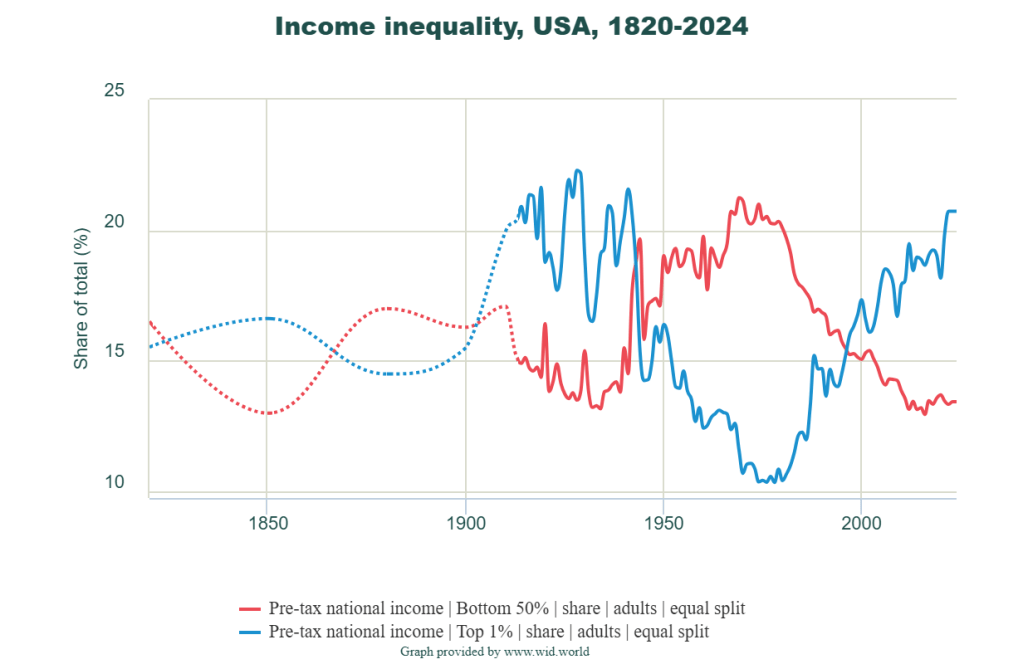
The other part is about American society.  After World War II our nation was as equitable as it had ever been, with prosperity widely shared and new opportunities for personal success, particularly through the GI bill and expansion of education.  In the years since then that equality has been eroded until today, we have reached unheard-of levels of wealth and poverty, beyond even the Gilded Age of the nineteenth century.  The following charts show the magnitude of the changes to both wealth and income:

There is no question that the quality of life for many people has deteriorated.  And it is conventional to say that the international idealism of the post-war years has been replaced by a grubbier reality where we are no longer dominant and every country struggles to compete with all others.  And the quality of life issue reflects that grubby struggle, in particular with the Chinese.  So the post-war idealism makes no sense anymore—we just have to win.

It is no accident that this conventional picture elected Trump.   That’s what it was created to do.  There is no shortage of money in this country, but in the years since World War II the powers-that-be have learned to protect their wealth from the population at large.  And electing Trump has enabled a pillaging of the country without precedent.  You have to blame someone, and it’s always the foreigners and the immigrants.

We certainly do have competition with other countries.  But the idea that all our economic problems are because we are under assault from the rest of the world is patently false.  Trade deficit numbers simply don’t tell today’s true story.  An example is the Apple iPhone—a big winner for the USA but counted as a trade deficit loser.  Much of the economy works like that. And the quality of life issue is unquestionably something we have done to ourselves.  This is a prosperous country, but not everyone has felt that prosperity.

In other words we as a nation are in the curious position of carrying out a foreign policy designed to protect domestic inequality! Of course it’s all about those foreigners! In that we are doubly hurt.  We are unable to deal with the actually tractable problem of population insecurity.  And we have lost our essential (and historical) role of helping worldwide stability in the face of the huge problems of climate change, nuclear proliferation, and the unclear consequences of AI.

To succeed we must—especially now—be able to recognize our broad interest as a nation in the world, above and beyond any corruption or special interests.   

We (and everyone else) need a stable, prosperous, and peaceful world for our success.  That is a worthy and achievable goal.  We used to understand these three keys to doing that, and we can do it again.  Our challenge is to recapture them—for ourselves and for our children.

The Crisis of Democracy

It’s common to speak of our current politics as a crisis of democracy.  We still have some features of democracy, but it doesn’t really work that way.  So the question that tends to get asked is how to address issues with our democracy to make it better.

If we’re going to fix things, it’s important to recognize that’s not quite right.  We don’t have a democracy anymore, and the government works exactly as intended. 

The first thing to emphasize that the functional Constitution is not a document; it is a construct enforced by the Supreme Court. The law is what the Court says it is.  There are no constraints on its interpretations, and in our current environment they don’t necessarily even give reasons for decisions.

Our current Supreme Court was put together over decades by the Koch organization with the objective of creating an authoritarian state, a dictatorial oligarchy for the benefit of big business and rich people.    This is no wild conspiracy theory—Jane Mayer’s Dark Money from 2016 documents what has always been hidden in plain sight.  The Kochs recognized early on they could take over the country through the Court, and they put together an organization funded by oligarchs to get there.  Their project produced Citizens United in 2010 and was essentially complete with the death of Ruth Bader Ginsberg in 2020. They aren’t fans of the whole Trump program–not tariffs for example–but the tax cuts and cuts in government services excuse all other sins.

They created and managed the Federalist Society and nurtured a community of lawyers to do the work.  All six so-called conservative justices have had careers in their service. The Koch organization at times has had a bigger operataing budget than the Republican Party.  They created institutes and named professorships in law schools. They have an organization to provide text for bills in Congress.  They recognized the extreme importance of the 2010 midterm state elections, because of redistricting after the 2010 census combined with new powers under the Citizens United Supreme Court decision. With the demise of spending limits they put unheard-of money into state-level campaigns and created the gerrymandering problems we have today.

(As a Massachusetts resident what I remember is the 2010 Scott Brown Senate election. You couldn’t turn on the television with seeing an ad from a PAC named something like “The Committee to Protect Social Security”. No one understood the avalanche of new money. That election effectively made Obama a lame-duck President–killing his filibuster-proof majority in the Senate, just as the emboldened Republican Party announced it would block all Presidential initiatives in the service of a Republican return to power. Citizens United was an effective anti-democratic tool from day 1.)

We now have the government they wanted—dictatorial and ready to be bought.  What we call corruption is intended behavior.  It’s how the powers-that-be get what they want.

Changing this is not going to be easy.  As Paul Krugman in particular has pointed out, the wealth and power of our domestic oligarchs have reached unprecedented levels.  Also by unlucky circumstance they now own a large chunk of domestic media channels—CBS and soon CNN together with Musk’s X plus the long-term ally Fox News.

So what is going on is not one or another problem with democracy.  We’ve experienced a well-planned and carefully-executed coup.  They’re pillaging the country.  As it turns out they’re also making a mess of things, even for their own interests, but thus far that hasn’t mattered to them.  And they’ve got the other media too scared to offer anything but token resistance. 

The 2026 election is of course critical. It can’t fix everything, but it would give a basis to start.  If we can win there, we can think about 2028 and the Court.  Otherwise all we can say is that 250 years was a good run RIP.

Effective Democracy

Let’s start with facts:  we live in a failed democracy that has transitioned to incompetent dictatorship. Given that kind of mess, it is worth going back to first principles to think about effective government.

First of all it should be noted that there is an intrinsic conflict of interests in any national government.  This isn’t complicated; it is basically parallel to what goes on in any corporation between the interests of labor and interests of management.  Near term they are dividing up profits, but longer term both have a common interest in the success of the company.   Successful companies are able to manage the conflict.

In government you have the economic powers-that-be versus the population as a whole.  Both have to benefit for success, but immediate interests are opposed in much the same way.  It should be emphasized that here too exclusive power to one or the other is disastrous. We’re accustomed to hearing one side of that story—uncontrolled spending on government benefits for the population will bankrupt the economic engines of the country. But an exclusive focus on the business side is equally bad and it’s not just a matter of living standards:  business interests are myopic both in terms of time scales and in terms of the environment needed for success.  You won’t have the technologies, or the people, or the physical environment necessary for the economy (and as we’ve seen recently, business people can risk bankrupting the country too!). Government has to speak for the whole picture. Even the patron saint of free enterprise—Adam Smith—was well aware of this issue.  “The government of an exclusive company of merchants is, perhaps, the worst of all governments for any country whatever.” There is nothing sacred or proven about claims that government should never interfere with the marvelous natural workings of the marketplace—that’s just self-serving propaganda for the “haves” side.

This intrinsic dichotomy is very important for effective government.  Both sides must be present but neither side can win.  That’s one of the reasons we’re in such bad shape right now.  What we have today is business capture of government—exactly what Adam Smith worried about.  To be effective government needs to provide means for functional negotiation and cooperation between both sides.  Those sides don’t map exactly to the Republicans and Democrats, but that’s pretty much what it comes down to.  Bipartisanship is not about being nice; it’s working out fundamental tradeoffs between the two sides.

That is precisely what we have lost–structurally.  There are three immediately obvious issues.  The first is the primary system.  Since primaries are partisan, candidates are chosen exclusively based on appeal to one side or the other.  That guarantees extreme positions and more importantly disenfranchises the center of the voting population.  A second example is the way partisan power is used to control legislation offered in Congress.  In the House the so-called Hastert rule only allows on the floor measures that are supported by a majority of Republicans.  In the Senate the majority leader Mitch McConnell routinely blocked anything he disagreed with—regardless of overall support.  Both rules disenfranchise the center and make the country effectively ungovernable except in extremes—so whiplashing policies are a matter of course.  Finally there is the Supreme Court: lifetime appointments plus limitless power give a huge incentive for partisan appointees.

All of this is bad news and good.  The bad news is that it isn’t clear when we’ll be in a position to fix any of it. The good news is that there are significant items that really aren’t so hard to fix.  For primaries, there are a number of possible variants, including non-partisan primaries with rank choice voting.  For the Congress, you don’t need to change the constitution to change the rules.  And there are many proposals to fix the terrible mistake that is the Supreme Court—an undemocratically-chosen body with lifetime appointments and no constraints on its power.   With a decent Supreme Court we should be able to fix gerrymandering, for example.  That is a math problem we chose to turn into a political mess.

Bipartisan cooperation is fundamental, and we can stop going out of our way to make it hard.  That way we can make the tradeoffs for the country to be governable.  Then we can move on to two other necessary and straightforward matters:  direct election of the President (the current system is grossly inequitable and invites fraud) and adding the few extra Senate seats needed to compensate the ill-represented largest states. Such measures won’t solve everything (not control of media for example), but we can make things quite a lot better.  We can make our democracy work.

It’s not so complicated–if we ever get a chance to do it.

Problems with the Constitution

There has always been plenty of talk about what is right and wrong with the Constitution of the United States. However much of that was on the back burner until recently. Now it is different. First we saw government collapsed into non-functional partisan chaos, and then Trump demonstrated that what we thought was a government of laws was actually a government of unenforceable traditions.

So what follows is a list of issues. I won’t say it is complete or well-organized, but the problems are all serious.

  • Open to dictatorial takeover

The Supreme Court was a terrible mistake.  There are no limits to its power, and it doesn’t even have to justify its decisions.  The Justices are chosen undemocratically and serve for life.  We’ve now seen they can even declare a President above the law, so that the entire Constitution is out the window.  It is a dictatorship waiting to happen.

  • Open to corruption (only works because of tradition, not law)

The entire electoral apparatus belongs to the states, where it is operated by partisan officials.  It is common practice to make voting difficult in opposition districts, but that is just the beginning. The whole voting apparatus is controlled by people who gain from controlling results.  It works if people are committed to democracy, but not otherwise.  Other democratic countries have established separate, nominally non-partisan organizations to administer voting.

  • Unrepresentative

The Senate is phenomenally unrepresentative.  Two senators per state means residents of small states have astonishingly outsize power.  At the very least, very large states such as California need additional Senators.  The problems of the Senate also affect the Electoral College, so that not only legislation but also Presidential elections are affected.

Then there is the whole question of gerrymandering. Computers have made this both easy and effective. The US Congress is currently so gerrymandered that very few districts have real elections. That severely limits democracy.

  • Doesn’t work for states

These is an urgent need for clarify the division of responsibility between the states and the federal government.  As an example, the federal government has traditionally backed up the states for emergencies of all kinds.  That is necessary because it has greater resources as well as the ability to run deficits if necessary (which many states can’t).  With both Covid and the operation of FEMA Trump decided he was either opposed or lukewarm about it, and that was that.  The Constitution has to be explicit about responsibilities.

  • Doesn’t work for the federal government

The federal government simply doesn’t work as intended.  We’ve reached an era of non-cooperation between parties, so government only works when a single party controls everything.  Between the “Hastert rule” in the House and the filibuster in the Senate, it’s easy to block everything otherwise.  That means the so-called separation of powers in government is largely non-functional  Furthermore the primary system for the nomination of candidates basically disenfranchises the political center, so that parties are by definition extreme.  That means government is either functionally blocked or unrepresentatively extreme.

  • There is no protection for governmental expertise

A functioning national government needs expertise upon which to base its conclusions.  For that reason Congress created a number of bodies intentionally buffered from Presidential politics.  More recently the Supreme Court has decided that any body working in the executive acts at the discretion of the President.  It is now impossible for anyone with necessary expertise to make a career in the federal government.

  • Unclear dividing lines between branches of government

The Trump administration is legislating by executive order, and the Supreme Court has decided that is okay.

  • The unspecified role of parties can undercut everything else

Everything about our two-party system is outside the Constitution.  So that, as mentioned earlier, we have a primary system that disenfranchises the political center, and there is nothing in the Constitution that has any bearing on it.  The Constitution needs at the least to say how elections work.  Anything not specified is vulnerable to corruption and takeover. Non-partisan primaries with rank choice voting is a possible step in that direction.

The Zero-Sum Trap

It’s not unusual to talk about zero-sum games as a political issue. Probably the most common example is in international relations, where the Trump people treat countries as ordinary business competitors: what profits them is lost to us. That’s a false analogy as we’ll discuss later, but that’s not the main point here. What we want to emphasize is that the notion of zero-sum games—where all gain is someone else’s loss—is even more pervasive and dangerously wrong than commonly believed.

There are many kinds of zero-sum examples:

  • Our progress means taking it from someone else (as just mentioned)
  • Anyone else’s progress means taking it from us (racial progress means blacks taking from whites)
  • Hurting others means helping us (the party line with DOGE).

Notice the logic runs both ways: not only does our progress require hurting others, but also hurting others can be assumed good for us!

The issue is not that such things can’t happen; the problem is assuming that they always do. The chaos around DOGE produced wild enthusiasm in Trump’s base even though there was no logical connection to anyone’s well-being (either in theory or in the One Big Beautiful Bill). Moreover, paradoxically, all the publicity about DOGE viciousness seemed to increase confidence in the unstated zero-sum assumption. “Look at all the progress in the first 100 days!”

To start with it is not surprising that a zero-sum situation is more the exception than the rule: that two different phenomena are so directly related means there is an explicit causal connection, and the costs and benefits need to more or less match up. There are such connections in budgeting decisions for example. However the connections between tariffs and anyone’s well-being, for example, are so circuitous and filled with logical gaps that no one is trying very hard to argue for them. Instead promoters fall back on a kind of instinctive belief in the zero-sum game. The more Trump talks about making others poorer, the more it must be the path of progress.

It’s useful at this point to review just how far the tariff argument is from being true. What companies are the pillars of US economic strength? They are the big tech companies that dominate market valuations, earnings, and international influence. Just eight such companies represent 40-50 percent of market valuations. What is the basis of their success? Are they winning because they can make better cheaper products that anyone else can make, so that tariffs can lead to even greater success and lots of new good jobs for US workers?

Actually not. Those companies represent technological advances that led to monopoly powers in their chosen sectors (those sectors are now starting to merge, but that’s another story). They have clear profit advantages over businesses in competitive sectors, and in fact they can force those companies in competitive sectors to bid against each other to supply them. These are primarily software companies (so they are not well-counted in balance of payment figures that ignore services) and their reason for success is technological advancement—often predicated on government-funded basic R&D—and ability to attract the best and brightest from everywhere to contribute to their success. Such monopolies are actually not new. In the good old days of American manufacturing it was the high-tech of its time. We don’t get to choose where the money is.

Tariffs have little or nothing to do with this picture. Somehow tariffs are supposed to create a new golden age for factory workers, recreating the good old days. However that is without the technology advantages that fueled the wages, without unions, and after many decades of automation that mean far fewer (and more skillled) people are needed in production. Tariffs have of course been threatened as retaliation for restrictions on tech company activities in other countries, but those are different fights over different issues. None of this means extracting blood from evil foreigners will deliver gold to Trump supporters here.

How about the benefits of white racial dominance and the deporting of immigrants? Most of the arguments for those come down to “everything they’ve gained is taken from us”. That’s easy to believe (one thinks of Vance’s performance in the VP debate where immigrants were the answer to every issue raised) but is it true? You can certainly find examples, black people promoted for their race or professions where desperate immigrants have depressed wages. But that isn’t the same as the net effect of what has happened. You can’t argue that by assuming it’s true.

What made this country’s historical success is the (relative) freedom of US society from the centuries-old societal hierarchies elsewhere. Anyone could come here and succeed. The US pioneered mass education, and its own aristocracies just didn’t have the powers to exclude that existed elsewhere. We have prospered from everyone’s contributions, people of all races and from everywhere. That there are more people in the picture does not mean everyone is poorer; historically it has made us richer. Even today the immigrant population (including the illegal part) is paying taxes, using fewer social services, committing less crime, and staffing difficult jobs (in agriculture, eldercare, and construction) that locals don’t want to do. The big technology companies are filled with immigrants and children of immigrants who are making the country richer for everyone. (As is evident from any discussion of AI for example, this is more a matter of scarce talent than outsourced jobs.)

When you think about it each zero-sum argument assumes a static world where all that matters is dividing up a fixed pot of goods. That’s where the zero-sum comes in—who is giving or taking. But the picture is completely wrong. It’s not just that the overall pot is growing, it’s that the pot is being redefined entirely. And it’s that effort—the creation of the new pot—that will determine our success as a nation. And again looking at the new corporate leaders of our economy, that new pot (as noted) is being created in large measure by immigrants and children of immigrants of all races and nationalities.

(It’s important to be careful about the conclusion here. This isn’t an argument for uncontrolled immigration or even for what rules should be applied for who gets in. It’s also not an argument either for or against any kind of affirmative action. In both cases there are tradeoffs that have to be made rationally. Every country decides how many immigrants it can absorb annually, but that decision should not be based on false stereotypes of what those immigrants represent. In the case of affirmative action, you don’t want to create new forms of favoritism, but at the same time you need to find ways to prevent existing prejudices from perpetuating past discrimination. That those subjects are out of scope here doesn’t mean they can’t be addressed.)

Government’s task is providing the environment for both economic progress and well-being of the population. A key objective is equality of opportunity, as we need contributions from all. And it is up to government to see that the two objectives—for the economy and for the population—are both satisfied. That is always a political challenge.

Government structure is important. That the private sector will miraculously do it all is a myth understood perfectly even by Adam Smith. That myth only persists (without evidence) as an excuse for government to neglect its second objective—for the population. Expecting arbitrarily-powered dictatorship to be more dynamic and effective is even worse—for reasons that are already evident. Dictators make uncorrectable mistakes and ignore what they don’t want to hear. We’re cutting basic research in all domains and treating climate change as treason, exactly what we don’t need in a technology-based world economy. That hurts BOTH the economy and the population. By our own history, democracy is a good thing.

Finally we need to return to the issue we started with—international relations. Are nations just a bunch of business competitors fighting for market share? The answer is no, because we all share one world and there is an enormous (if not always recognized) common interest in making it work. Without thinking hard we are all confronted with the pressing problems of climate change and the ever-present threat of war. Chaos risks disaster. And there is a positive push also. Over the past decades we have proven that by cooperation (admittedly incomplete) we have been to grow the pot of benefits enormously for all. This could hardly be farther from a zero-sum scenario.

Zero-sum reasoning is a big problem, because it is instinctive and can be crucially wrong. We can’t prosper by believing life is all about fighting it out for advantage. If we want to be successful the task is to build prosperity for the future—for our entire population and for the world. Nothing says that’s easy, but it’s the only game there is.

Do We Neeed More Proof that Dictators are Bad for the Economy?

When dictators make bad decisions no one can stop them. Here are a few:

  • Trump likes oil, so we’re doing everything possible to push fossil fuels in the economy, and eliminating anything to support sustainable energy.   We are even so petty as to take out installed car charging stations for government employees.  So we’ve pegged our economy and everything in it to fossil fuels, a future that is going away–not tomorrow but necessarily soon, whether we like it or not.  We’re not just a non-player in the coming economy (presumably the US auto manufacturers will be lucky if they’re picked up–instead of closed down–by the dominant Chinese players), we’re tying a weight around the neck of all our industrial production.
  • We’re killing any kind of government supported research.  We have made ourselves non-players in anything beyond current mainstream production.  If you ask business leaders how much basic research is done by the private sector they will tell you the answer is pretty much none.  Business deals with current and coming product.  We as a country will no longer be inventing the future.  We can ask the Chinese for help when we need it.
  • We have decided there is no need for competence in government employees.  Instead for the entire federal government all that matters in loyalty.  There are no more real government jobs—just political appointees.  If these are the rules of the game, there will be no more competence or help from Washington.  If you don’t think that matters you should look at the mess today.  That’s the tiniest piece of what is coming.
  • We have decided to convert all of our alliances to protection rackets.  Unfortunately we’re not the only game in town.  We have opponents in China and Russia.  They, not us, have understood there is strength in numbers.  We have given them an enormous present with no positives in return.  For Russia we have even descended to flattery.
  • Our now to be jettisoned international order was established to provide stability and reduce the danger of war. It wasn’t perfect but it gave us many years of growth and peace. The danger to growth has been much talked about, but the danger to peace less so. In this new era of every land for itself, all efforts to manage nuclear proliferation are now out the window. On the contrary, every country had better get its own nuclear weapons fast–or be prepared to face defeat. In our glorification of selfish greed we’re stupidly asking for disaster.

Many people have figured out these are mistakes.  But as long as this dictatorship continues, we as a nation we have no way to fix it.

The Only Thing New is That They’re Getting Away with It

I need to return to Adam Smith’s quote from last time.  It’s so accurate it’s incredible.  First the quote:

“The proposal of any new law or regulation of commerce which comes from this order [merchants and manufacturers], ought always to be listened to with great precaution, and ought never to be adopted till after having been long and carefully examined, not only with the most scrupulous, but with the most suspicious attention. It comes from an order of men, whose interest is never exactly the same with that of the public, who have generally an interest to deceive and even to oppress the public, and who accordingly have, upon many occasions, both deceived and oppressed it.”  (Wealth of Nations, Book 1, Chapter 3)

All by itself this stands as rebuttal to the Republican Party’s standard argument: “We’re businessmen, so we’re good for the economy.” It seems businessmen are not so benevolent. Let’s look at the record—Adam Smith could hardly have been more to the point.

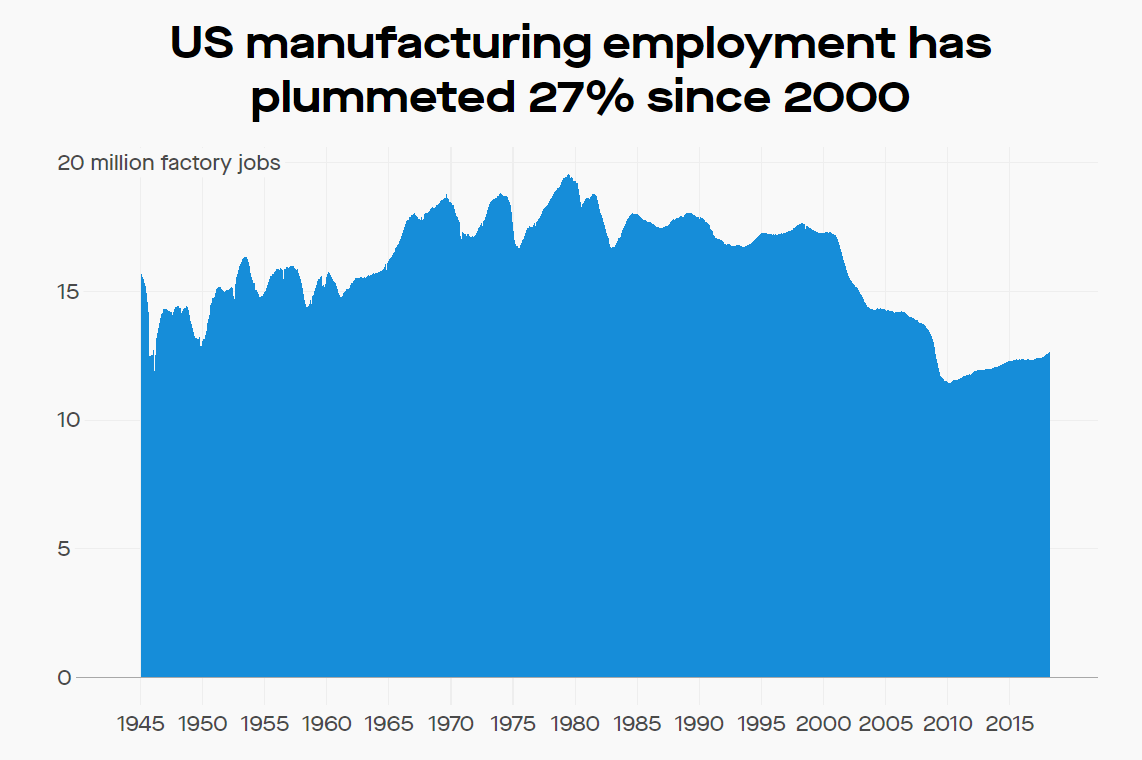
I’ll start with Obama’s first term.  George W. Bush left a mess so bad that it is only partially acknowledged.  The stock market crashed and the economy was shutting down (basically from what amounted to misguided deregulation of the overall banking system through mortgage-backed securities).  But that wasn’t the whole story.  Hidden behind the smokescreen of “neoliberalism” was the fact that essentially all of the job loss to China occurred either during Bush’s administration or with their crash. Just look:

That’s no accident. The Bush people refused to resist China’s WTO-prohibited trade practices (e.g. currency manipulation), because they were actively promoting off-shoring—since that’s what business wanted (e.g. about 70-80% of Walmart suppliers were in China).  In this case it’s tempting to say “deceived and oppressed” was coupled with pure incompetence, but that actually misrepresents a situation that Adam Smith understood perfectly.  Both the deregulation and the off-shoring were cases of business getting what it wanted without the necessary “suspicious attention”.

Obama’s job was to get us out of that mess, and he was well-underway when Republican decided that he might succeed.  That could not be allowed, since there was an election coming up.  So with the fabricated excuse of the “balanced budget amendment” rhetoric they essentially shut down government including all stimulus to the economy.  That meant jobs and income for many people.  They also blocked any aid to the millions of people who lost jobs from Bush’s off-shoring.  “Deceived and oppressed” is right on.

Now we get to Trump.  The “balanced budget amendment” rhetoric disappears instantly, and was replaced by a tax cut funded by a 2 trillion dollar deficit.  That was going to cure the last part of the recovery they had sabotaged.  However the economy was actually in pretty good shape, and as we noted last time the only stimulus that Obama ever got past the Republicans (in his first term) was on the order of $500 billion.  This needs to be emphasized.  We read articles about governments in Africa where department heads steal millions by handling their budgets as personal slush funds.  We in the US don’t do things like that.  We’re much more civilized.  Using the “balanced budget” ploy the Republican Party took 1.5 trillion dollars of benefits for its owners quite legally from the American people. If you want stumulus you’ve got to pay us first. “Deceived” is the very least you could say.

That money went straight to Wall Street.  It inflated corporate profits, so stocks went up.  But the companies didn’t spend that money on employees or the business, they used it for stock buybacks—a second kick in the pants for the market.  For the people in Adam Smith’s quote all you can say is—what a wonderful world this is!   

And they’re ready to do it again.  They’ve made up the fiction that inflation is all due to spending money for the benefit of the population.  Can’t do that.  Bad idea. Have to give it to us, and it will be Nirvana.

The next deficit is estimated at $4T.  Republicans have signed-on salivating—Will wonders never cease? (And that’s before the sweetheart deals with individual billionaires!) But that’s not the end of it. Trump’s new set of proposals (tariffs, deportations, tax cuts) is wildy inflationary, potential as damaging as what trashed the economy under George W. Bush—again what you get without “suspicious attention”. (It may be a side issue, but we even have a potential repeat of Bush’s banking debacle with all the cryptocurrency money behind Trump.) All of us have to hope it doesn’t happen.

Adam Smith did his job.  Can’t say we weren’t warned.