The Only Thing New is That They’re Getting Away with It

I need to return to Adam Smith’s quote from last time.  It’s so accurate it’s incredible.  First the quote:

“The proposal of any new law or regulation of commerce which comes from this order [merchants and manufacturers], ought always to be listened to with great precaution, and ought never to be adopted till after having been long and carefully examined, not only with the most scrupulous, but with the most suspicious attention. It comes from an order of men, whose interest is never exactly the same with that of the public, who have generally an interest to deceive and even to oppress the public, and who accordingly have, upon many occasions, both deceived and oppressed it.”  (Wealth of Nations, Book 1, Chapter 3)

All by itself this stands as rebuttal to the Republican Party’s standard argument: “We’re businessmen, so we’re good for the economy.” It seems businessmen are not so benevolent. Let’s look at the record—Adam Smith could hardly have been more to the point.

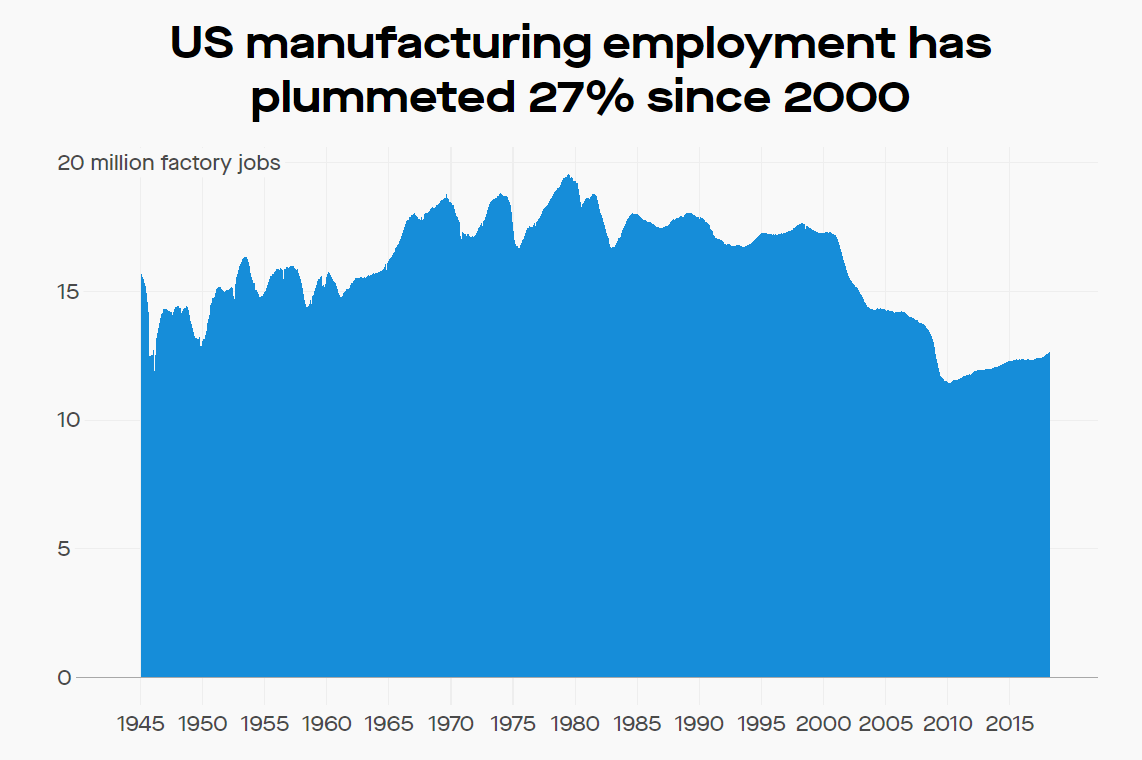
I’ll start with Obama’s first term.  George W. Bush left a mess so bad that it is only partially acknowledged.  The stock market crashed and the economy was shutting down (basically from what amounted to misguided deregulation of the overall banking system through mortgage-backed securities).  But that wasn’t the whole story.  Hidden behind the smokescreen of “neoliberalism” was the fact that essentially all of the job loss to China occurred either during Bush’s administration or with their crash. Just look:

That’s no accident. The Bush people refused to resist China’s WTO-prohibited trade practices (e.g. currency manipulation), because they were actively promoting off-shoring—since that’s what business wanted (e.g. about 70-80% of Walmart suppliers were in China).  In this case it’s tempting to say “deceived and oppressed” was coupled with pure incompetence, but that actually misrepresents a situation that Adam Smith understood perfectly.  Both the deregulation and the off-shoring were cases of business getting what it wanted without the necessary “suspicious attention”.

Obama’s job was to get us out of that mess, and he was well-underway when Republican decided that he might succeed.  That could not be allowed, since there was an election coming up.  So with the fabricated excuse of the “balanced budget amendment” rhetoric they essentially shut down government including all stimulus to the economy.  That meant jobs and income for many people.  They also blocked any aid to the millions of people who lost jobs from Bush’s off-shoring.  “Deceived and oppressed” is right on.

Now we get to Trump.  The “balanced budget amendment” rhetoric disappears instantly, and was replaced by a tax cut funded by a 2 trillion dollar deficit.  That was going to cure the last part of the recovery they had sabotaged.  However the economy was actually in pretty good shape, and as we noted last time the only stimulus that Obama ever got past the Republicans (in his first term) was on the order of $500 billion.  This needs to be emphasized.  We read articles about governments in Africa where department heads steal millions by handling their budgets as personal slush funds.  We in the US don’t do things like that.  We’re much more civilized.  Using the “balanced budget” ploy the Republican Party took 1.5 trillion dollars of benefits for its owners quite legally from the American people. If you want stumulus you’ve got to pay us first. “Deceived” is the very least you could say.

That money went straight to Wall Street.  It inflated corporate profits, so stocks went up.  But the companies didn’t spend that money on employees or the business, they used it for stock buybacks—a second kick in the pants for the market.  For the people in Adam Smith’s quote all you can say is—what a wonderful world this is!   

And they’re ready to do it again.  They’ve made up the fiction that inflation is all due to spending money for the benefit of the population.  Can’t do that.  Bad idea. Have to give it to us, and it will be Nirvana.

The next deficit is estimated at $4T.  Republicans have signed-on salivating—Will wonders never cease? (And that’s before the sweetheart deals with individual billionaires!) But that’s not the end of it. Trump’s new set of proposals (tariffs, deportations, tax cuts) is wildy inflationary, potential as damaging as what trashed the economy under George W. Bush—again what you get without “suspicious attention”. (It may be a side issue, but we even have a potential repeat of Bush’s banking debacle with all the cryptocurrency money behind Trump.) All of us have to hope it doesn’t happen.

Adam Smith did his job.  Can’t say we weren’t warned.

A Real Comparison of Economic Policies

Since both Biden and Trump have records as President, the press is full of articles like this one attempting to compare their economic policies and evaluate the results.  Now that Harris has replaced Biden and announced a few measures, she’s in the game too.  Unfortunately most such articles completely miss the mark.

The reason is that you cannot judge anyone’s economic policy except in the context of the problems he or she faced.  And you cannot make any judgment of how good he or she would be as President now without assessing the problems we face today and comparing our needs against the candidates’ demonstrated approaches.

That may sound obvious, but I haven’t seen a single article that tried hard enough to be serious.  Let’s start with Trump.  Obama left the country in pretty good shape, but one has to understand that his whole Presidency was spent trying to recover from the 2008 crash.  In that he had done pretty well (compared to other western countries), but he had one serious problem:  particularly in his second term the Republican Party decided to sabotage the recovery.  Looking ahead to the 2016 election they essentially shut down government—promoting a “balanced budget amendment” as a reason to block all stimulus spending.  That left some work to be done with unemployment, for example. So that’s what Trump inherited—a good economy that had been throttled short of complete recovery.

As soon as Trump took office the “balanced budget amendment” discussion vanished, and Trump stimulated the economy with a 2 trillion dollar budget deficit.  That completed Obama’s recovery at enormous cost to the country. For comparison, the largest stimulus Obama was able to get through Congress (in his first term) was about $500 M.  The vast part of Trump’s $2 T did not go into jobs or corporate investment; it went into stock buybacks.  Trump bought maybe $500 M of progress with a $1.5T contribution to inequality in the US.  Further, despite all the talk of reviving manufacturing, US manufacturing (as a sector) was in recession before Covid hit.  Once Covid happened, Trump simply retreated from running the country.

Biden inherited a mess.  First we had to recover from Covid, so there was much time and effort spent on getting the vaccine to everyone.  In this the biggest single problem was sabotage by misinformation from Republicans in general and Trump in particular.  During Covid there was a series of bipartisan deficit-funded bills to keep the country running with progressively less Republican support.  Once recovery started, however, there were some big surprises.  In key areas supply and demand were badly mismatched—there was a massive shortfall in computer chips needed for cars and other big-ticket products, new patterns of demand appeared for housing reflecting living arrangements during the pandemic, and the shipping industry took many months to be fully back in business—causing shortages of all kinds of imported products.  There were also shorter-term spot shortages, which led to longer-term price increases from major suppliers happy to take the chance.

Biden’s last (Democrat-only) stimulus has been blamed for all inflation that followed Covid.  Many articles have been written about his terrible mistake—the money delivered to US families didn’t even cover the inflation of the following year!  That conclusion ranks with the “balanced budget amendment” for self-serving dishonesty.  Given the magnitude of those other inflationary pressures, there is no question that the stimulus payments covered considerably more than any inflationary effects of the stimulus itself (and inflation in the US was lower than anywhere else in the Western world—stimulus or not).  Biden was correct in deciding that there was a fair chance that the post-Covid recovery would not be painless, and that stimulus money was needed to help people. In so doing he violated the mantra that the Republican Party is most desperate to defend: “you can’t spend money to help people”.  Help only comes top-down, from money spent on us.  The best commentary on this subject comes from Adam Smith himself:

“The proposal of any new law or regulation of commerce which comes from this order [merchants and manufacturers], ought always to be listened to with great precaution, and ought never to be adopted till after having been long and carefully examined, not only with the most scrupulous, but with the most suspicious attention. It comes from an order of men, whose interest is never exactly the same with that of the public, who have generally an interest to deceive and even to oppress the public, and who accordingly have, upon many occasions, both deceived and oppressed it.”  (Wealth of Nations, Book 1, Chapter 3)

Before we leave this subject of inflation there is one more question that needs to be answered:  why, despite the huge budget deficit, was there no inflation under Trump?  The main part of the answer has already been noted—the country was not yet completely out of the 2008 crash.   There was no wage pressure, and people were not ready to spend.  Furthermore we had actual downward pressure on prices from those evil Chinese—all that cheap stuff in Walmart was keeping prices low.  By Trump’s third year there were signs of a rise in wages, but then Covid hit and that was the end of that.  As far as inflation was concerned, Trump was “saved by the bell”.  As we noted at the beginning, you cannot say anything sensible about a President’s economic policy without putting it in the context of the time.  Trump did not prove that he knew how to run up a huge deficit without inflation any more than he proved he could fight Covid with bleach.

Biden got the country going again and finally started rebuilding the country’s decaying infrastructure and  undertaking changes that will be required (whether we like it or not) for climate change.  He recognized the importance of education, although he was blocked from doing as much as is needed to provide opportunities for all (and the costs of his programs were hugely exaggerated).  Manufacturing is now in vastly better shape than under Trump.  He has also started with the task of finally doing something about decades of consolidations and monopolies during our period of non-enforcement of anti-trust laws.  It needs to be emphasized that anti-trust activities are NOT examples of overreach of government against the free market.  Even Adam Smith (again) emphasized the need to combat monopolies, and not just because they make things more expensive—they block innovative new businesses, make the country less competitive, and even weaken a nation’s military strength.

At this point it’s time to stop describing the historical context and consider where to go from here.  The first conclusion is probably the most important:  there is nothing in Trump’s historical performance that shows competence in managing the economy.  He gave himself (and his ilk) a big tax cut, that helped an artificially-stunted recovery (at very high cost), and avoided inflation only because of the incomplete recovery and because Covid bailed him out. That history is no recommendation.  We cannot let ourselves be tricked by the blindness of all of those economic analyses without context:  “Trump’s tax cuts led to full employment last time, so maybe they’ll be good this time too.”  ARGH!!

So the question of Trump’s economic competence comes down to his economic plans.  While Trump has been vague about many things, there are three items about which he has been absolutely clear:

  • A complete tariff wall around the US protecting all US industry, 10% overall and 60% on imports from China.
  • Deporting all undocumented immigrants, amounting to at least 11 million people
  • A huge tax cut modeled on his last one, currently estimated to cost $4 T.

The attitude of economists on this subject was summarized in a recent NY Times article:  not just bad but catastrophic.  We have to get used to that idea.  The fact that Trump got through his first term is not proof that he knows what he’s doing.  The plan can really be completely crazy.  Remember Trump’s six bankruptcies. Also, we have to get used to the idea that economic stability is not guaranteed.  The Brits voted for Brexit, and their standard of living took an immediate hit from which it may never recover.  This plan is actually worse.

We’ll go briefly through the items one-by-one

The Tariff Wall

Tariffs (including Trump’s tariffs from last time) are effectively a tax paid by the buyer in higher prices.  A universal tariff like this one is therefore massively inflationary and not just for imported goods.  Historically (and in Trump’s last term) domestic producers also have taken the chance to raise prices. Universal tariffs also invite retaliation and diminished US clout worldwide.  Given the level of consolidation in the US economy, the tariffs will significantly reduce competition and dynamism of business domestically, as many markets will be monopoly or cartel controlled.  And by isolating the US from developments elsewhere, it guarantees that the US will be left behind for any developments that don’t originate here, making us a second-class power.

Deporting 11 million people

These people are working today.  We’re eliminating the lowest tier of the workforce, with no obvious new population to take over.   Both the loss and the disruption are massively inflationary.  Many of those jobs may never be filled.  The Brexit people found that they had to import a whole new bunch of foreigners to replace the ones they were so happy to get rid of.

The $4T tax cut

The huge deficit is again massively inflationary.  The only reason that didn’t happen last time is that the economy was still short of recovery—which is not the case now.  Further the huge deficit would be on top of all other spending issues we will have to face, including for climate change and defense.  Businesses didn’t need it last time–they spent it on stock buybacks, not on investment in the business or on the employees. Last time’s claim that it would pay for itself proved completely untrue.

We are talking about a real hit to everyone’s well-being with no short-term path to recovery.  And that’s before even thinking about the threats to democracy.

Finally we need to end this with a look  at the other side.  If that’s what we’re getting from Trump what would we be getting from Harris?  After all we’re told she’s a wild-eyed radical.  Her running mate was so far left that he spent government money giving meals to school kids!

There’s nothing in the Democrats plans that talks about anything close to a 4 trillion dollar deficit.   There’s nothing in the Democrats plans that talks about engineering of people’s lives the way Vance is so eager to do.  Isn’t freedom from that sort of thing what made us different from the hated communists?

What is different is positive.   There is a role for government in making people’s lives better.  That means education, jobs, a future.  Harris’s initial proposal talks about aid for families with children and combating the kind of post-Covid price-fixing mentioned earlier. There is also a role for government in helping the private sector with things it doesn’t do well—like anti-trust, like educating the population for the jobs that need to be filled, like preventing business from croaking on climate change because doing something reduces immediate profits.  No one is talking about hurting business competitiveness, but it is the task of government to act in the interest of everyone.

This is an election where the country needs to reject what is radical egomania and return to what are in fact our long-time values.

The Riots in Britain are a Lesson

(from a NY Times article comment)

Post-Brexit Britain is a cautionary tale for the US: Britain is a nation whose bad choices made it dramatically weaker and poorer based on lies and rosy-colored dreams of past glory. Under such circumstances it not surprising that people will grasp for scapegoats. The British far right certainly has every incentive to whip up its supporters and try to sidestep blame.

I want to say more about the parallels to Brexit. Trump is proposing a US behind trade barriers and totally self-sufficient in its imperial power—just like the good old days. Kick out the foreigners and we don’t need anyone else. But we can’t be a world power out of selling over-priced cheap stuff to one another. We are a world power because of what we represent at a world scale. Our standard of living and our military power are both based on economic and technological power at world scale. Trump’s isolationism is retreat.

That’s not to say people don’t get hurt by foreign competition (or other changes), but we can’t fix those problems by running away from them. Taking care of people is the real job to do. Hiding behind nativism and xenophobia is Brexit, and just like Brexit it will leave its enthusiastic supporters worse off than ever. And ready, as in Britain, to jump on the next scapegoat bandwagon.

Algebra in the Eighth Grade

This piece somehow never got into the NY Times as a comment to one of many articles about algebra in the eighth grade. For anyone who has missed this battle, the state school board in California at one time issued a prohibition on algebra in the eighth grade as an anti-racism measure. More generally, the over-representation of black kids in remedial math classes and white kids in college-prep math classes has been taken in some circles as prima facie evidence of racism, to be rooted out by all means.

Algebra in the eighth grade has become a key issue for both sides. The battle is not just over whether kids should be able to take a subject when they’re ready for it. Some selective colleges have upped the ante by requiring calculus as prerequisite for all applicants, something hard to schedule if kids can’t take algebra in the eighth grade. Here’s the piece.

This article misses the point. The real problem is that by the eighth grade children differ drastically in math preparation. There are lots of reasons for that—and it’s certainly not just a question of ability. However it is a fact, and it affects whether they are ready to take algebra in the eighth grade. Making up for that difference is not a little something to be done on the side. Focusing on the eight grade trivializes the problem. 

Having different classes for students with different backgrounds is not a bad idea. Taking a class where you can’t understand what is going on will make you hate math forever. However one should never mistake lack of background for lack of ability. Kids should not be tracked; courses should have prerequisites. This isn’t easy, but I’ve worked in schools where that is done. 

That may not get every kid ready for algebra in the eighth grade, but that was never really the problem to begin with. As you would never guess from the article, the vast majority of colleges teach basic calculus to lots of students as part of the curriculum. The admission process to selective colleges is badly screwed up, so some of them require early calculus in the same way they want kids to have cured cancer—it’s just nuts. But that isn’t the main problem to be solved. The main problem is teaching kids math, and most of that problem is earlier than the eighth grade.

Message for Business

We’ve spoken here before about how the evangelical community needs to understand that Trump is not their guy.

However the issue is more general.  It’s too easy to dismiss evangelicals as disconnected from reality and perhaps swayed by self-interested leaders. In fact all of us have spent lifetimes insulated from the reality of authoritarian government.  The US elections and democratic system are certainly not perfect, but we the people still do have power.  It’s hard to recognize that once that goes, the world is different.

Even the well-heeled and well-educated business community has that problem.  Much was made of Jamie Dimon’s comment at Davos that Europeans in particular should stop worrying about Trump, because ultimately nothing serious was going to happen.  A recent Edsall piece pointed out that many other business leaders believe the same thing.  Like the Evangelical’s focus on abortion, the business focus on the Trump tax cuts has convinced business people that he’s their guy.

As Edsall’s article points out, the history of authoritarian takeovers tells another story.  Once government is unaccountable, what follows is massive corruption and shakedowns of all players.  That’s in addition to the whims and the uncorrectable mistakes of the leader.  Businesses–and in particular their leaders–have much to lose, as their counterparts elsewhere have found out to their shock and surprise.

For now Trump’s threats–combined with the taxcut carrot–seem to hold sway with much of the business community.   But the Trump people have made no secret of their plan to end democracy in favor of an  Viktor Orban-like regime.  As a threat, there is nothing in Biden’s program that comes close to matching that one.

Message for Evangelical Voters

Everyone seems to have written off the evangelicals as a lost cause. We hear from many directions that they regard Trump as chosen by God to lead the country from infamy to some kind of evangelical paradise. That’s despite a personal history that is anything but Godly.

However personal history is not the issue. The message to the evangelicals has got to be something much more to the point. Despite the rhetoric, the fact is Trump is NOT THEIR GUY. He’s a con man doing what he’s has always done: make money off people who have the misfortune to trust him. He and his hacks are the ones saying he’s chosen by God. He has grabbed hold of an issue that means nothing to him, so that he can pick their pockets and run the country for himself and his ilk.

He has delivered on abortion. No money in that. What is money is tax breaks to big business donors and Trump himself. He did that last time, and he has said he is going to do it again. Already last time the massive tax cuts in good times went mostly to Wall Street and left the country with a record increase in debt. Further custs would be felt in medical care costs, education costs, the environment, and Social Security. There won’t be any “winning for his people”.

He has also said that he is opposed to democracy and is going to rule accordingly. That does NOT mean he is going to run the country for you. It means that he is going to run the country for HIM, and there won’t be a single thing you can do about it. This will not be the idealized American past of peace, friendship, and family values. It will be an unChristian paradise where anything goes for the rich and powerful, with nothing for the well-being of anyone else. Unafordable healthcare, no labor or environmental protections, no future for anyone’s children outside the rich. In all his bankruptcies Trump sucked out money and screwed the contractors and vendors who trusted him.

Biden is not threatening your practice of religion or anything else about how you live. And he regards himself as President responsible for the whole country, including you. You may find that much of what he has proposed is relevant to you. There is also no threat to your continued voice in the running of the country.

Trump is NOT the unGodly warrior for Christ. God is only his foot in the door. After that there’s the lesson repeated over and over in history: enemies of democracy are no one’s friend.

Genocide is the Wrong Question

It seems to me that the discussion of genocide yes or no in Gaza is actually letting Israel off the hook.

It’s easy to defend a charge of genocide. It’s true that the war with Hamas is still going on. It’s true that Hamas’ network of tunnels is such that it is impossible to imagine military action that doesn’t involve large numbers of civilian casualties. It’s even true that the Israelis are more or less losing the war, because they haven’t significantly reduced Hamas ability to launch another October 7 attack, and they haven’t even made much headway on those tunnels. So it’s not genocide, it’s an ongoing war of self-defense.

But that’s not actually what’s going on. When Netanyahu launched the war he certainly knew there was no chance of completely eliminating Hamas. He may have believed he could do it anyway; he may have just decided it was a good slogan. But early in the war it must have been clear to everyone that it wasn’t going to happen. For Netanyahu himself the war brought its own benefits–so he didn’t have to care–but you can’t fight a war without real objectives. And it must have been clear to everyone what those objectives had to be.

They had to be the same objectives as in the occupied zones: make sure the population knows who is boss and that massive force stands ready to crush any missteps or simply act on whim. For years that had been Netanyahu’s answer to all questions. It had worked to stop blowing up busses. It was the only achievable option for Gaza.

It’s not genocide, but it’s a war against the population. Make sure they never forget what happened to them–and that we can do it again. Absolute hell in every dimension. You don’t even have to try very hard. It’s mostly a byproduct of fighting Hamas and not caring about consequences, although blocking food trucks is a step beyond. It also serves Netanyahu’s other long-term objective–making a two-state solution impossible by hatred.

One hopes against hope there is some way to recover from this mess. That’s another subject. But it’s worth being clear about what is actually going on–and that it’s not new.

About Geopolitics

As point of departure it’s worth asking a simple question: why after the second world war did the United States emerge as dominant, with the major powers of Europe clearly reduced to playing second fiddle? The answer is straightforward: even after recovery from the war the economic and military power represented by the US dwarfed anything that a single European could marshall. (In that it’s worth recognizing the tight coupling between economic and military power.)

So where are we today? If we compare the US to China, we’re close to being superceded as a production powerhouse and we’re certainly well-behind in population and market size (an issue for training of AI systems or for migration to electric cars). Does that mean we’re on the way out?

The answer is in how to think about it. Our economic and military unit is the US plus our allies in Europe and Asia, with an overall population and market size comparable to or greater than China’s. Like it or not they are all us. It’s important to recognize that our economic and military relationships are not benevolence–they exist to serve us. NATO in particular exists, because after World War II and still today the European allies are our first line of defense against the power of Russia. And it’s not just NATO.

The dimensions of power have changed, so that in the world of today we can’t think just domestically. At the end of the second world war, even enemies like France and Germany recognized that in the new world they had no choice but to learn to get along. We similarly need to go farther in defining bonds of cooperation. In that sense even Brexit is less important than establishing the dimensions of cooperation within the entire alliance.

In today’s world chest-beating xenophobia is suicidal (this recent article has some interesting examples of counter-productive domestic monopolies). High tariff walls translate to non-competitive industries with technology obsolescence and ultimately a lower standard of living and military weakness. Internationalism is necessary and in two distinct pieces. The working relationships with our allies are as important to get right as the working relationships between the states of the US. While those relationships are weaker, they count for market size, technology, and military power. Beyond that, relations are tougher, but there are some areas–peace, climate change, control of nuclear weapons–where it just has to happen. Ignoring those challenges is also suicidal.

Despite the messiness of everyday news we don’t necessarily live in bad or discouraging times. We just need to recognize our strengths and what it takes to leverage them. And the overriding common interest we all have in a single interrelated world.