It seems to me that the discussion of TikTok is distorted by the kind of xenophobic paranoia that frequently gets in the way. It’s not that there isn’t a problem, it’s that the real problem is not solved by a fixation on nasty foreigners.
There are two frequently discussed problems (that often get confused with each other):
We’re giving a whole lot of information to TikTok that could be used by the Chinese government for nefarious purposes.
The Chinese government could use their state-sanctioned control of TikTok to propagandize to TikTok’s base of customers.
The first point is pretty close to nonsense. Monumental amounts of information on the American population are already being collected, organized, and merchandized by companies who do this for a living. The last time I looked at this issue, more than ten years ago, you could already match what TikTok knows. Today it’s far worse. We need legal controls on information gathering. The fixation on TikTok for this issue is a distraction.
The second point is a more serious issue, as we’ve had more than enough experience with the coercive effects of social media. The problem, however, is that the dangers from TikTok are not an awful lot different than the dangers from good old American social media. There’s nothing that stops the Chinese government from putting propaganda on TikTok, but we’ve already had the Russians (and the Koch people) doing the same thing on Facebook. Unless we put up legal barriers to deliberate manipulation, social media are for sale to the highest bidder. Banning TikTok is just plain not the issue. (To my mind, any network operator that selects content for unsolicited distribution to users should be legally responsible for that content.)
You can even say flatly that the reason there is such bipartisan agreement on banning TikTok is that it is a handy way to make it seem that you’re doing something about a serious problem–without upsetting the real perpetrators much at all.
The ideas here are based on a small amount of data and are undoubtedly well-known in some form to many people (perhaps even anyone who has played a two-part invention!). However they don’t show up in the usual discussions of Bach, and they certainly don’t seem to have influenced performances on recordings.
I’m been playing some pretty basic Bach—three-part inventions (in D and B flat) and a Well-Tempered Klavier I fugue (in B flat). What is striking is that all of these pieces are in a very specific form you could call Bach’s sonata form. I’ll say a little about the specifics in a minute, but the important thing is that it is obvious that Bach wants those pieces to be played in a way that reflects this clear dramatic structure. No one would ever play Mozart or Beethoven without respecting the dramatic structure those composers have set up, frequently based on their own versions of sonata form. However for some reason pretty much no one does that with Bach. Is there a concern about “authentic performance”? How can it be inauthentic if it is clearly intended?
Bach wrote for a harpsichord, so he didn’t have dynamic variation to use in performance. But that doesn’t mean he couldn’t build drama. Tempo variation and ornaments were parts of his language, and he undoubtedly used them to the same ends.
Bach’s sonata form is in five sections:
Entry of the voices
Limited development based on the fugal subject as presented and transitioning to a strong cadence in a new key—as an end to the exposition.
Development section proper, with a clear departure point and free use of any pieces or rhythms of the fugal subject or other features of the exposition
Recapitulation in the subdominant as a clear contrast with development. In all three pieces Bach goes to some pains to emphasize the recapitulation event.
Transition to the tonic as if anything a bigger event, followed by a short kind of victory lap
All three cited pieces do this exactly.
I think you can make a case more generally that people pay too much attention to the “horizontal” structure of Bach’s music—the intricacies of multi-voice writing—and not enough attention to the “vertical” structure—the musical events created by all the voices acting together. That overemphasis on the “horizontal” leads to performances where the sole objective seems to be making sure the fugal subject is heard clearly regardless of whatever else is going on. In the extreme such performances can amount to little more than the same thing played over and over again in different keys—because that’s just about all you can hear. It’s strange that this persists in an era fixated on historically correct performance, since it is patently inauthentic for keyboard!
Another side of the same thing is in the comment you sometimes hear about how amazing it is that that real emotional music emerges out of all that complicated polyphony. I think that point of view is wrong. Bach wanted to produce music, and the complicated polyphony was his language to produce it. He manipulated that language the same way any other artist manipulates his medium of creation. Bach’s ability to master polyphony is jaw-dropping, but that doesn’t mean he regarded it as the primary objective.
There’s a relevant quote from Beethoven: “I believe that Bach’s works for solo violin are perhaps the greatest example in any art form of a master’s ability to move with freedom and assurance, even in chains.” We spend too much time talking about chains.
P.S. My own ability to make a case for this is limited, but I’ve attached a recording of a familiar fugue from book 2 of the Well-Tempered Clavier. This is fugue #2 in C-minor. There is plenty of drama here, but the recapitulation is rather different than what was described above–it’s actually purely dramatic. For the record there is a difference of opinion about whether the piece should end in C major or minor. My edition used C major, and I agree with that because of the surprise C major chord that occurs earlier in the recapitulation.
Heather McGhee begins her book The Sum of Us with the question “Why can’t we have nice things?”. And she makes clear what she means: “basic aspects of a high-functioning society, like adequately funded schools or reliable infrastructure, wages that keep workers out of poverty or a public health system to handle pandemics”.
She then goes on to explore how racism has been systematically used by the wealthy and powerful to keep that from happening—which is to say how they keep that money and power for themselves. I’m happy to promote her book, however I also want to spend a little time here on her question—on the mindset that says we can’t.
My example is Biden’s student loan forgiveness plan. I’m not going to argue the details. What I am going to argue is the senselessness of the knee-jerk reactions, i.e. how ridiculously entrenched is the idea that we just can’t have nice things.
The cost of the program was estimated by the government accounting office as $400 B, which puts it in the same ballpark as some stimulus packages. Virtually without exception that number was taken by the press at full face value. This was ridiculously, “humongously” expensive. It was going to undermine free enterprise everywhere, drive inflation, and possibly bankrupt the country. “We can’t afford things like that.”
There are two problems with that assessment. Let’s start with the $400 B number. For accounting reasons, it is for a program lifetime total taken over 30 years. That reduces the average yearly value to $13 B, which is the number to compare against stimulus packages. Except that number is itself too high. Again for accounting reasons it assumes that all current debtors will keep paying for the full period—something that has never happened in the past. Let’s take $10 B as a nice round high estimate, and compare it with another per-year item in the budget—the defense budget just passed. That number is $858 B. The humungous expense is 1% of that total. It’s not even big enough to count as a rounding error, and the inflation claim is a joke.
We’re so used to “we can’t afford things like that” that the press can’t do even that much arithmetic.
What’s more (on the free enterprise issue) that money was spent because college had become vastly more expensive precisely during the worst downturn since the Great Depression. (And the Republican legislature refused to do anything about it—hiding behind the bogus “balanced budget amendment”.) We like to talk about equality of opportunity. We, the USA, pioneered high school for all. In today’s economy college or some other form of post-secondary education has become necessary for good jobs (and bad jobs in this country won’t even get you above the poverty line!). So we’re not talking about buying televisions on credit—we’re talking about most people’s only chance at a middle class existence.
Biden’s debt forgiveness plan does not fix everything wrong with affordability of education. And it isn’t means-tested (although people who borrow are usually not rich and means tests are almost always counterproductive). But it is a step forward and addresses a real problem that was not caused (despite the rhetoric) by sheer profligacy. And the most ardent critics of the incomplete solution are the people committed to doing nothing at all.
Most galling, however, is the universal knee-jerk of “we can’t afford things like that” which can’t be bothered for even a cursory look at what’s real.
There’s an important article about climate change in the latest IEEE Spectrum. It’s only two pages long, but there is much to think about. It is high time to recognize the reality of what we’re fighting.
The article points out that a reasonable estimate for the cost of the energy transition is $275 T. That’s an enormous, almost unthinkable number. It may well be right.
While the article itself is not big on drawing conclusions, it does have an important one: “because the world’s low-income countries could not carry such burdens, affluent nations would have to devote on the order of 15 to 20 percent of their annual economic product to the task. Such shares are comparable only to the spending that was required to win World War II.” We’ve talked about the “rest of the world” problem before, but without such dramatic support. No one anywhere is talking about that level of effort.
In fact, as a nation, we still have the idea that climate change is a matter of every country (or state) putting its own house in order. Once we’ve done our part, it’s up to everyone else to do theirs. However we in the US have:
The highest per capita energy usage in the world. Only Russia is close.
Close to the highest per capita GDP
Historically, still the biggest contribution to global CO2 and the climate mess we’re in
And somehow all we have to do is take care of ourselves? And this can be handled as a small activity on the side? There’s only one atmosphere, and with that mindset we’ll get nowhere.
Biden has finally started something, but there are still major barriers here. Here are a few:
Oil company control of the Republican Party and many media outlets. (Let’s call a spade a spade: the Kochs—an oil services company—have complete control of the judiciary!)
Oil company propaganda about “individual responsibility” versus government action
Arrogance in the environment movement that has made climate a culture war item.
Splits in the environmental movement on needed electric infrastructure (supported by a kind religious faith in purely local solutions)
“America first” attitudes about aid to the rest of the world
Furthermore internationally the picture has continued to deteriorate:
Trump’s catastrophic renouncing of the Paris Agreement has been impossible to walk back. He killed the idea of world unanimity, so cheating by Russia, Saudi Arabian and others is now the order of the day.
There are continuing and intensifying international fights over contributions of rich nations to the climate efforts of poorer ones.
Trump’s bullying view of international relations has been taken up with a vengeance by both Russia and China. So most international discussion and cooperation is effectively dead.
Given the size of the problem and the limited time available, where do we go from here?
One recent answer came in a set of climate scenarios coming from Princeton University. They claim that they have evaluated a comprehensive set of climate control approaches, but all of their options end up with a huge role for carbon capture. Maybe they were influenced by oil company money, but in any case they have given up on the energy transition itself! And carbon capture on that (unproven) scale would end up in the same $275 T ballpark.
So the conclusion, I’m afraid, is that we can’t rule out geoengineering. However distasteful and risky that may be, we’d better find out as much about it as we can It is a fact (however often denied) that we don’t have all the technologies we need, and we’ve done a bad job with the ones we do have. We may well have to buy time until we’re better able to cope.
But given the uncertainties in geoengineering effects, we had better make sure that anything we put into the atmosphere will be back out in a matter of months–so we’re not stuck with a global disaster of our own making. And we’d better recognize that geoengineering has a drug-like dependency: we can never get off of it until all that extra CO2 has been taken back out!
The public discussion of Biden’s student loan plan seems to be about some other country—certainly not this one.
Much of the discussion takes the point of view that Biden’s plan is a wildly-expensive and unnecessary change, since post-secondary education is functioning the way it always has. And further the plan isn’t sufficiently targeted to the poor, so there is no point in doing it.
In fact post-secondary education in this country is so broken you hardly know where to start. And the people targeted by the plan were so badly screwed by us that we have a responsibility to notice.
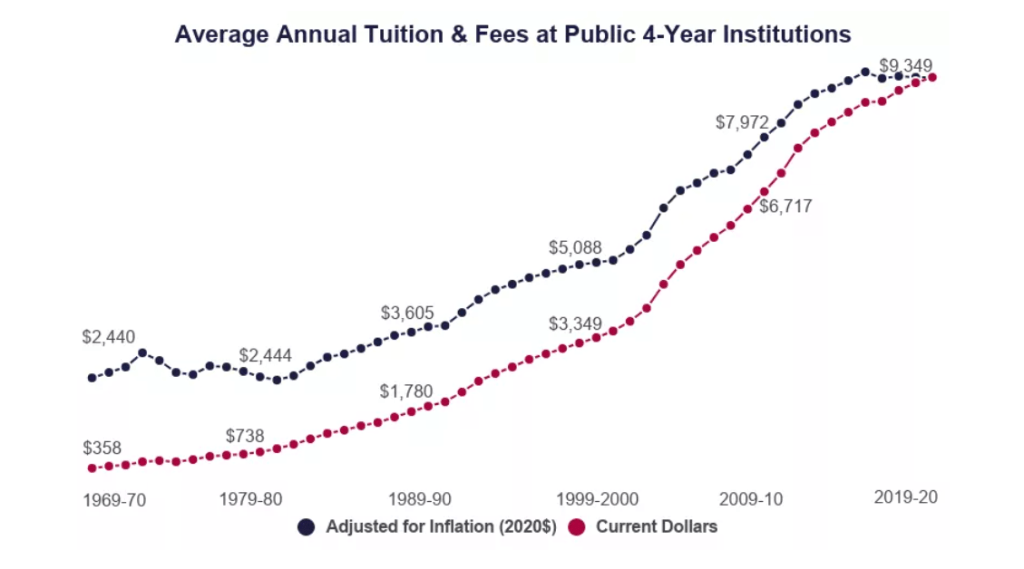
Let’s look at the history. The following chart is a point of departure:
It’s obvious from the chart that around 2008 something happened to the cost of college—it took off. A prime ingredient was the George Bush’s 2008 crash, which was a double whammy: states had less money to spend—so tuition went up—and students and their parents had less money to pay it. As we all learned during the Covid crisis, states have limited ability to deal with new expenses, as many are prohibited from running deficits. They need to rely on the federal government to help them out.
However the Republican Congress blocked all stimulus (remember the “balanced budget amendment”) to provoke dissatisfaction for the 2016 election. So there was no help to be had. Unsurprisingly people had to take on new levels of debt. And with Republicans continuing to sabotage the recovery, there were few jobs for these people when they graduated (or didn’t) and went immediately into arrears. Student load debt didn’t grow because students were irresponsible, it grew because government was.
Adding to that, Republicans spent years protecting fraudulent private pseudo-educational institutions because of the supposed superiority of the private sector. At such places you could earn a degree in “culinary arts”, for example, which was considered valueless in any real restaurant. Essentially all students at those institutions incurred monumental levels of debt and no skills. The worst of those have now been shut down, but Betsy DeVos did everything she could to defend them.
As a country we screwed a generation of students. From the numbers on the chart, $10 or $20 thousand seems relevant, but assuredly not profligate. As for inflation, the risk has been exaggerated by false comparison to the stimulus packages. The cost here is budgeted over decades; its current impact is minimal.
However we should be clear that this is a Band-Aid on a God-awful wound, because for the most part things have only gotten worse.
First of all, averaging over all institutions in the country gets a rather diverse mix of good and bad colleges. That’s appropriate for addressing needs of borrowers. However If you want to go to a good institution to get yourself a good job, the numbers are basically twice what’s on the chart: around $20 thousand yearly for a good public institution. For private colleges, we can be more exact since they act as a cartel: $80K. Even applying to these places can cost thousands. So much for equality of opportunity.
What’s more the public university system, instead of being strengthened, is under attack. That’s not just a matter of the well-publicized politization of education, bad as that is. Public funding in many states has been reduced to the point that public colleges are admitting out-of-state (or out-of-country) students in preference to in-state ones, because they need the extra money. That has actually become a major contributor to student loan debt! The financial situation is so dire that colleges are spending more on administrators to raise money than on education itself.
All of that sounds like a hard problem, but as with healthcare, just about every other developed country has found a way to do it. We need to strengthen the public system with necessarily more of a role for federal funding. Public education has to be first-rate and affordable—and available to everyone in every state. We’ve got to banish the preposterous model of education as a severely-limited resource with parents ready to kill to get their children into the right places! In addition we need to limit the size of loans people need to take and be rational about the payback. The Australian system, with payback based on ability to pay, is one working option.
It’s worth stating the obvious fact that with the current cost of education, the only way we’re keeping this country going is by importing foreign graduates (and telling them how much we hate their being here!). We’d have to shut down Silicon Valley otherwise. We should also be clear that when we talk about national security we’re talking not about aircraft carriers but about our national competence in key technologies.
It is also worth stressing the problem is NOT (despite rumblings from both the left and the right) that we’re sending too many people to college. Good jobs need sophisticated training. You can look at the government’s own (or anyone else’s) expectations of the jobs we’re going to need to fill. Sure there should be more specifically vocational training also, but that’s not the answer to the problem we know we’ve got. Also we’ve learned from the Covid experience that online instruction is no silver bullet to replace teachers.
Finally it’s worth responding to the charge that we’re not sufficiently targeting our payments to the poor. The fact is that the only route to equality of opportunity is making sure that there is a first-class system available to everyone. We used to understand that. We were the first to recognize that secondary education needed to be available to everyone. Eventually other countries caught on, because there was a big advantage to the country in doing it.
This has been proven so many times it’s ridiculous to have to state it—education is the backbone of the strength of the country. Despite some rhetoric, there’s nothing either left-wing or right-wing about this. Even Adam Smith knew it—he didn’t futz around wondering how little training poor people could get by with, he wanted universal literacy in the eighteenth century. If we want to succeed as a nation, we need to succeed at education.
This note is occasioned by John McWhorter’s piece in the NY Times, basically praising Clarence Thomas as a thinker who has been too easily dismissed.
While I agree with Mr. McWhorter on some subjects, I think he is very wrong on this one. And his mistake is the same one made by other people about other public figures.
First about Clarence Thomas:
He is someone who has received help every step of his career, but who has nonetheless declared himself self-made. His autobiography is emphatic to the point of absurdity on the subject.
His general philosophy is heavily influenced by that mythology. Like many other pseudo-self-made people (there are admittedly more rich than poor of them), he asserts “I did it, so can anyone else who has what it takes.” No one should be asking government for help. That he sincerely believes this does not make it either true or admirable.
Despite his self-delusions, he has not achieved his success as a thinker. He has achieved success as a propagandist for power. His ideas, however well or badly thought-out, are irrelevant to his current position. He is a tool in the Koch organization’s (and Republican party’s) battle plan. The position being propagated is simple and convenient: we just don’t have to care.
Contrary to what you sometimes read in the papers, he has not driven the Supreme Court to its current position on the extreme right. That is a Koch-managed and funded enterprise that has put a succession of Federalist Society judges on the Court.
We should now talk more generally. There were places and times in the past when people seemed at least worried about selling out. That is, whether they were putting personal advantage above some notion of morality.
We are no longer at that place or time. In the United States (and elsewhere) today, there is no morality stronger than financial success. People don’t need to agonize anymore, because riches are proof of morality. That’s the Clarence Thomas problem, and he is far from the only example.
I’d even put Milton Friedman in that category (along with a good chunk of the Federalist Society). Milton Friedman was certainly capable of understanding the logical flaw in his argument: it’s okay to declare that corporations serve their stockholders—but only if someone else is minding the store. If those same corporations are also running government, then no one is minding the store. Instead he made himself a wealthy and respected genius, again as a propagandist for power.
No one should be venerating propagandists for power, no matter how sincere such people believe themselves to be.
Today about half the United States electorate seems to think that the end of democracy would be great—they could just keep on winning. It’s not said enough: that’s a fallacy regardless of where you sit on the political spectrum. The end of democracy means the end of leverage.
As history has proved over and over again, the winners when democracy dies are the real elites who hold power. In this case were talking about the Kochs, the Thiels, the Mercers, the Murdochs. In the absence of democracy, no functioning elections means no power for anyone else. All other leverage is gone.
Those people have been very clear about what that means. What they want is what’s good for them. No taxes on rich people and corporations. No regulation. No government services they don’t need—that is no social security, no Medicare, two-tier education, nothing for climate, no safety net. Back to the glory days of the nineteenth century, when businesses could get away with anything.
For now a section of the population finds common cause with those people on guns and abortion, but those were never the main issues. The only reason we’re talking about those issues today is that we do have a democracy today and voting matters. Guns and abortion are a path to power, but not a commitment to support anyone in any way.
Once democracy goes, we’ll have nothing to say. And nothing is what everyone—both their supporters and their opponents—is going to get.
Monotheism amounts to an imperialistic assertion of primacy. That sounds like one of those wild-eyed slogans from the radical left or right. But in fact it is a simple statement of what drives quite a lot of policy, both domestic and international.
Let’s start close to home. In both Britain and the US there is a big problem with past imperial grandeur. The Brits just can’t get over their lost empire, and they keep doing completely illogical and crazy things (e.g. Brexit) in hopes of getting it back. The fact that the world has changed since then, with new powers and new bases for strength doesn’t register. Since the empire is taken to be an expression of British superiority (and of God’s grace raining down on Britain) there is no reason why it can’t just happen again. There is only one God and he’s ours.
The US has a similar problem, just a little later in time. We had the 1950’s and even 60’s when in the years following the destruction of the World War II the US was unquestionably the world’s only remaining superpower. If anything we were more dominant than the British as their peak. And we’re just as blind in looking back to it. Our dominance was a result of national superiority and God’s grace. We are the chosen rulers of the world and there’s nothing that ought to stop that.
The Chinese and the Russians have similar issues. Having lived in Italy at one point, there’s more than a bit of it (going back several centuries) there too.
The Old Testament (as I understand it) had a more limited notion of monotheism: each nation had it’s own god or gods and international struggles were also struggles of those gods. That sounds a little more accurate. Contemporary monotheism amounts to assertions of primacy. An astounding percentage of Americans are ready to talk about God’s protective shield over the US and our God-given role in running the rest of the world. That gets in the way of any notion international cooperation or any workable national objectives. With God on your side, reality just doesn’t matter.
The Brits have already driven themselves to at least a short-term future of poverty. It is relevant to notice—although seldom mentioned—that the pre-EO version of Britain was much slower than the continent in recovering from World War II and generally poorer per capita.
The US is on the brink of doing the same thing. We’ve got a dictatorial theocracy going, as well as a “we don’t need anyone” ethos on the right that denies any need to interact with the rest of the world except under terms of dominance. Furthermore the pervasive xenophobia denies the (currently enormous) contribution of foreigners to the economic strength of the US.
However the biggest problems are not even that. As climate change and also Covid and the Ukraine crisis show us, we have only one world. All the national gods are going to have to cooperate if we’re going to get out of this mess. Enough with national monotheism.
 on the outside