Tesla and Ice

13466619083_803e381a03_b

This is a short note on a couple of issues related only in that they say something relevant about the future we should be planning for.

The first relates to Tesla and its production difficulties with the new, lower-priced model 3.  The highly-automated production of the model 3 is well-behind schedule, to the point where it is a big hit to the cash flow of the company.  We mention it here, though, because the delay is an indication that mass production of electric cars is something fundamentally new.

An electric car is a much simpler machine than an ordinary, gas-powered vehicle.  In principle the construction should be both cheaper and easier to automate.  Current production of Teslas is intrinsically a low-volume operation.  The model 3 will be the first indication of what newly-imagined electric car production is like.

I don’t know if we’re in for a shock or not (this is after all a first go at it), but this could be another big change to conventional middle-class employment.  And there will be follow-on effects for gas stations, and especially maintenance and repair.  This is another of many indications that broad, technology-based disruption of jobs is going to happen.


The other story is about the commissioning of a new class of Russian icebreaker—targeted at clearing northern ship lanes freed up by the retreat of polar ice with global warming.  The phenomenon is already clear, although the amount of traffic is still small.  The Russians are preparing for the opportunity with multiple classes of new machines planned for release up to 2025.  The Chinese have announced cooperation with the objective of reducing shipping times to Europe by a third.

The US is of course uninterested in consequences of climate change.  The only Coast Guard ice breaker is 40 years old, and they have a hard time getting authorization to get a new one.  The Bering strait, however, could be a shipping lane.

This is a very small example, but climate change affects many things, and as a country we’re trying to avoid finding out about them.


The current federal budget is put together for a world where the private sector will take care of everything.  That has always been a fantasy—the efficiency of the private sector comes in large part from its ability to ignore everything not relevant to immediate financial success.  It is particularly false for a world undergoing fundamental change.  We either recognize it and help people through it, or we fall behind and revert to the nightmares of the nineteenth century.

Update on Climate Change

s09_FossilFuel_and_Cement_emissions_1990

This note is an update to the climate change article from last year.  The story hasn’t gotten any better, but there is enough that’s new to warrant a revisit.

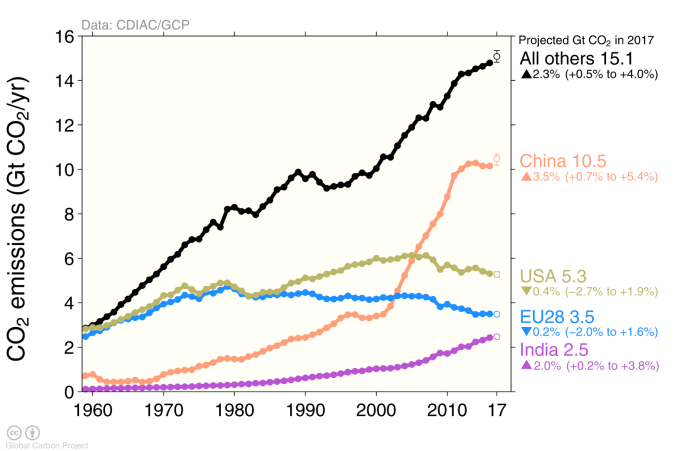
The most fundamental piece of bad news is the opening figure, which comes from the Global Carbon Project.  After three years of seeming stability, the world production of carbon dioxide increased significantly in 2017.  (The figure says “projection” just to indicate that the final computations are in process.)  Without too much evidence we might as well call that the Trump bump.  As we noted last time, worldwide unanimity on climate change is important precisely because the advantages of cheating are so obvious.  We—with probably the most to gain from the Paris Agreement process—are the cheaters in chief.  So it’s not surprising others will have fewer second thoughts as well.

We have to put this change into perspective.  Even a stable value of CO2 emission means things are getting worse, because it is the total amount of CO2 in the atmosphere that drives temperature change, and it all adds up.  The stable value was attractive, because it seemed to indicate that CO2 had finally peaked and might start to decline.  And the decline might mean the total CO2 could be bounded.  We’re now back to worrying about the peak, with no idea how bad things will get.

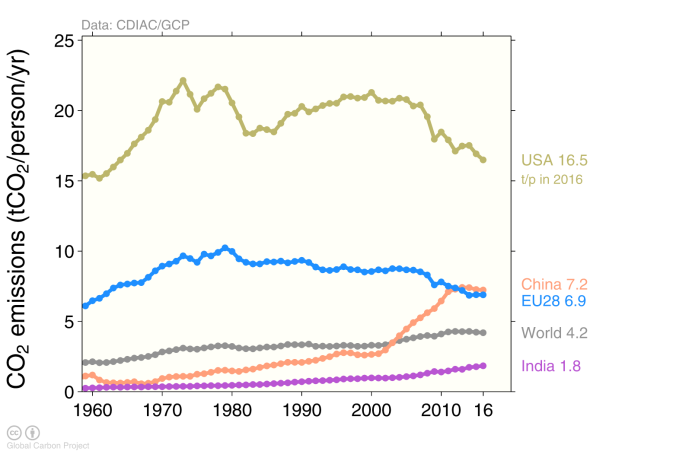
Two more new slides from the Global Carbon Project show what we stand to gain from Paris Agreement unanimity.  The first shows the current per capita production of carbon dioxide.

s12_Top_FF_Emitters_percapita

As has been true for many years US per capita usage sits way above everyone else, more than twice both Europe and China.  That is a direct expression of our carbon-powered standard of living.

The second slide shows who is going to have to make changes to protect that US standard of living from the effects of climate change.

s11_Projections

This shows that the major growth in carbon dioxide production is not from the biggest economies (note that even China has stabilized), it’s from the have-nots trying to achieve some fraction of our standard of living.   We are asking them to ignore not only our past exploitation of fossil fuel resources but even our current high per capita use and to delay their own immediate hopes for a better life in order to make the world a safer place for everyone.  So much for the question of who benefits from the Paris Agreement process!

That introduces the next topic—public attitudes to climate change.  There were enough strange weather events in the past year to give people pause, so we’re getting close to—but still not over—the hump.  The latest poll numbers have both good news and bad.  First the good news:

Overall, 45 percent of those surveyed said global warming would pose a serious threat in their lifetimes, the highest overall percentage recorded since Gallup first asked the question in 1997. Despite partisan divisions, majorities of Americans as a whole continue to believe by wide margins that most scientists think global warming is taking place, that it is caused by human activities and that its effects have begun.

Then the bad—the improvement is only partisan:

Gallup asked whether people agreed that most scientists believe global warming is occurring, and 42 percent of Republicans said yes, down from 53 percent a year earlier and back to a level last seen in 2014. Just 35 percent of Republicans said that they believe global warming is caused by human activities, down from 40 percent.

This seems like another proof of a much-discussed feature of human nature—when people are confronted with proof that their beliefs are wrong, they double down on defending those beliefs.   Unfortunately those are the people running the show.

How can that turn around?  A recent Steven Pinker book made an interesting point.  Much of the rhetoric around climate change focuses on conservation and a new world view of collective responsibility.  But conservation actually isn’t the main point—since we’re not repealing the industrial revolution, the main point has to be new energy sources.  We’re not creating a new world where no one drives Chevy Suburbans anymore, we’re just changing the power source.  Conservation, however important, is about buying time until we can get there.  Perhaps that’s one way to get climate change out of the culture wars (as it should be).

In any case the focus has to be on the reality of climate change, and everything else is tactics. With tactics it’s easier to be bipartisan.   One indication is that Congress, over Trump’s objection, passed a bill continuing tax breaks for solar, nuclear, geothermal, and carbon-capture projects.  This effort united left-wing and right-wing approaches to climate change largely under the radar.  However, it must be recognized that even with such efforts the US is now lagging far behind in support for the technology of climate change.

Carbon capture (separating out CO2 and storing it underground or elsewhere) deserves some special mention, because it has become a bigger topic in the past year.  On one hand this is an idea that has been around for decades without going very far, and what’s more the coal industry supports it as a lifeline.  On the other hand the technology seems to be improving, the Obama administration supported it as a transitional technology, and even the IPCC climate studies assume some form of it will be used.  It currently exists as an expensive add-on for power plants, and some still-speculative variants have been proposed to pull carbon dioxide straight out of the air.  Both the power plant and out-of-the-air applications have a common need for CO2 storage technology, of which there are many variants.

The biggest issue with carbon capture is that it can be (and is being) used to delay doing anything about climate change—why worry about carbon getting into the atmosphere if we’ll pull it all out later.  The problem is that the technology still has such big questions about cost and scaling, that “later” could be very late or never (and some effects, such as melting glaciers, are irreversible).  Even the cheapest estimates say it will cost continuing trillions.  What you have to say is that the technology investment is necessary and at worst it at least gets the climate dialog past the hoax stage.  And if we could just get the Kochs interested in that business (which is largely oil industry technology), it would settle the Republican perception of climate change once and for all!

Returning to reality, we have to conclude the past year seems like a pause for progress.  After Trump took the US out of the Paris Agreement, many wanted to talk about all that could be done to maintain momentum nonetheless.  The chart at the beginning shows the limits of that point of view.  There are other indicators as well:

– The auto industry’s step back from future fuel efficiency standards

Exxon’s declaration that climate change is no risk to their profits

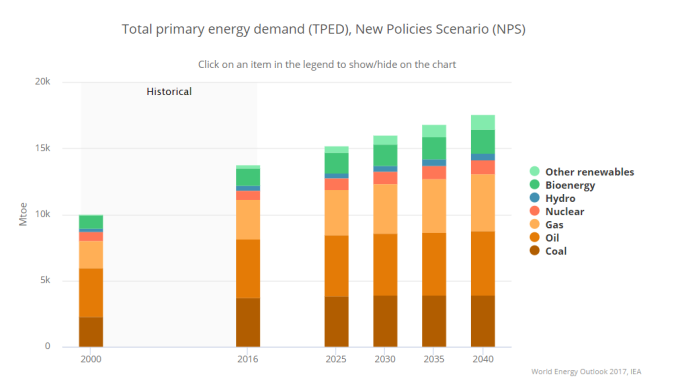
– Business as usual in the International Energy Agency’s World Energy Outlook:

iea_weo

– Even the new preoccupation with carbon capture has to be viewed as a vote of no-confidence in the progress of conservation.   If prevention isn’t going to happen, then repair is all we’ve got.

What’s more than there has even been a preoccupation with a more drastic step, so-called geo-engineering.  This means injecting chemicals or particles into the atmosphere so as to dim the sun and cool the earth despite the increasing CO2 concentration.  There are many risks:  continuing ocean acidification, reduced photosynthesis and food supply, and weaponization of the technology.  Since CO2 would continue to accumulate, any loss of protection would have disastrous effects.  These are desperate measures.

As to what we should be doing, the picture is not too different from last year, but we can be perhaps more explicit.

  1. Because burning carbon is now recognized to have definite costs (i.e. whatever is necessary to counteract the CO2 increase), we need some kind of carbon tax so that the free market economy can react correctly. Since that cost is not currently captured, our economy is incurring a significant distortion that needs to be fixed.
  2. We need to get back into the Paris Agreement process to return focus to the goal. To repeat the obvious, the Paris process was always intended to be iterative—with countries readjusting their goals to eventually reach the target. We’re only at step one, so we had better help the world get back on-track.
  3. We have to recognize that at this stage we’re in no position to judge winners and losers among contributing technologies. So the solution has to be all of the above: nuclear, solar, wind, geothermal, batteries, carbon capture, even substituting gas for coal as a temporary measure.  The IPCC gave us what they called a carbon dioxide budget—the amount of CO2 we can add and still stay below a global temperature rise of 2 ⁰ C.  In 2014 (the year of the report) it was 800 giga-tons.  It is now below 700.
  4. People have to recognize that despite confusing news reports, we are all in this together. Some people will be hit by sea-level rise, some by drought, some by sheer temperature, some by storms, some by an effect we haven’t seen yet. Some may even be a little later.  But ultimately there’s nowhere to hide, and even “later” comes fast.
  5. There is no excuse for not funding research in all the contributing technologies and also research to understand the climate effects we are going to live with for however many years it takes to get past fossil fuels.
  6. Ideally all elements of society should be involved in planning such major changes. The carbon tax will help make that happen, but it’s not the whole story. We can’t keep fighting about this.

This administration likes to talk about itself as bringing business practices to government.   The evidence for climate change is such that any reasonable business would be doing its best to quantify the risk, so as to take appropriate action.   Businesses that choose to ignore disruptive new technologies or entrants are the ones that disappear—along with their disparaging comments on how the new stuff will never amount to anything.

Unless we choose to wake up—that’s us.  We’ll act now or pay far more dearly later.


Hurricane Harvey and the Burden of Proof


Hurricane Harvey was an extraordinary event.   The rainfall totals and flooding were without precedent even in the hurricane-prone Texas Gulf region.  The New York Times pointed out that fully 40% of the flooded buildings were in areas classified as “of minimal flood hazard.”

Scientists have been very circumspect about what part of this to attribute to climate change.   Michael Mann gave a careful summary of contributing factors, principally sea-level rise and water temperature.  The message is that climate change didn’t cause the hurricane, but did make it worse.  No one can quantify just how much worse, and certainly out-of-control development in Houston contributed to the destructive effects.

However, the fact remains this was an unimaginable storm.   It was out of the range of what anyone thought to see from weather, even from hurricanes.  That is the threat of climate change.  Weather isn’t limited to what we know and understand.  Once we perturb the system, the power of the elements can surpass anything we are used to—that is what’s at stake.  We can’t even guarantee the changes will be gradual.

The evidence behind climate change is considerable and increasing.  A previous post here discussed one particular way of looking at it.  Any reasonable business, faced with a risk of this magnitude, would be doing its best to quantify that risk, so as to take appropriate action.   Businesses that choose to ignore disruptive new technologies or entrants are the ones that disappear—along with their disparaging comments on how the new stuff will never amount to anything.

That’s us.   Coal and oil interests (Koch brothers and their cohorts) are horrified that anyone would even think about keeping their assets in the ground.   With this administration anything that any business doesn’t like is bad–and for climate change we actually have Koch representatives (Scott Pruitt, Mike Pence) running the show.  So climate change doesn’t exist.  Can’t even talk about it.   Come back to me when things are so bad I can’t laugh at you.

What is the burden of proof here?  We are long past the stage of serious concern.   We haven’t reached the stage where people with something to lose are ready to give in, but that’s not going to be until their businesses blow up in a storm.   With climate change you have to act early if you want to prevent a future of weather run amok.   Carbon dioxide in the atmosphere just adds up.  If you wait for things to get bad, they will go from bad to continually worse through all the years it takes to get off coal, oil, and gas—and then stay that way for many decades more.

We are at the stage where the appropriate response to risk is action.  Research and the Paris Agreement process are imperatives.  CEO’s of failed companies can always go on to the next one, but with climate change there’s nowhere to go.

Forecasting Climate Change

This note is an introduction to the task of forecasting climate change.  It avoids most details of the climate simulation models, but it does try to give a feel for what we know and why.  This fits with the previous more general post on climate change and the Paris Agreement.

At its basis climate change is straightforward:  the burning of fossil fuels puts extra carbon dioxide (CO2) in the air.   That raises the concentration of CO2 in the atmosphere.  And that in turn causes temperatures to rise.

You can go a long way with just that, but as we’ll see the story is ultimately far from simple.   The story here has two parts:

  1. Projecting historical trends
  2. New factors in a warming world

The two parts are quite different.   The first identifies clear patterns from the data going back over the past 70 years.   The second is necessarily more difficult, as it covers new phenomena resulting from climate change itself.  The first functions as a baseline, with the second adding new effects to the base.

Part 1 – Projecting historical trends

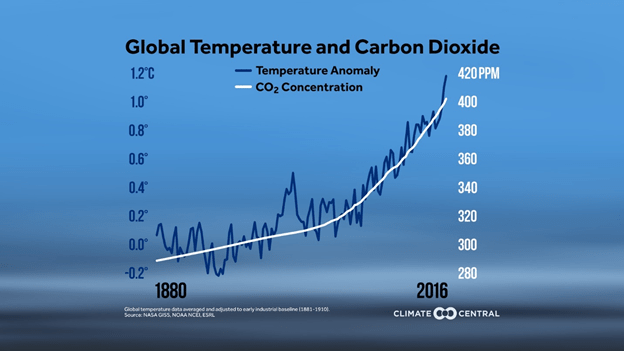
The point of departure here is the correlation of CO2 in the atmosphere (in “parts per million”, abbreviated ppm) and temperature change.  The following slide shows how that looks over time.  (“Temperature anomaly” just means temperature rise since the start of the industrial revolution.)  The temperature rise and CO2 concentration are clearly tied closely together.

Figure 1
Forecast1


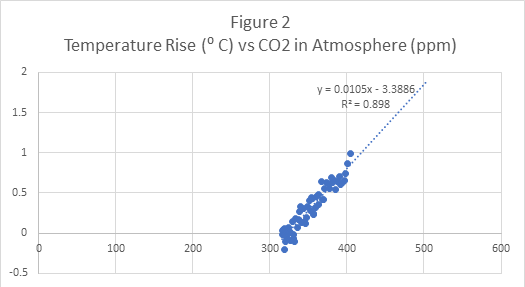
We can do better than Figure 1 however, just by explicitly correlating annual temperature values and CO2 concentrations.  We use online data from 1959 to 2016 for the calculation, taking temperature values from here and CO2 concentrations from here.

When we plot it up, the result is a remarkably clear trendline:
Forecast2

In the trendline the temperature value y (in degrees C) is related to the concentration x (in ppm) by the equation y = .0105x – 3.3886.  The slope .0105 is particularly important.  It says that on average whenever the ppm value increases by 1, the temperature increases by .0105 degrees Centigrade.   As in the previous chart the temperature scale here shows degrees above the pre-industrial world temperature (i.e. the temperature pre-1880).

(To be clear, the linear relation between temperature and ppm is remarkably obvious in the data, but not a surprise.   The temperature rise comes from reflection of infrared radiation back to earth.  The probability of that happening is the probability of radiation interacting with a CO2 molecule–and that is proportional to the concentration of CO2 in the atmosphere.)

We have now have a precise statement of how CO2 concentration changes affect the temperature.  The next step to see how the CO2 production affects those concentration changes. For that we need another slide as introduction.

Figure 3
Forecast3

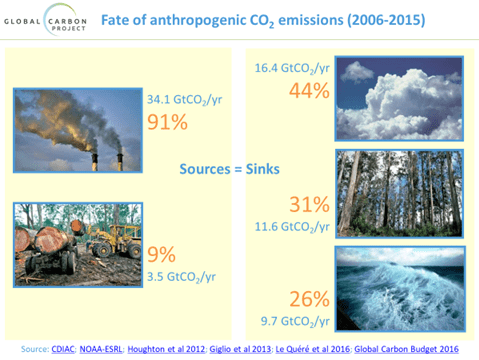
What this says is that the first thing to understand about the effect of CO2 production is how much CO2 actually ends up in the atmosphere.  We’ll talk about each side of the slide separately.

The left side points out that CO2 from fossil fuel burning is only 91% of the total, because there is another factor that is completely different—deforestation and similar land use changes.  For our purposes we will simply inflate our production number by 10% to get to the correct total.

The right side then points out that of the total (inflated) production number, only 44% actually stays in the atmosphere.   The rest is absorbed by trees and oceans.

Hence we have the simple equation:

CO2 added to the atmosphere = CO2 produced x (1.1) x (.44).   (For what follows you should know that CO2 production is reported in “gigatons”, abbreviated Gt.)

Next we need to get from gigatons of CO2 in the atmosphere to CO2 concentration in ppm.   That, however, is just physics—counting molecules in the air—and it has a standard answer:

Increased CO2 concentration (in ppm) = Added CO2 (in Gt) / 7.81.

(To be precise, the reference gives the equation: extra CO2 ppm = added carbon / 2.13.  To get the equation for CO2 instead of carbon, you correct for the relative atomic weights of CO2 vs carbon.  Since CO2 has two oxygen atoms in addition to carbon, that means 2.13 is replaced in the formula by 2.13 x 44/12 = 7.81)

Putting the two equations together we get this simple relationship:

Increased CO2 concentration (in ppm) = CO2 produced (in Gt) x (1.1) x (.44) / 7.81.  That is

Increased CO2 concentration (in ppm) = CO2 produced (in Gt) x (.0614)

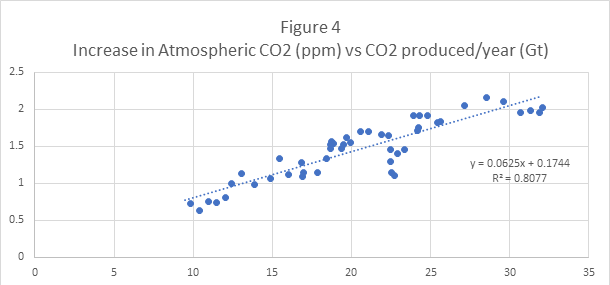
Since annual CO2 production figures are also available online, we can actually verify this result using real data.  The following figure gives the result (computed using rolling 5-year averages for the annual incremental ppm):
Forecast4

As before slope of the line is most important, because it gives the added ppm resulting from a 1 Gt of CO2 produced.   In other words, .0625 is the observed value corresponding to the theoretical .0614 we just mentioned.  Remarkably close given all the factors involved.  (As additional confirmation, it should be noted that there are even studies based on carbon isotopes identifying the extra CO2 in the atmosphere as coming specifically from burning of fossil fuels.)


We can now put the two stages of our argument together.

We have found two results:

  1. For each additional Gt of CO2 produced, the concentration of CO2 in the atmosphere increases by .0614 ppm.
  2. For each concentration increase of 1 ppm, we get a temperature increase of .0105 degrees C.

Putting those together we get:

For each Gt of CO2 produced, the temperature can be expected to rise by .0614 x .0105 = .0006447 degrees C.  You can’t get much more explicit than that.


Using that formula we can establish a baseline for climate change.

First we need to clarify that the 2 ⁰ C upper limit in Figure 2 was there for a reason.  For quite some time, a 2 ⁰ C temperature increase has been regarded as a tipping point, where temperature-related changes become both serious and irreversible.  For that reason the Paris Climate Agreement is targeted specifically at avoiding a temperature rise of that magnitude.  (More details on the tipping point can be found here.)

First question:  how much more CO2 can we emit before we hit the limit?

In stating this question we have implicitly used an important fact about CO2 that underlies much of the analysis of climate change:  carbon dioxide stays in the atmosphere for decades, so long in fact that for analysis purposes we can assume it just adds up.  For that reason the IPCC (“Intergovernmental Panel on Climate Change”—the key international research body for climate change) refers to a so-called “CO2 budget”.  The CO2 budget is the amount of carbon dioxide you can put in the atmosphere and still stay under the 2 ⁰ C target temperature limit.  The idea is that it doesn’t matter when or how you do it, that’s the budget you’ve got.

For 2016 the current world temperature was estimated to be .99 ⁰ C above the per-industrial level.  Since we are at .99 ⁰ C above the pre-industrial value, we are 1.01 ⁰ C from the limit value of 2 ⁰ C.

From our final equation we have as baseline

(Gt’s to get there) x .0006447 = 1.01 degrees.   So the limit is = 1.01/.0006447 = 1567  Gt’s of CO2.

Next question:  How long will it take to get there at current production levels?

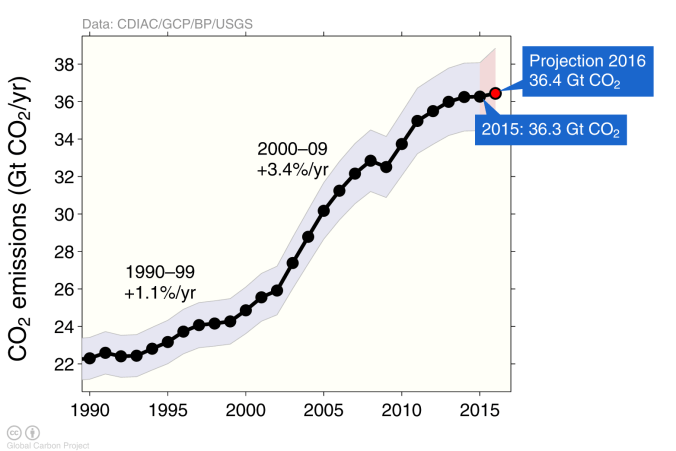
To answer that we need to look at the following chart of historical CO2 production levels:

Figure 5
s08_FossilFuel_and_Cement_emissions


At least for now production seems to be stabilizing, so we will use the 2016 value of 36.4 Gt for the annual CO2 production.  With that we get, again as baseline,

Time to 2 ⁰ C limit = 1567/36.4 = 43 years.  So if nothing changes we hit disaster in 2059. (Of course avoiding disaster means acting earlier.  We’ll return to that later.)

What this number means

As we’ve been careful to say, this isn’t the whole story.   However what it does say is that the trend of the last 70 years is unambiguous and specific.   It yields a carbon dioxide budget and a date to reckon with.   Even this most straightforward calculation says we have a serious problem.

The reason that isn’t the whole story is that climate change itself has produced new phenomena that add to the baseline.   Examples include

– Temperature change in the oceans

– Acidity change in the oceans

– Decline in arctic sea ice

– Melting of ice caps

– Melting of permafrost

So before we can be precise about carbon budgets and timeframes we need to incorporate the effects of these new kinds of changes, because it all adds up.

Since this is new territory, we can’t rely on history for this new piece.   It requires both new science to understand the effects and new simulation models to track their interactions.   That effort is the subject of the next section.


Part2 – New factors in a warming world

For the newer changes to the environment, the only way to understand the future is to learn enough to model the actual behavior.  That effort is a major goal of ongoing climate science.

Then, since the effects are linked with each other, they must be tied together into a simulation model of the natural environment.   Of necessity, this must include not only the atmosphere but land and water effects as well.  The IPCC currently has four major simulation projects, to model scenarios with low, medium, and high levels of retained heat in the atmosphere.  Those simulations are enormously complicated; they model specific per-year patterns of greenhouse gas generation in particular geographic locations with associated ocean currents, forests, glaciers, and so forth.

While the complexity of the models is beyond the scope here (see this overview for a summary), what we can do is describe some of the issues that are modeled, with an indication of ongoing work to support the results.

We should also underline the importance of this work.   Because warming trends already put us in new territory, there is no history to estimate or even bound the magnitude of these new interrelated effects.  Without looking in detail, we just plain don’t know what is going to happen.  One sobering lesson from the longer historical record is that with climate, small changes can produce big effects.

With that as introduction, we now look at some of the important issues under study.  In this we’ll see how the changes mentioned earlier actually come into play.

CO2 uptake in the oceans and on land

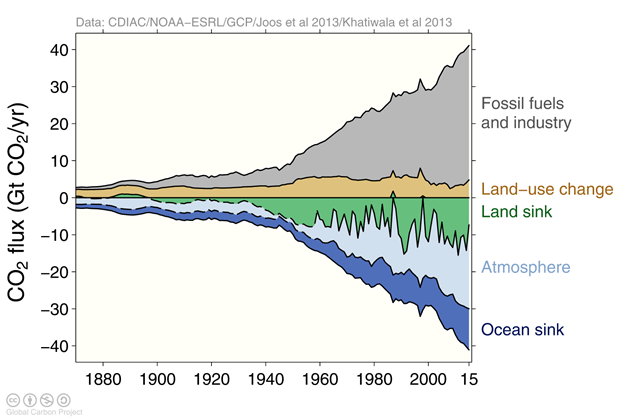
As we noted earlier, only 44% of the CO2 that is produced ends up in the atmosphere.  The following chart shows how that has evolved over time.  What gets into the atmosphere is what isn’t captured by the ocean and land sinks.

Figure 6
Forecast6

Any change in the absorptive capacity of the ocean or land sinks has a big effect on climate, by multiplying the impact of whatever carbon dioxide is produced.  And there have been concerns, particularly recently, that the absorptive capacity may be reaching a saturation limit.  So there is considerable ongoing work to understand the mechanisms responsible for the uptake.

For the oceans the story turns out to have several parts:

– The oceans are warming, and warmer water has less capacity for CO2.   That part is relatively easy to quantify.

– A large part of the uptake, however, is due to photoplankton in the water.  It turns out that there are multiple species and issues to be understood.  Very significantly, the photophlankton are sensitive to the rise in acidity of the oceans.   So there are a quantifiable scenarios where rising acidity will reduce the ocean uptake by killing photoplankton.

– Additionally, all of the ocean uptake involves a relatively thin layer of surface water.  That upper layer is refreshed by the operation of ocean currents.   As we’ll discuss in a minute, the currents themselves are vulnerable for disruption by climate change, so refresh rates will change in some scenarios.

For land sinks the story is simpler—threats to forests from rising temperatures, and new forest areas created by natural or artificial means.  Note that the land sinks have been historically volatile, as you can see in Figure 6, so modeling has to be explicit and detailed.

Melting ice caps

One of the most obvious effects of climate change has been the melting of ice caps and glaciers in Greenland, Antarctica, and elsewhere.   This melting contributes to warming by reducing reflectivity of ice-covered surface, but can later increase carbon uptake if the glacier is replaced by forest.  Both effects are included in the models.

Glacial melting now appears to be happening faster than expected, so there is active work on the timetable.  The melting also affects the salinity and therefore density of the surrounding water, which in turn can affect ocean currents.  And that, as we just saw, affects ocean uptake of CO2.

It should be noted that melting of glaciers is one of the longest lasting effects of climate change.   Once ice sheets begin movement toward the sea, the process becomes virtually unstoppable.  Which means locking-in many meters of sea level rise in long-term projections.  The Greenland ice cap alone represents 7 meters of sea level rise.

Ocean currents

Over the past few decades, it has become clear that ocean currents are linked with each other in a more comprehensive way than was understood before.  The current view (the “ocean conveyer belt” or “thermohaline circulation”) is shown in the following simplified figure.

Figure 7
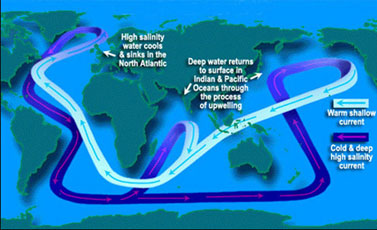
Figure7

What is relatively new is the notion of deep water currents connecting surface flows—so disruption of any part of the circuit affects the flow overall.

Disruption of the circuit has many consequences.  We have already seen it can affect carbon dioxide uptake by the oceans.  It also affects upwelling of nutrients and hence most life in the oceans, as well as the weather worldwide.

One important special case is the down-welling in the north Atlantic, in that it appears to be affected by melting of the Greenland ice cap.   That directly impacts the Gulf Stream, but the via the “conveyer belt” the effects would be felt worldwide.   Details are described here.

Other greenhouse gases

Thus far we have talked only about CO2, because its residence time in the atmosphere is much longer than for other greenhouse gases, such as methane.  Methane, however, is much more potent molecule-for-molecule, so there are examples where it needs to be taken specifically into account.

One such example is permafrost melting in the Asian tundra.   Since permafrost is partially-decayed vegetable matter, melting of permafrost actually releases methane directly.   The methane only persists in the atmosphere for about a year, but because of its potency it creates a short-term effect on climate that has been incorporated into the models.

Note that because permafrost is a phenomenon of the tundra, this is a case where the models need to react to the specific effects in particular geographic regions.

Cloud cover

Cloud cover is a surprisingly contentious subject.  On one hand it is nothing new, so in that sense it is already in the baseline.  On the other, it has such large potential effects both positive and negative, that it is hard to dismiss as something that might fundamentally change.

The basic arguments are straightforward:   clouds reduce warming by reflecting sunlight back but they also trap heat coming from the earth.   In general for high clouds the warming effect is predominant and for low clouds the cooling effect is.

There has been considerable effort to decide upon the net effect, which for now appears weakly warming.

Carbon capture

Carbon capture is a technological idea that has been around for some time without ever maturing to the point where it can be called real.   The idea is that CO2 would be captured at emission or even removed from the atmosphere and either stored somewhere (underground or at the sea bottom) or handled by a biological process that would render it harmless.

Anyone who thinks the current IPCC models are deliberately alarmist should realize that the models actually include carbon capture technology starting as early as 2030.  As this indicates, the models are in fact a best shot at the future and should not be thought of as a worst case.

Darken the sun

Finally, as a last item, we mention one more category of climate work that does not fit in the IPCC models.  These are the speculative “if all else fails” projects.   They are directed to the case where the IPCC process has failed, and the world is locked into an unlivable future.  For that case they propose gases or particles to be dispersed around the earth to cut down the strength of solar radiation.

While such projects turn up occasionally in the press, all of them have very serious downsides—to start with they reduce photosynthesis and hence food production everywhere on earth—and the people working on them recognize that explicitly.  It is important to realize those are not alternatives but risky and desperate measures for a future we are trying to avoid.


That ends our short summary of modeling issues.

While we have given only a few examples, it should be clear that the effects are potentially large.  And we see that in the last IPCC report from 2014. (That was the 5th such report.  The next one is scheduled for 2018.)

By incorporating all effects, the IPCC’s carbon dioxide budget drops to about half of the baseline–800 Gt starting from the end of 2014.  That means the time to exhaust the CO2 budget is also about half—twenty years.  The specific effects are described in some detail in the IPCC report itself.

Figure 8 presents the IPCC conclusions as a single key chart.

Figure 8

s51_JacksonBridge15_Fig1_lines

The chart shows that with current fuel consumption (black curve) we will get to 2 degrees C in about 20 years, but in that scenario the temperature just keeps rising afterwards. If we want to stay below 2 degrees C, we need to be cutting carbon dioxide production much sooner, about 2020 in the -4% per year scenario.  Recall that since CO2 just adds up, things only stop getting worse when we are essentially done with coal, oil, and gas.

That summarizes the scientific consensus.  Time is short to stay under the 2 ⁰ C limit.  But as discussed in the overview post on climate change, getting there requires action but not miracles.

To end, it is worth emphasizing the importance of research going forward.   There are two points:

1. The world’s climate has already changed in unprecedented ways, and we’ve had little time to understand all its new workings and dangers. This is a very complicated system, and we have perturbed it in a significant way.   There are no guarantees that all changes will be gradual.  The world needs the most accurate possible view of the future.

2. For the transition from fossil fuels—we’ve said we don’t need miracles. But it’s a big job to do, so the more we know the better!


Urgency on Climate Change

There is no special event triggering this note, just a feeling that the urgency behind climate change action is somehow getting lost.

To start with, there’s one part of the science that everyone needs to know.  Carbon dioxide, the primary factor in climate change, remains in the atmosphere for many decades.   For practical purposes, all the carbon dioxide from burning coal, oil, and gas just adds up.

As a consequence, even with a world really ready to act on climate change, things will continue to get worse through all the years while we try to get fossil fuel usage down to zero.   And it will stay that way for many more decades afterwards.  The commitment has to be made with enough lead time–or it will be too late.

The Paris Agreement was never intended as more than a first step.  At the current stage, the Paris Agreement is effectively a vehicle by which we are getting China and India to stabilize fossil fuel use at a per capita value far below ours–for the benefit of the rest of the world including us.  The following figures give the aggregate and then per capita carbon dioxide production by country.  Note the sharp rise and recent stabilization in China on the first chart and the high US curve on the second.

s11_Top_FF_emitters_abs

s12_Top_FF_Emitters_percapita

Current commitments do not get all the way to the Paris Agreement’s goals, but those are only first steps in an ongoing process.  Our exit from the Paris Agreement deliberately undercut the international unanimity that was doing the job for us.

What’s more, for initial steps on climate change, the world and the US in particular have gotten lucky.  The now large-scale production of recently-discovered American natural gas means that we can get a 50% reduction in carbon dioxide production—as compared with coal–without trying very hard.  (Coal is all carbon, so burning it produces just carbon dioxide.  Natural gas is half hydrogen, so half the output is water.  Note that the same logic shows that for climate change there is no such thing as “clean coal”.)

There is in fact an ongoing conversion to natural gas.   Despite our Paris Agreement rhetoric, we don’t have a problem meeting near-term climate goals–much of it is already happening based in part on the price of gas.  But by promoting coal use domestically (and weakening environmental rules for natural gas producers) we insist on creating problems for ourselves and–worse–sending a damaging message to others.  To be clear, natural gas is only a half-step (and a risk for encouraging the producers), but it is buying time for renewable sources to be more widely deployed.   The Paris Agreement goals require an ongoing commitment–but not miracles.

The following figure shows our status now.   After many years of increase, global carbon dioxide production has been stabilizing.  However the only year of decrease is still the 2008 crash.s08_FossilFuel_and_Cement_emissions

Scientists have given 2 degrees Centigrade above pre-industrial temperatures as a tipping point, where temperature-related changes become serious and irreversible.  (See here for a good summary of the scientific consensus, here for a blog post on forecasting.)  This is not something to be laughed away.  We are now at 1 degree. The next chart shows that with current fuel consumption (black curve) we will get to 2 degrees in about 20 years, but in that scenario the temperature just keeps rising afterwards. If we want to stay below 2 degrees C, we have to start cutting carbon dioxide production much sooner, about 2020 in the -4% per year scenario. And that means every country in the world has to keep at it every year —hence the importance of unanimity in the Paris Agreement process. Things only stop getting worse when we are essentially done with coal, oil, and gas.

s51_JacksonBridge15_Fig1_lines

Notice there are no winners and losers with climate change.   Either we stop using fossils fuels or we don’t.  If we do, then we can stabilize the temperature, and it is to everyone’s advantage to keep it under 2 ⁰ C.  If we don’t, then temperatures will continue to rise, and there will be nowhere to hide.

That’s the situation.  There never was any hoax, conspiracy or political game playing—95% of climate scientists worldwide support this.  Try to get that kind of agreement on any subject.  Read this if you want the history.

The bottom line is that climate change is more urgent than we like to think.  It is natural to want to wait and see how bad things will get.  But this is a not a case where that works.  If we wait for symptoms of warming to become our top priority it will be too late.  We will be locked-in as carbon continues to add up, bringing years of increasingly disastrous change.   This is like cancer—first symptoms may be bearable, but if you don’t act now it’s all over.

We need to do everything possible to prepare, and that’s a big job.  We need research both on climate change itself and on everything to do to counteract it.  Industry and government need to prepare for a major transformation, and we need to get back to productive engagement (for our benefit) to finish the job started by the Paris Agreement.

It may be a big job, but it is our role to play, and there is no barrier–other than inaction–to getting it done.

Our President of China

There has been a lot of talk recently about China’s growing presence on the world stage and how the US as predominant power should react to it.  With that in mind we go to China, just outside the Forbidden City, where the Chinese are planning their strategy…

Xi Jinping: There are many factors we need to consider, economic and political.  Today we are an economic servant to the West, building their iPhones and other toys.  We need to learn to take their place.

Planner: The Americans have many advantages.  They have excellent universities and their pick of talent from all over the world.  They have an interlocking system of university, government, and private research labs.  It’s hard enough to catch up, much less to lead.

Xi: We have to go step by step.  I’ve heard that many of their new companies are led by foreigners.  We can cut into that and certainly lure our own people home–a little xenophobia would help.   As for education and research, we know that government money is critical both in government labs and in the universities.  We have to find a way to slow down that money and then duplicate their system here.

Planner: Sounds like a lot of work, but we’ll start on it.  They’ve been working for decades to get where they are.

Xi: We need to get more specific now.  What are the lead technologies we can use to establish our dominance?

Planner: It’s hard to answer that question.  Software is always there; the particular new twist seems to be Artificial Intelligence.  That ties in with robotics.  Biotech.  Probably the biggest thing is energy–climate change means the whole world will have to convert.

Xi: The Americans are big players in all of those, but progress is very international.  If we can get them to isolate their people we can win.  Energy is too big–we need to limit their role.

Planner: They were a driving force behind the Paris Climate Agreement.  Maybe we can sabotage that.

Xi: Great.  Good first step!

Xi: The next subject is politics.  The Americans have been leading the so-called ‘free world’ forever.  Everybody works with them; no country wants to be left out.  All major international agreements of any kind go through them.  They’ve done very well that way–they are the richest, most dominant country in the world.  Our presence is tiny compared to theirs–how can we match their influence?

Planner: The only way I can think of is to get them just to quit. Get out of our way so we can take over.

Xi: I don’t understand.

Planner: It seems that over the years the Americans have come to believe their own propaganda–that all of their international agreements and institutions were setup out of pure beneficence!  Nothing to do with remaining the richest, most dominant country in the world.  They even think that about foreign aid.

Xi: You’ve got to be kidding.  No one else thinks that.

Planner: All we’ve got to do is push them over the brink:  No international institutions, no foreign aid–all unaffordable charity and a foreign plot.

Xi: You really think you can pull that off??

Planner: Well, just a minute.  We need some kind of slogan.  Something catchy…

Planner: I’ve got it!!  AMERICA FIRST.

Xi: Welcome to the Chinese Century.