Update on Climate Change

s09_FossilFuel_and_Cement_emissions_1990

This note is an update to the climate change article from last year.  The story hasn’t gotten any better, but there is enough that’s new to warrant a revisit.

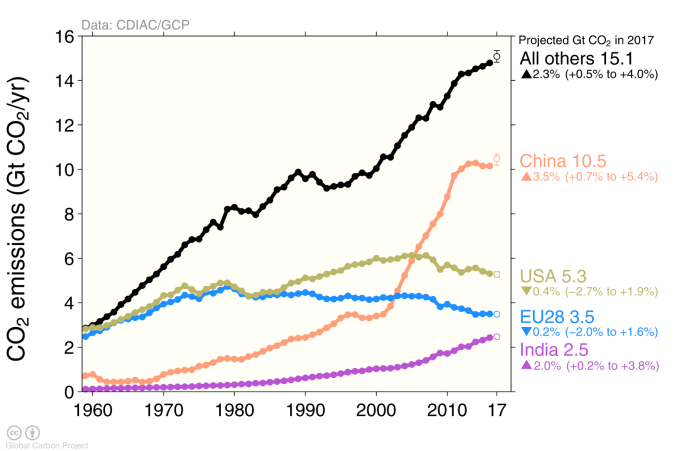
The most fundamental piece of bad news is the opening figure, which comes from the Global Carbon Project.  After three years of seeming stability, the world production of carbon dioxide increased significantly in 2017.  (The figure says “projection” just to indicate that the final computations are in process.)  Without too much evidence we might as well call that the Trump bump.  As we noted last time, worldwide unanimity on climate change is important precisely because the advantages of cheating are so obvious.  We—with probably the most to gain from the Paris Agreement process—are the cheaters in chief.  So it’s not surprising others will have fewer second thoughts as well.

We have to put this change into perspective.  Even a stable value of CO2 emission means things are getting worse, because it is the total amount of CO2 in the atmosphere that drives temperature change, and it all adds up.  The stable value was attractive, because it seemed to indicate that CO2 had finally peaked and might start to decline.  And the decline might mean the total CO2 could be bounded.  We’re now back to worrying about the peak, with no idea how bad things will get.

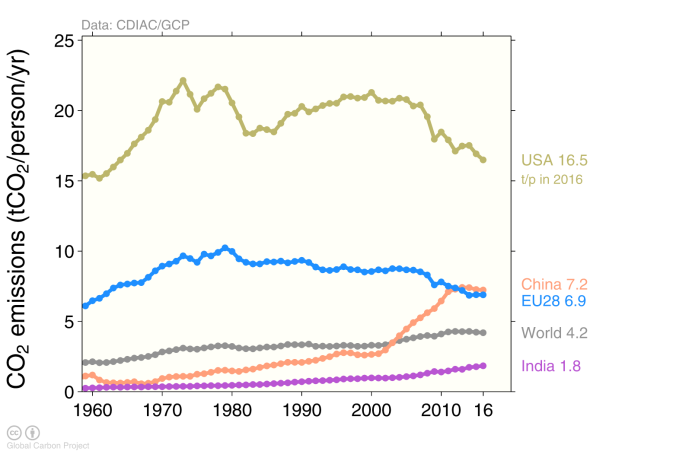
Two more new slides from the Global Carbon Project show what we stand to gain from Paris Agreement unanimity.  The first shows the current per capita production of carbon dioxide.

s12_Top_FF_Emitters_percapita

As has been true for many years US per capita usage sits way above everyone else, more than twice both Europe and China.  That is a direct expression of our carbon-powered standard of living.

The second slide shows who is going to have to make changes to protect that US standard of living from the effects of climate change.

s11_Projections

This shows that the major growth in carbon dioxide production is not from the biggest economies (note that even China has stabilized), it’s from the have-nots trying to achieve some fraction of our standard of living.   We are asking them to ignore not only our past exploitation of fossil fuel resources but even our current high per capita use and to delay their own immediate hopes for a better life in order to make the world a safer place for everyone.  So much for the question of who benefits from the Paris Agreement process!

That introduces the next topic—public attitudes to climate change.  There were enough strange weather events in the past year to give people pause, so we’re getting close to—but still not over—the hump.  The latest poll numbers have both good news and bad.  First the good news:

Overall, 45 percent of those surveyed said global warming would pose a serious threat in their lifetimes, the highest overall percentage recorded since Gallup first asked the question in 1997. Despite partisan divisions, majorities of Americans as a whole continue to believe by wide margins that most scientists think global warming is taking place, that it is caused by human activities and that its effects have begun.

Then the bad—the improvement is only partisan:

Gallup asked whether people agreed that most scientists believe global warming is occurring, and 42 percent of Republicans said yes, down from 53 percent a year earlier and back to a level last seen in 2014. Just 35 percent of Republicans said that they believe global warming is caused by human activities, down from 40 percent.

This seems like another proof of a much-discussed feature of human nature—when people are confronted with proof that their beliefs are wrong, they double down on defending those beliefs.   Unfortunately those are the people running the show.

How can that turn around?  A recent Steven Pinker book made an interesting point.  Much of the rhetoric around climate change focuses on conservation and a new world view of collective responsibility.  But conservation actually isn’t the main point—since we’re not repealing the industrial revolution, the main point has to be new energy sources.  We’re not creating a new world where no one drives Chevy Suburbans anymore, we’re just changing the power source.  Conservation, however important, is about buying time until we can get there.  Perhaps that’s one way to get climate change out of the culture wars (as it should be).

In any case the focus has to be on the reality of climate change, and everything else is tactics. With tactics it’s easier to be bipartisan.   One indication is that Congress, over Trump’s objection, passed a bill continuing tax breaks for solar, nuclear, geothermal, and carbon-capture projects.  This effort united left-wing and right-wing approaches to climate change largely under the radar.  However, it must be recognized that even with such efforts the US is now lagging far behind in support for the technology of climate change.

Carbon capture (separating out CO2 and storing it underground or elsewhere) deserves some special mention, because it has become a bigger topic in the past year.  On one hand this is an idea that has been around for decades without going very far, and what’s more the coal industry supports it as a lifeline.  On the other hand the technology seems to be improving, the Obama administration supported it as a transitional technology, and even the IPCC climate studies assume some form of it will be used.  It currently exists as an expensive add-on for power plants, and some still-speculative variants have been proposed to pull carbon dioxide straight out of the air.  Both the power plant and out-of-the-air applications have a common need for CO2 storage technology, of which there are many variants.

The biggest issue with carbon capture is that it can be (and is being) used to delay doing anything about climate change—why worry about carbon getting into the atmosphere if we’ll pull it all out later.  The problem is that the technology still has such big questions about cost and scaling, that “later” could be very late or never (and some effects, such as melting glaciers, are irreversible).  Even the cheapest estimates say it will cost continuing trillions.  What you have to say is that the technology investment is necessary and at worst it at least gets the climate dialog past the hoax stage.  And if we could just get the Kochs interested in that business (which is largely oil industry technology), it would settle the Republican perception of climate change once and for all!

Returning to reality, we have to conclude the past year seems like a pause for progress.  After Trump took the US out of the Paris Agreement, many wanted to talk about all that could be done to maintain momentum nonetheless.  The chart at the beginning shows the limits of that point of view.  There are other indicators as well:

– The auto industry’s step back from future fuel efficiency standards

Exxon’s declaration that climate change is no risk to their profits

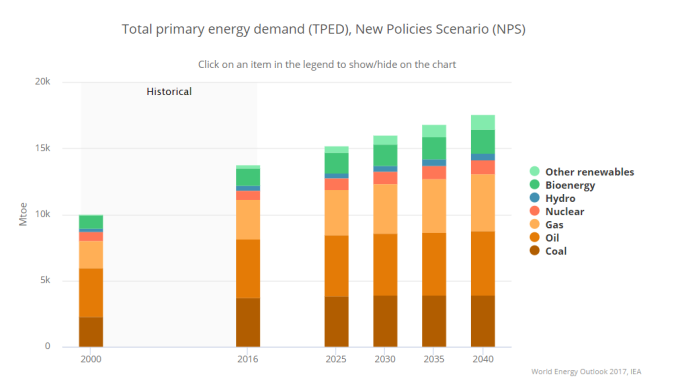
– Business as usual in the International Energy Agency’s World Energy Outlook:

iea_weo

– Even the new preoccupation with carbon capture has to be viewed as a vote of no-confidence in the progress of conservation.   If prevention isn’t going to happen, then repair is all we’ve got.

What’s more than there has even been a preoccupation with a more drastic step, so-called geo-engineering.  This means injecting chemicals or particles into the atmosphere so as to dim the sun and cool the earth despite the increasing CO2 concentration.  There are many risks:  continuing ocean acidification, reduced photosynthesis and food supply, and weaponization of the technology.  Since CO2 would continue to accumulate, any loss of protection would have disastrous effects.  These are desperate measures.

As to what we should be doing, the picture is not too different from last year, but we can be perhaps more explicit.

  1. Because burning carbon is now recognized to have definite costs (i.e. whatever is necessary to counteract the CO2 increase), we need some kind of carbon tax so that the free market economy can react correctly. Since that cost is not currently captured, our economy is incurring a significant distortion that needs to be fixed.
  2. We need to get back into the Paris Agreement process to return focus to the goal. To repeat the obvious, the Paris process was always intended to be iterative—with countries readjusting their goals to eventually reach the target. We’re only at step one, so we had better help the world get back on-track.
  3. We have to recognize that at this stage we’re in no position to judge winners and losers among contributing technologies. So the solution has to be all of the above: nuclear, solar, wind, geothermal, batteries, carbon capture, even substituting gas for coal as a temporary measure.  The IPCC gave us what they called a carbon dioxide budget—the amount of CO2 we can add and still stay below a global temperature rise of 2 ⁰ C.  In 2014 (the year of the report) it was 800 giga-tons.  It is now below 700.
  4. People have to recognize that despite confusing news reports, we are all in this together. Some people will be hit by sea-level rise, some by drought, some by sheer temperature, some by storms, some by an effect we haven’t seen yet. Some may even be a little later.  But ultimately there’s nowhere to hide, and even “later” comes fast.
  5. There is no excuse for not funding research in all the contributing technologies and also research to understand the climate effects we are going to live with for however many years it takes to get past fossil fuels.
  6. Ideally all elements of society should be involved in planning such major changes. The carbon tax will help make that happen, but it’s not the whole story. We can’t keep fighting about this.

This administration likes to talk about itself as bringing business practices to government.   The evidence for climate change is such that any reasonable business would be doing its best to quantify the risk, so as to take appropriate action.   Businesses that choose to ignore disruptive new technologies or entrants are the ones that disappear—along with their disparaging comments on how the new stuff will never amount to anything.

Unless we choose to wake up—that’s us.  We’ll act now or pay far more dearly later.


Private Sector Fantasies

Adam_Smith_The_Muir_portrait1

This note is about a subject with perhaps more deliberately-sown confusion than any other:  the role of government in a market economy.

We start with the saint of free markets Adam Smith.   Adam Smith had no delusions that the free market system would somehow manage itself.   He saw three roles for government in a market economy:  defense, justice, and education.  Further he understood that the private sector and the free market were not the same thing—one of the roles of justice was to prevent the private sector from creating monopolies and thus perverting the free market.  In other words even as an ideal, the free market was neither self -policing (it needed to be protected against its own tendency to create abuses) nor self-sustaining (it needed government to create the population of educated workers).

With that as introduction, we want to talk more about the relations of business and government.  There are three sections.  The first two expand on policing and sustaining of the free market, as just discussed.  The third talks about scope—what objectives for society are in or out of scope for the free market. The Trump administration has positioned itself as the defender of free markets against government.  Instead they are defenders of something rather different, with real dangers as a result.


Policing the free market

Monopolies are bad.  they raise prices and stifle progress.  They are also by many measures growing in power.  But they are not the only area where the free market needs to be protected from itself.   For example, lack of business transparency perverts the capital markets, so the SEC plays a crucial role.

A more complicated but equally crucial role is regulation of the boom and bust cycles (with bank failures and human misery) that used to be endemic to capitalism.  Government has two responsibilities for controlling those cycles:

  1. It needs to act “countercyclically”. Despite the jargon term, this is so basic as to be biblical—save in good times to prepare for bad. In a recession the government is the only party able to stop the spiral of low sales -> layoffs -> even lower sales-> even more layoffs.  It does that by injecting money into the economy to stabilize sales.  But in a recession, tax revenues are down, and the money has to come from somewhere–preferably savings but if necessary debt.  In 2008 George W. Bush had just fought an off-budget 3 trillion-dollar war, so the cupboard was bare.  Republicans screamed about increasing the deficit, even proposing constitutional amendments for balanced budgets.  Their line “real people tighten their belts when they have to” was a deliberate misrepresentation.  Real people save for bad times; otherwise they have to borrow to put food on the table.
  2. Government needs to recognize and control the excesses that can creep in to cause havoc in the business cycle. While many factors contributed to the 2008 crash, the most spectacularly deadly was the perversion of the banking system caused by mortgage-backed securities. In the giddiness of deregulation no one was looking.  The aftermath produced the Dodd-Frank legislation as an antidote.

Finally, as a last example, there are categories of risk where you can’t count on the business decision-making process to do the job.  Low-probability/high costs events (plane crashes, oil rig blow-outs) should in theory be prevented by rational decision-making, but in practice it’s hard to refrain from increasing profits by ignoring something that “really isn’t going to happen”.  So there is a role for government there too—protecting both the public and the businesses.

Current status:

– The administration’s anti-trust position remains to be seen.  Trump campaigned against mergers, but appointed an industry-representing trust lawyer to head the anti-trust division.

– There seems to be no recognition of business cycle issues.  Trump’s tax plan runs a big deficit to stimulate an economy close to full employment.  This runs the risk of repeating 2008 with an even worse debt position to fight it.  He also wants to repeal Dodd-Frank and says he won’t enforce it now.

– The general rule is that any regulation opposed by any business is bad.

=>  There is no serious recognition that the financial system needs policing.  Trump runs the show based on what he has wanted to see for his own businesses.  This is a blind dash into another 2008 or worse.


Sustaining the free market

Adam Smith pointed out the need for government to supply a suitably-trained workforce.   In the eighteenth century that meant simply literacy.   The definition of suitably-trained has changed over time.  By 1940 a then astounding 50% of American students finished high school.  In that era no other country approached that level of broad education support.   Then the GI bill made college possible for veterans, and public colleges expanded widely throughout the 1960’s and 70’s.  This coincided with unquestioned American economic dominance.  An educated workforce (at all levels) remains a critical national requirement.

You can take that one step farther.  Equality of opportunity is usually discussed in terms of social effects, but there is a corresponding benefit to the free market.   Business and the market benefit when all persons are able to achieve up to their capabilities.  The United States used to lead the world in upward mobility, but with rising inequality it now ranks behind most developed countries.

There is one more government role that fits here as well, namely research.  Government support of research produces people to be hired by cutting-edge businesses, and also supports the creation of new businesses to exploit the progress of science and technology.

Current status:

– For college, the student debt crisis speaks for itself.  A whole generation of students can’t imagine when they will be able to get out of debt.  This is compounded by De Vos’ support of shady lenders and weakening of controls on fraudulent educational institutions.

– For K- 12 education, states have retreated in funding, and De Vos is proposing a voucher system that will abandon the broader population.  Vouchers will be fixed in dollar value, to be augmented by surcharges at the now-privatized schools.   If you want a good education you pay for it; if you can’t, there is no guarantee of what you get.  This is institutionalized separate and unequal.

– Trump’s budget essentially abandons the government’s role in research, and his appointees have attempted to minimize the role of science.

=> There is surprisingly little recognition that government has an important role here at all–except to privatize it!


Scope of the free market

Adam Smith felt that the private sector could not be trusted even to defend free markets.  So it is not surprising that there are other aspects of society that need defending as well.

We give a few examples:

– Well-being of workers.   Smith describes effects of supply and demand on workers, and he even points out that adequately-paid workers may be more productive, but he makes no claim of utopia from the free market.   In fact in Smith’s description, workers’ welfare depends on a market for labor in which individuals have little bargaining power.

– Resources and the environment

Enterprises will use the environment for their own benefit, unless there are rules to the contrary.

– Infrastructure

Public resources such as roads, bridge, airports, internet, etc. should be built and maintained as needed by everyone.

Current status:

– Trump has pushed to limit OSHA workrules, opposes unions, and has no plans to raise the minimum wage.

– The EPA is being severely cut and redirected to helping businesses.

– The stated approach to infrastructure is via private investment, which will go where the money is.

=> There is no recognition that areas such as these can be out of scope for the private sector.  Instead there is a blind belief that growth solves everything.


From this summary it should be clear how far we are from free market economics.

The current national policy is that the private sector just needs to be encouraged to go do its thing.   We don’t have to care about policing its risk, we can let it take care of education and research, and nothing other than its success is needed to solve every other problem in society.  Just make sure it’s flush with cash and let it go.

That was the history of the nineteenth century, and for vast part of the population it was no picnic.  And it is worth remembering that 1929 really did happen.

Even thinking of the more recent past there’s an eerie familiarity about our situation.  We have a supremely confident lunatic fringe with the power to run amok.  The last lunatic fringe to take control of our government (remember the neocons?) gave us the Iraq war—which destabilized the Middle East and bankrupted the country—and the crash of 2008.

This time it could well be worse.

Our President of China

There has been a lot of talk recently about China’s growing presence on the world stage and how the US as predominant power should react to it.  With that in mind we go to China, just outside the Forbidden City, where the Chinese are planning their strategy…

Xi Jinping: There are many factors we need to consider, economic and political.  Today we are an economic servant to the West, building their iPhones and other toys.  We need to learn to take their place.

Planner: The Americans have many advantages.  They have excellent universities and their pick of talent from all over the world.  They have an interlocking system of university, government, and private research labs.  It’s hard enough to catch up, much less to lead.

Xi: We have to go step by step.  I’ve heard that many of their new companies are led by foreigners.  We can cut into that and certainly lure our own people home–a little xenophobia would help.   As for education and research, we know that government money is critical both in government labs and in the universities.  We have to find a way to slow down that money and then duplicate their system here.

Planner: Sounds like a lot of work, but we’ll start on it.  They’ve been working for decades to get where they are.

Xi: We need to get more specific now.  What are the lead technologies we can use to establish our dominance?

Planner: It’s hard to answer that question.  Software is always there; the particular new twist seems to be Artificial Intelligence.  That ties in with robotics.  Biotech.  Probably the biggest thing is energy–climate change means the whole world will have to convert.

Xi: The Americans are big players in all of those, but progress is very international.  If we can get them to isolate their people we can win.  Energy is too big–we need to limit their role.

Planner: They were a driving force behind the Paris Climate Agreement.  Maybe we can sabotage that.

Xi: Great.  Good first step!

Xi: The next subject is politics.  The Americans have been leading the so-called ‘free world’ forever.  Everybody works with them; no country wants to be left out.  All major international agreements of any kind go through them.  They’ve done very well that way–they are the richest, most dominant country in the world.  Our presence is tiny compared to theirs–how can we match their influence?

Planner: The only way I can think of is to get them just to quit. Get out of our way so we can take over.

Xi: I don’t understand.

Planner: It seems that over the years the Americans have come to believe their own propaganda–that all of their international agreements and institutions were setup out of pure beneficence!  Nothing to do with remaining the richest, most dominant country in the world.  They even think that about foreign aid.

Xi: You’ve got to be kidding.  No one else thinks that.

Planner: All we’ve got to do is push them over the brink:  No international institutions, no foreign aid–all unaffordable charity and a foreign plot.

Xi: You really think you can pull that off??

Planner: Well, just a minute.  We need some kind of slogan.  Something catchy…

Planner: I’ve got it!!  AMERICA FIRST.

Xi: Welcome to the Chinese Century.