Problems with the Constitution

There has always been plenty of talk about what is right and wrong with the Constitution of the United States. However much of that was on the back burner until recently. Now it is different. First we saw government collapsed into non-functional partisan chaos, and then Trump demonstrated that what we thought was a government of laws was actually a government of unenforceable traditions.

So what follows is a list of issues. I won’t say it is complete or well-organized, but the problems are all serious.

  • Open to dictatorial takeover

The Supreme Court was a terrible mistake.  There are no limits to its power, and it doesn’t even have to justify its decisions.  The Justices are chosen undemocratically and serve for life.  We’ve now seen they can even declare a President above the law, so that the entire Constitution is out the window.  It is a dictatorship waiting to happen.

  • Open to corruption (only works because of tradition, not law)

The entire electoral apparatus belongs to the states, where it is operated by partisan officials.  It is common practice to make voting difficult in opposition districts, but that is just the beginning. The whole voting apparatus is controlled by people who gain from controlling results.  It works if people are committed to democracy, but not otherwise.  Other democratic countries have established separate, nominally non-partisan organizations to administer voting.

  • Unrepresentative

The Senate is phenomenally unrepresentative.  Two senators per state means residents of small states have astonishingly outsize power.  At the very least, very large states such as California need additional Senators.  The problems of the Senate also affect the Electoral College, so that not only legislation but also Presidential elections are affected.

Then there is the whole question of gerrymandering. Computers have made this both easy and effective. The US Congress is currently so gerrymandered that very few districts have real elections. That severely limits democracy.

  • Doesn’t work for states

These is an urgent need for clarify the division of responsibility between the states and the federal government.  As an example, the federal government has traditionally backed up the states for emergencies of all kinds.  That is necessary because it has greater resources as well as the ability to run deficits if necessary (which many states can’t).  With both Covid and the operation of FEMA Trump decided he was either opposed or lukewarm about it, and that was that.  The Constitution has to be explicit about responsibilities.

  • Doesn’t work for the federal government

The federal government simply doesn’t work as intended.  We’ve reached an era of non-cooperation between parties, so government only works when a single party controls everything.  Between the “Hastert rule” in the House and the filibuster in the Senate, it’s easy to block everything otherwise.  That means the so-called separation of powers in government is largely non-functional  Furthermore the primary system for the nomination of candidates basically disenfranchises the political center, so that parties are by definition extreme.  That means government is either functionally blocked or unrepresentatively extreme.

  • There is no protection for governmental expertise

A functioning national government needs expertise upon which to base its conclusions.  For that reason Congress created a number of bodies intentionally buffered from Presidential politics.  More recently the Supreme Court has decided that any body working in the executive acts at the discretion of the President.  It is now impossible for anyone with necessary expertise to make a career in the federal government.

  • Unclear dividing lines between branches of government

The Trump administration is legislating by executive order, and the Supreme Court has decided that is okay.

  • The unspecified role of parties can undercut everything else

Everything about our two-party system is outside the Constitution.  So that, as mentioned earlier, we have a primary system that disenfranchises the political center, and there is nothing in the Constitution that has any bearing on it.  The Constitution needs at the least to say how elections work.  Anything not specified is vulnerable to corruption and takeover. Non-partisan primaries with rank choice voting is a possible step in that direction.

My Letter to the Democrats After the Election

For what it’s worth, I think the single most important thing that needs to happen in the Democratic Party is to fire everyone associated with the disastrously-mismanaged Harris campaign.  For now all I see are excuses, including in a much-discussed podcast.  If the Democrats can’t come to terms with what they did wrong, it’s hard to imagine them ever doing anything right. The campaign validated the charge that Democrats are arrogant elitists with no respect for the people they claim to represent. In so doing they didn’t just lose the election, they discredited everything they stand for.

If Biden had run, he would have run on his record.  While Biden’s favorability rating was low, the Biden economy was the envy of the Western world, inflation was lowest here, and the country had taken important steps for climate and infrastructure.  Biden was replaced not because he was unsuccessful but because he was no longer up to the demands of campaigning.  We had expected him to lead the fight on his record in the first debate, and were shocked when he wasn’t up to it.  Harris was put in place to address that problem.

Harris had a tough job, to put together her own campaign with only a few months before the election.  So she had to rely on party regulars to make that happen.  Poor Harris.  Poor all of us.

Harris’ genius handlers threw all of that out for a new approach.  Because of the low Biden numbers, we wouldn’t defend any of Biden’s accomplishments.  Instead Harris would become a brand new candidate, not linked to Biden’s problems, and exciting for the future.

There were two obvious problems with that:

–        It was an outright lie.  If you want to be the adult in the room, you can start by not lying.

–        It didn’t address the reasons for Biden’s low rating—in particular the pain of inflation with higher prices continuing to the present day.  In answer to the pressing question—who is to blame for my pain?—the answer was Biden, but he’s not here, so let’s just move on.  Who were we kidding?  That was acceptable to Democrats, because we believed in Biden’s economy, but for anyone else it was an infuriating punting of responsibility.

The geniuses presumably decided they were so much smarter than the voters that no one would notice.  But in fact it was the geniuses who were morons, and the voters knew exactly what was going on.  The core of the Harris campaign was an insulting and infuriating lie.

I went door-to-door with the campaign, and ran into this problem constantly.  I and other people tried to point this out to the campaign, but we were informed by campaign organizers that there were no channels up to the campaign from the field.   No one cared about all those people talking to voters.

The geniuses had a few other equally brilliant contributions:

–        Since they weren’t defending Biden’s record on the economy, they didn’t want to talk about inflation at all.  In particular no one was making the point (that you read everywhere now that the election is over!) that all three of Trump’s major measures (tariffs, tax cuts, and deportations) are wildly inflationary.  So virtually none of Trump voters thought there was any risk to their vote.

–        They repeated Hillary Clinton’s mistake of counting on big Republican defections, to the point that they went out of the way to tone down anything that might offend Republicans.  One terrible mistake was to moderate Walz’s behavior in the Vice Presidential debate—where the Harris campaign lost momentum that it never recovered.  The debate served no purpose other than to “sanewash” truly hateful Vance. Further no one ever mentioned George Bush’s disastrous 2008 crash—which is certainly relevant for Trump’s proposed policies.

This election ultimately came down to a contest of dishonesty and arrogance on both sides.  We need to recognize that the Democrats were not better than Trump in that respect.  Who knows if an honest campaign would have won, but in our eagerness for dishonesty we lost big with the people most hurt by inflation, as shown by this exit poll:

I’m not claiming there were no other issues–after all Netanyahu and Trump made sure we had a mess in the Middle East with even an October surprise in Lebanon.  But mistakes need to be acknowledged.  After this disaster there needs to be an accounting for consultants and anyone in the campaign organization making $500K or more. If we don’t fire them all we deserve what we get.

This election reminds me of experiences I’ve had in business.  A bunch of people in a room are working on a serious problem, and someone (usually in sales) gets up and announces “we need to think outside the box.”  What followed invariably was something impossibly unethical, some way of cheating customers where they couldn’t figure out what happened until too late.  Here the problem is inflation.  Let’s think outside the box—we’ll put all that awful stuff on Biden and walk away scott free!

The Only Thing New is That They’re Getting Away with It

I need to return to Adam Smith’s quote from last time.  It’s so accurate it’s incredible.  First the quote:

“The proposal of any new law or regulation of commerce which comes from this order [merchants and manufacturers], ought always to be listened to with great precaution, and ought never to be adopted till after having been long and carefully examined, not only with the most scrupulous, but with the most suspicious attention. It comes from an order of men, whose interest is never exactly the same with that of the public, who have generally an interest to deceive and even to oppress the public, and who accordingly have, upon many occasions, both deceived and oppressed it.”  (Wealth of Nations, Book 1, Chapter 3)

All by itself this stands as rebuttal to the Republican Party’s standard argument: “We’re businessmen, so we’re good for the economy.” It seems businessmen are not so benevolent. Let’s look at the record—Adam Smith could hardly have been more to the point.

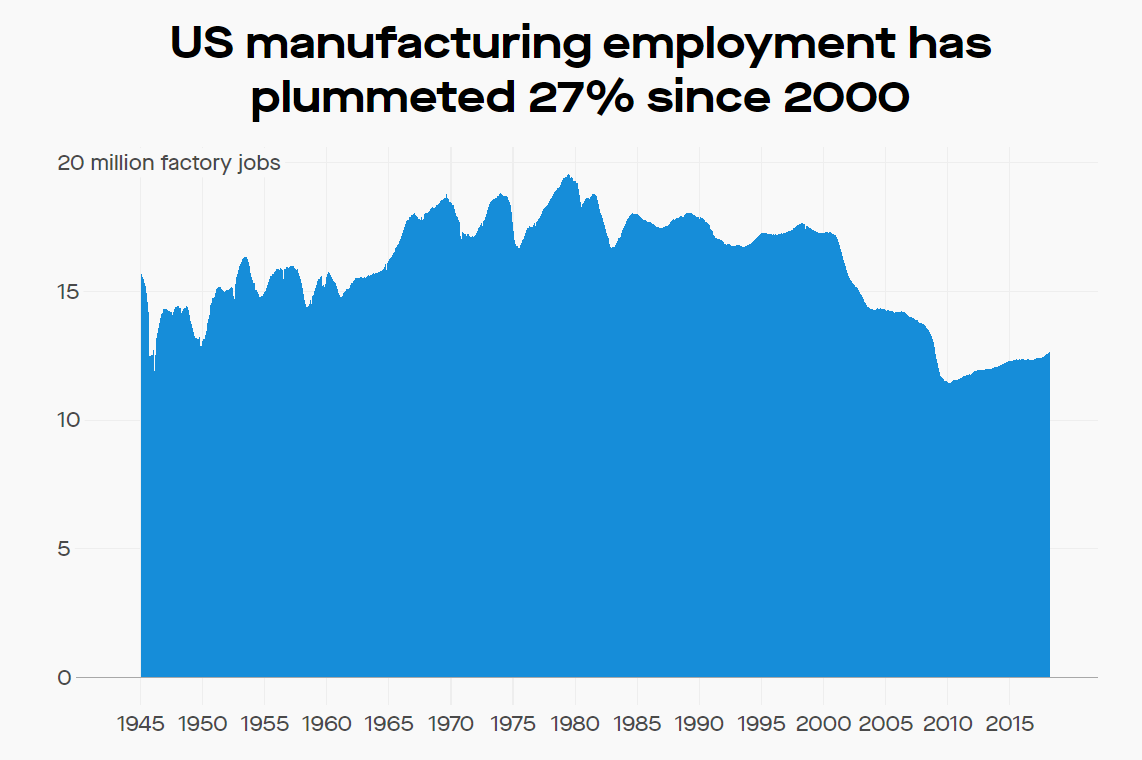
I’ll start with Obama’s first term.  George W. Bush left a mess so bad that it is only partially acknowledged.  The stock market crashed and the economy was shutting down (basically from what amounted to misguided deregulation of the overall banking system through mortgage-backed securities).  But that wasn’t the whole story.  Hidden behind the smokescreen of “neoliberalism” was the fact that essentially all of the job loss to China occurred either during Bush’s administration or with their crash. Just look:

That’s no accident. The Bush people refused to resist China’s WTO-prohibited trade practices (e.g. currency manipulation), because they were actively promoting off-shoring—since that’s what business wanted (e.g. about 70-80% of Walmart suppliers were in China).  In this case it’s tempting to say “deceived and oppressed” was coupled with pure incompetence, but that actually misrepresents a situation that Adam Smith understood perfectly.  Both the deregulation and the off-shoring were cases of business getting what it wanted without the necessary “suspicious attention”.

Obama’s job was to get us out of that mess, and he was well-underway when Republican decided that he might succeed.  That could not be allowed, since there was an election coming up.  So with the fabricated excuse of the “balanced budget amendment” rhetoric they essentially shut down government including all stimulus to the economy.  That meant jobs and income for many people.  They also blocked any aid to the millions of people who lost jobs from Bush’s off-shoring.  “Deceived and oppressed” is right on.

Now we get to Trump.  The “balanced budget amendment” rhetoric disappears instantly, and was replaced by a tax cut funded by a 2 trillion dollar deficit.  That was going to cure the last part of the recovery they had sabotaged.  However the economy was actually in pretty good shape, and as we noted last time the only stimulus that Obama ever got past the Republicans (in his first term) was on the order of $500 billion.  This needs to be emphasized.  We read articles about governments in Africa where department heads steal millions by handling their budgets as personal slush funds.  We in the US don’t do things like that.  We’re much more civilized.  Using the “balanced budget” ploy the Republican Party took 1.5 trillion dollars of benefits for its owners quite legally from the American people. If you want stumulus you’ve got to pay us first. “Deceived” is the very least you could say.

That money went straight to Wall Street.  It inflated corporate profits, so stocks went up.  But the companies didn’t spend that money on employees or the business, they used it for stock buybacks—a second kick in the pants for the market.  For the people in Adam Smith’s quote all you can say is—what a wonderful world this is!   

And they’re ready to do it again.  They’ve made up the fiction that inflation is all due to spending money for the benefit of the population.  Can’t do that.  Bad idea. Have to give it to us, and it will be Nirvana.

The next deficit is estimated at $4T.  Republicans have signed-on salivating—Will wonders never cease? (And that’s before the sweetheart deals with individual billionaires!) But that’s not the end of it. Trump’s new set of proposals (tariffs, deportations, tax cuts) is wildy inflationary, potential as damaging as what trashed the economy under George W. Bush—again what you get without “suspicious attention”. (It may be a side issue, but we even have a potential repeat of Bush’s banking debacle with all the cryptocurrency money behind Trump.) All of us have to hope it doesn’t happen.

Adam Smith did his job.  Can’t say we weren’t warned.

A Real Comparison of Economic Policies

Since both Biden and Trump have records as President, the press is full of articles like this one attempting to compare their economic policies and evaluate the results.  Now that Harris has replaced Biden and announced a few measures, she’s in the game too.  Unfortunately most such articles completely miss the mark.

The reason is that you cannot judge anyone’s economic policy except in the context of the problems he or she faced.  And you cannot make any judgment of how good he or she would be as President now without assessing the problems we face today and comparing our needs against the candidates’ demonstrated approaches.

That may sound obvious, but I haven’t seen a single article that tried hard enough to be serious.  Let’s start with Trump.  Obama left the country in pretty good shape, but one has to understand that his whole Presidency was spent trying to recover from the 2008 crash.  In that he had done pretty well (compared to other western countries), but he had one serious problem:  particularly in his second term the Republican Party decided to sabotage the recovery.  Looking ahead to the 2016 election they essentially shut down government—promoting a “balanced budget amendment” as a reason to block all stimulus spending.  That left some work to be done with unemployment, for example. So that’s what Trump inherited—a good economy that had been throttled short of complete recovery.

As soon as Trump took office the “balanced budget amendment” discussion vanished, and Trump stimulated the economy with a 2 trillion dollar budget deficit.  That completed Obama’s recovery at enormous cost to the country. For comparison, the largest stimulus Obama was able to get through Congress (in his first term) was about $500 M.  The vast part of Trump’s $2 T did not go into jobs or corporate investment; it went into stock buybacks.  Trump bought maybe $500 M of progress with a $1.5T contribution to inequality in the US.  Further, despite all the talk of reviving manufacturing, US manufacturing (as a sector) was in recession before Covid hit.  Once Covid happened, Trump simply retreated from running the country.

Biden inherited a mess.  First we had to recover from Covid, so there was much time and effort spent on getting the vaccine to everyone.  In this the biggest single problem was sabotage by misinformation from Republicans in general and Trump in particular.  During Covid there was a series of bipartisan deficit-funded bills to keep the country running with progressively less Republican support.  Once recovery started, however, there were some big surprises.  In key areas supply and demand were badly mismatched—there was a massive shortfall in computer chips needed for cars and other big-ticket products, new patterns of demand appeared for housing reflecting living arrangements during the pandemic, and the shipping industry took many months to be fully back in business—causing shortages of all kinds of imported products.  There were also shorter-term spot shortages, which led to longer-term price increases from major suppliers happy to take the chance.

Biden’s last (Democrat-only) stimulus has been blamed for all inflation that followed Covid.  Many articles have been written about his terrible mistake—the money delivered to US families didn’t even cover the inflation of the following year!  That conclusion ranks with the “balanced budget amendment” for self-serving dishonesty.  Given the magnitude of those other inflationary pressures, there is no question that the stimulus payments covered considerably more than any inflationary effects of the stimulus itself (and inflation in the US was lower than anywhere else in the Western world—stimulus or not).  Biden was correct in deciding that there was a fair chance that the post-Covid recovery would not be painless, and that stimulus money was needed to help people. In so doing he violated the mantra that the Republican Party is most desperate to defend: “you can’t spend money to help people”.  Help only comes top-down, from money spent on us.  The best commentary on this subject comes from Adam Smith himself:

“The proposal of any new law or regulation of commerce which comes from this order [merchants and manufacturers], ought always to be listened to with great precaution, and ought never to be adopted till after having been long and carefully examined, not only with the most scrupulous, but with the most suspicious attention. It comes from an order of men, whose interest is never exactly the same with that of the public, who have generally an interest to deceive and even to oppress the public, and who accordingly have, upon many occasions, both deceived and oppressed it.”  (Wealth of Nations, Book 1, Chapter 3)

Before we leave this subject of inflation there is one more question that needs to be answered:  why, despite the huge budget deficit, was there no inflation under Trump?  The main part of the answer has already been noted—the country was not yet completely out of the 2008 crash.   There was no wage pressure, and people were not ready to spend.  Furthermore we had actual downward pressure on prices from those evil Chinese—all that cheap stuff in Walmart was keeping prices low.  By Trump’s third year there were signs of a rise in wages, but then Covid hit and that was the end of that.  As far as inflation was concerned, Trump was “saved by the bell”.  As we noted at the beginning, you cannot say anything sensible about a President’s economic policy without putting it in the context of the time.  Trump did not prove that he knew how to run up a huge deficit without inflation any more than he proved he could fight Covid with bleach.

Biden got the country going again and finally started rebuilding the country’s decaying infrastructure and  undertaking changes that will be required (whether we like it or not) for climate change.  He recognized the importance of education, although he was blocked from doing as much as is needed to provide opportunities for all (and the costs of his programs were hugely exaggerated).  Manufacturing is now in vastly better shape than under Trump.  He has also started with the task of finally doing something about decades of consolidations and monopolies during our period of non-enforcement of anti-trust laws.  It needs to be emphasized that anti-trust activities are NOT examples of overreach of government against the free market.  Even Adam Smith (again) emphasized the need to combat monopolies, and not just because they make things more expensive—they block innovative new businesses, make the country less competitive, and even weaken a nation’s military strength.

At this point it’s time to stop describing the historical context and consider where to go from here.  The first conclusion is probably the most important:  there is nothing in Trump’s historical performance that shows competence in managing the economy.  He gave himself (and his ilk) a big tax cut, that helped an artificially-stunted recovery (at very high cost), and avoided inflation only because of the incomplete recovery and because Covid bailed him out. That history is no recommendation.  We cannot let ourselves be tricked by the blindness of all of those economic analyses without context:  “Trump’s tax cuts led to full employment last time, so maybe they’ll be good this time too.”  ARGH!!

So the question of Trump’s economic competence comes down to his economic plans.  While Trump has been vague about many things, there are three items about which he has been absolutely clear:

  • A complete tariff wall around the US protecting all US industry, 10% overall and 60% on imports from China.
  • Deporting all undocumented immigrants, amounting to at least 11 million people
  • A huge tax cut modeled on his last one, currently estimated to cost $4 T.

The attitude of economists on this subject was summarized in a recent NY Times article:  not just bad but catastrophic.  We have to get used to that idea.  The fact that Trump got through his first term is not proof that he knows what he’s doing.  The plan can really be completely crazy.  Remember Trump’s six bankruptcies. Also, we have to get used to the idea that economic stability is not guaranteed.  The Brits voted for Brexit, and their standard of living took an immediate hit from which it may never recover.  This plan is actually worse.

We’ll go briefly through the items one-by-one

The Tariff Wall

Tariffs (including Trump’s tariffs from last time) are effectively a tax paid by the buyer in higher prices.  A universal tariff like this one is therefore massively inflationary and not just for imported goods.  Historically (and in Trump’s last term) domestic producers also have taken the chance to raise prices. Universal tariffs also invite retaliation and diminished US clout worldwide.  Given the level of consolidation in the US economy, the tariffs will significantly reduce competition and dynamism of business domestically, as many markets will be monopoly or cartel controlled.  And by isolating the US from developments elsewhere, it guarantees that the US will be left behind for any developments that don’t originate here, making us a second-class power.

Deporting 11 million people

These people are working today.  We’re eliminating the lowest tier of the workforce, with no obvious new population to take over.   Both the loss and the disruption are massively inflationary.  Many of those jobs may never be filled.  The Brexit people found that they had to import a whole new bunch of foreigners to replace the ones they were so happy to get rid of.

The $4T tax cut

The huge deficit is again massively inflationary.  The only reason that didn’t happen last time is that the economy was still short of recovery—which is not the case now.  Further the huge deficit would be on top of all other spending issues we will have to face, including for climate change and defense.  Businesses didn’t need it last time–they spent it on stock buybacks, not on investment in the business or on the employees. Last time’s claim that it would pay for itself proved completely untrue.

We are talking about a real hit to everyone’s well-being with no short-term path to recovery.  And that’s before even thinking about the threats to democracy.

Finally we need to end this with a look  at the other side.  If that’s what we’re getting from Trump what would we be getting from Harris?  After all we’re told she’s a wild-eyed radical.  Her running mate was so far left that he spent government money giving meals to school kids!

There’s nothing in the Democrats plans that talks about anything close to a 4 trillion dollar deficit.   There’s nothing in the Democrats plans that talks about engineering of people’s lives the way Vance is so eager to do.  Isn’t freedom from that sort of thing what made us different from the hated communists?

What is different is positive.   There is a role for government in making people’s lives better.  That means education, jobs, a future.  Harris’s initial proposal talks about aid for families with children and combating the kind of post-Covid price-fixing mentioned earlier. There is also a role for government in helping the private sector with things it doesn’t do well—like anti-trust, like educating the population for the jobs that need to be filled, like preventing business from croaking on climate change because doing something reduces immediate profits.  No one is talking about hurting business competitiveness, but it is the task of government to act in the interest of everyone.

This is an election where the country needs to reject what is radical egomania and return to what are in fact our long-time values.

Message for Business

We’ve spoken here before about how the evangelical community needs to understand that Trump is not their guy.

However the issue is more general.  It’s too easy to dismiss evangelicals as disconnected from reality and perhaps swayed by self-interested leaders. In fact all of us have spent lifetimes insulated from the reality of authoritarian government.  The US elections and democratic system are certainly not perfect, but we the people still do have power.  It’s hard to recognize that once that goes, the world is different.

Even the well-heeled and well-educated business community has that problem.  Much was made of Jamie Dimon’s comment at Davos that Europeans in particular should stop worrying about Trump, because ultimately nothing serious was going to happen.  A recent Edsall piece pointed out that many other business leaders believe the same thing.  Like the Evangelical’s focus on abortion, the business focus on the Trump tax cuts has convinced business people that he’s their guy.

As Edsall’s article points out, the history of authoritarian takeovers tells another story.  Once government is unaccountable, what follows is massive corruption and shakedowns of all players.  That’s in addition to the whims and the uncorrectable mistakes of the leader.  Businesses–and in particular their leaders–have much to lose, as their counterparts elsewhere have found out to their shock and surprise.

For now Trump’s threats–combined with the taxcut carrot–seem to hold sway with much of the business community.   But the Trump people have made no secret of their plan to end democracy in favor of an  Viktor Orban-like regime.  As a threat, there is nothing in Biden’s program that comes close to matching that one.

Message for Evangelical Voters

Everyone seems to have written off the evangelicals as a lost cause. We hear from many directions that they regard Trump as chosen by God to lead the country from infamy to some kind of evangelical paradise. That’s despite a personal history that is anything but Godly.

However personal history is not the issue. The message to the evangelicals has got to be something much more to the point. Despite the rhetoric, the fact is Trump is NOT THEIR GUY. He’s a con man doing what he’s has always done: make money off people who have the misfortune to trust him. He and his hacks are the ones saying he’s chosen by God. He has grabbed hold of an issue that means nothing to him, so that he can pick their pockets and run the country for himself and his ilk.

He has delivered on abortion. No money in that. What is money is tax breaks to big business donors and Trump himself. He did that last time, and he has said he is going to do it again. Already last time the massive tax cuts in good times went mostly to Wall Street and left the country with a record increase in debt. Further custs would be felt in medical care costs, education costs, the environment, and Social Security. There won’t be any “winning for his people”.

He has also said that he is opposed to democracy and is going to rule accordingly. That does NOT mean he is going to run the country for you. It means that he is going to run the country for HIM, and there won’t be a single thing you can do about it. This will not be the idealized American past of peace, friendship, and family values. It will be an unChristian paradise where anything goes for the rich and powerful, with nothing for the well-being of anyone else. Unafordable healthcare, no labor or environmental protections, no future for anyone’s children outside the rich. In all his bankruptcies Trump sucked out money and screwed the contractors and vendors who trusted him.

Biden is not threatening your practice of religion or anything else about how you live. And he regards himself as President responsible for the whole country, including you. You may find that much of what he has proposed is relevant to you. There is also no threat to your continued voice in the running of the country.

Trump is NOT the unGodly warrior for Christ. God is only his foot in the door. After that there’s the lesson repeated over and over in history: enemies of democracy are no one’s friend.

Summarizing the Gaza War

After all the bloodshed and polemics it’s easy to forget what has actually happened with the Gaza war.

Prior to October 7 Israel was in a pretty good situation that seemed likely to get better.  They had relations with several Arab countries and the prize of a relationship with Saudi Arabia seemed to be in the offing. Palestinians weren’t the main topic, but they also had something to gain from leverage in the process.

Hamas was desperate to prevent all that.  Any moves toward peace were the enemy of a purified Islamic state in Palestine.  On October 7 they carried out the most horrifying and offensive attack possible, with killing of children in front of their parents (and then killing the parents) as well as rapes and anything else they could think of.  The objective was to provoke an Israeli reaction that would torpedo the looming progress.

The Israeli government was certainly capable of understanding what was going on.   However instead of the obvious reaction—whatever we do we do we’re not going to let Hamas dictate our future—they did exactly the opposite.  Why was that? (Contrary to the usual rhetoric this was not a fight for Israel’s existence.)

Simply put, Israel’s interest and Netanyahu’s interest were not the same.  Netanyahu’s long-standing support of Hamas (as a counterweight to the Palestinian Authority) and his negligence of reported threats were directly responsible for the success of the Hamas attacks.  And despite his denials, all polls indicated that the Israeli population understood that.  So he had a problem. And the only way out was a great big war.

From that point on, the interests of Hamas and Netanyahu once again coincided.  The more civilians killed the better.  For Hamas it made them heroes defending the Arab world against the inhumanity of the Israelis.  For Netanyahu it proved that only he was tough enough to do what it takes.  (And what’s more, the longer the war the better the chance to bring back his buddy Trump who would support the dictatorial takeover of Israel.)

The interests of Israel however have been lost in the shuffle.  Anti-Semitism everywhere is on the rise, with not just relations with the Arab world but even the existence of Israel now active subjects of dispute.  Further the stated military objective—the elimination of Hamas—is nowhere near accomplished.  Despite the massive destruction and loss of life, it is estimated that Hamas has lost approximately 8,000 of its approximately 30,000-man army.  As the tunnels are mostly intact, there is no plan for how to change that.

But this war was never fought for Israel.  For Netanyahu it’s not clear how much he has burnished his reputation, but any challenge to his power has been pushed out to the indefinite future.  And Hamas is riding high.  So whatever horror the rest of the world may feel, we’ve got to call the war a smashing success for its perpetrators.  May they both rot in Hell.

Republicans and Guns

With all the conversations about guns in this country, it’s worth being clear that the Republican Party is, was, and will ever be the party of guns. 

As we’ve noted before, the big donors to the party don’t care about guns—they care about money.   But guns are important as a means to that end.  Guns elect Republicans, and Republicans deliver tax cuts and relief from regulation.  All of that money has certainly pumped up guns as an identity issue.

However guns are not just one issue among many being promoted.  Guns are central to the whole Republican project.

Going back to Nixon’s “southern strategy” and before, Republicans are all about fear.  They have institutionalized and spread the long-term Southern terror of black insurrection.  There’s a big dangerous black man (or an immigrant) behind every tree, and he’s out to get you and your family.  Blacks control the Democratic Party, so it’s complicit.   Democrats want to take aware your guns and leave you exposed and unprotected.  Joe Biden refuses to help.  You’ve got to take matters into your own hands.  Republicans are the only thing between you and chaos.

As always in this election campaign the big issue is crime.  This isn’t about statistics or really addressing crime in any organized way.  It’s all about that big dangerous black man you have to be ready to shoot.  This isn’t a matter of convincing individual politicians–Republicans can never give up on guns.

The only option is to defeat them.