Democracy is Not Natural

There is a fundamental misunderstanding of democracy that undermines much domestic and foreign policy.  One way to put it is that democracy is seen as a kind of natural way for societies to organize themselves.  What could be more normal than a bunch of people getting together for mutual benefit?  Just get rid of the autocrats, and the people will rule.

Unfortunately it’s the autocrats who are natural, and democratic societies are fragile, rare, and in dire need of careful cultivation.

For starters we can go back to the classical Greek models.   Democracy in Athens was both a sham and a disaster.  The Athenian democracy was created by Pericles as a way of wresting power from aristocrats.  Under its auspices he ruled with enormous personal power, and when he died things went to hell quickly.  The chaos led first to an authoritarian takeover (stopped only by the army) and then to the defeat of Athens by Sparta in the Peloponnesian wars.  Plato, writing later, dismissed democracy as nothing more than a prelude to dictatorship. 

As another example, a whole raft of new democracies were created in eastern Europe in the wake of World War I.  By the end of the 1920’s every single one of them was a dictatorship.  Once you’re in power there’s no reason to give it up.  And without a broad societal commitment to democracy, there’s nothing to prevent that.  Hitler of course was installed by a democratic election, and the conversion to dictatorship followed quickly and easily.

In the US today we’re so accustomed to this idea of democracy as normal, that we’re unprepared for today’s anti-democratic Republican party.  Since we don’t even ask why democracy is good, the question “why should we give up when we’re winning?” has no answer. Republicans today and their Supreme Court are unapologetically all about winning and maintaining power indefinitely. We’re surprised how easy it is to subvert our institutions, but that‘s what happens if society is not prepared to fight.

There are in fact a strong arguments for democracy.  We can look today at what goes on in China and Russian.  With authoritarian leadership you can never correct disastrous mistakes or deal effectively with corruption.  Further, autocrats once installed are beholden to no one. Rule of law goes out the window, so there is no protection from the rich and powerful. As we’ve pointed out here before, the enemies of democracy are no one’s friends. One problem is that people tend to think that the status quo is permanent, since they’ve always lived it.  So real consequences tend to come as a surprise.  Think of Brexit and the Supreme Court Dobbs decision.

Democracy is important, fragile, easily lost, and very hard to recover.  The powers that be (e.g the ever-present Koch organization) will always want to stand above rule of law.  They have enormous powers to sway the population, and once the population loses interest it’s hard to keep them out.  It is everyone’s responsibility to stand up for democracy.  There’s plenty of publicity these days about the threat to democracy in Israel, but the threat is just as real here and now.  It may take the same kind of mass movements to fight it.  As we all know the Supreme Court already has an end to democracy on its docket, and we can expect to hear about it in June.

Finally it’s worth recognizing that this same misunderstanding of democracy contributes to foreign policy goals that are to say the least delusional.  Most countries are corrupt dictatorships, and they’re going to stay that way.  Further our own attempts at state building (as in Iraq or Afghanistan) will continue to fail in chaos and corruption, because belief in self-evident democracy means there is no recognition of the magnitude of the job (or our own contributions to the problems). In one of Elena Ferrante’s novels she speaks of the power of expectations in controlling behavior—you cannot suddenly have democracy and the rule of law if that’s contrary to the everyone’s experience: 

“It was a world of favors, of services exchanged for other services, of debts contracted and debts called in, of concessions obtained and never returned, of pacts that could be broken and others that held until death. It was a world based on friendships and animosities, on associations and affiliations, on old enmities and new alliances. How could one change that world? By oneself, no one could. There was only one possibility: to become part of it, accept its conditions, go along with it to survive.”

Our biggest responsibility to the world is to build a working democratic society.  At the moment that’s a tall order, but that’s the job we’ve got.  In this juncture in history the US and EU are critical–the West is on the line to show it is a model that can be believed in. That’s not self-evident.
What To Do About TikTok

It seems to me that the discussion of TikTok is distorted by the kind of xenophobic paranoia that frequently gets in the way. It’s not that there isn’t a problem, it’s that the real problem is not solved by a fixation on nasty foreigners.

There are two frequently discussed problems (that often get confused with each other):

  1. We’re giving a whole lot of information to TikTok that could be used by the Chinese government for nefarious purposes.
  2. The Chinese government could use their state-sanctioned control of TikTok to propagandize to TikTok’s base of customers.

The first point is pretty close to nonsense. Monumental amounts of information on the American population are already being collected, organized, and merchandized by companies who do this for a living. The last time I looked at this issue, more than ten years ago, you could already match what TikTok knows. Today it’s far worse. We need legal controls on information gathering. The fixation on TikTok for this issue is a distraction.

The second point is a more serious issue, as we’ve had more than enough experience with the coercive effects of social media. The problem, however, is that the dangers from TikTok are not an awful lot different than the dangers from good old American social media. There’s nothing that stops the Chinese government from putting propaganda on TikTok, but we’ve already had the Russians (and the Koch people) doing the same thing on Facebook. Unless we put up legal barriers to deliberate manipulation, social media are for sale to the highest bidder. Banning TikTok is just plain not the issue. (To my mind, any network operator that selects content for unsolicited distribution to users should be legally responsible for that content.)

You can even say flatly that the reason there is such bipartisan agreement on banning TikTok is that it is a handy way to make it seem that you’re doing something about a serious problem–without upsetting the real perpetrators much at all.

Education—Student Loan Debt and the Rest

The public discussion of Biden’s student loan plan seems to be about some other country—certainly not this one.

Much of the discussion takes the point of view that Biden’s plan is a wildly-expensive and unnecessary change, since post-secondary education is functioning the way it always has.  And further the plan isn’t sufficiently targeted to the poor, so there is no point in doing it.

In fact post-secondary education in this country is so broken you hardly know where to start.  And the people targeted by the plan were so badly screwed by us that we have a responsibility to notice. 

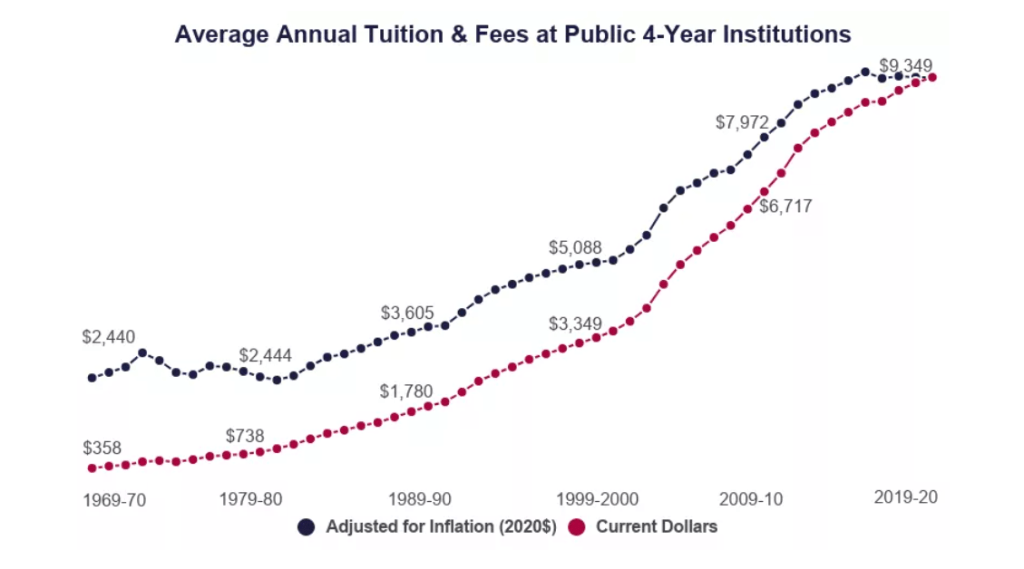
Let’s look at the history.  The following chart is a point of departure:

It’s obvious from the chart that around 2008 something happened to the cost of college—it took off.  A prime ingredient was the George Bush’s 2008 crash, which was a double whammy:  states had less money to spend—so tuition went up—and students and their parents had less money to pay it.  As we all learned during the Covid crisis, states have limited ability to deal with new expenses, as many are prohibited from running deficits.  They need to rely on the federal government to help them out. 

However the Republican Congress blocked all stimulus (remember the “balanced budget amendment”) to provoke dissatisfaction for the 2016 election.  So there was no help to be had.   Unsurprisingly people had to take on new levels of debt.  And with Republicans continuing to sabotage the recovery, there were few jobs for these people when they graduated (or didn’t) and went immediately into arrears.  Student load debt didn’t grow because students were irresponsible, it grew because government was.

Adding to that, Republicans spent years protecting fraudulent private pseudo-educational institutions because of the supposed superiority of the private sector.  At such places you could earn a degree in “culinary arts”, for example, which was considered valueless in any real restaurant.   Essentially all students at those institutions incurred monumental levels of debt and no skills.  The worst of those have now been shut down, but Betsy DeVos did everything she could to defend them.

As a country we screwed a generation of students.  From the numbers on the chart, $10 or $20 thousand seems relevant, but assuredly not profligate. As for inflation, the risk has been exaggerated by false comparison to the stimulus packages.  The cost here is budgeted over decades; its current impact is minimal.

However we should be clear that this is a Band-Aid on a God-awful wound, because for the most part things have only gotten worse.

First of all, averaging over all institutions in the country gets a rather diverse mix of good and bad colleges. That’s appropriate for addressing needs of borrowers.  However If you want to go to a good institution to get yourself a good job, the numbers are basically twice what’s on the chart:  around $20 thousand yearly for a good public institution.   For private colleges, we can be more exact since they act as a cartel:  $80K.   Even applying to these places can cost thousands.  So much for equality of opportunity. 

What’s more the public university system, instead of being strengthened, is under attack.  That’s not just a matter of the well-publicized politization of education, bad as that is.   Public funding in many states has been reduced to the point that public colleges are admitting out-of-state (or out-of-country) students in preference to in-state ones, because they need the extra money.  That has actually become a major contributor to student loan debt!  The financial situation is so dire that colleges are spending more on administrators to raise money than on education itself.

All of that sounds like a hard problem, but as with healthcare, just about every other developed country has found a way to do it.  We need to strengthen the public system with necessarily more of a role for federal funding.  Public education has to be first-rate and affordable—and available to everyone in every state.  We’ve got to banish the preposterous model of education as a severely-limited resource with parents ready to kill to get their children into the right places!  In addition we need to limit the size of loans people need to take and be rational about the payback.  The Australian system, with payback based on ability to pay, is one working option.

It’s worth stating the obvious fact that with the current cost of education, the only way we’re keeping this country going is by importing foreign graduates (and telling them how much we hate their being here!).  We’d have to shut down Silicon Valley otherwise.  We should also be clear that when we talk about national security we’re talking not about aircraft carriers but about our national competence in key technologies.

It is also worth stressing the problem is NOT (despite rumblings from both the left and the right) that we’re sending too many people to college.  Good jobs need sophisticated training.  You can look at the government’s own (or anyone else’s) expectations of the jobs we’re going to need to fill.  Sure there should be more specifically vocational training also, but that’s not the answer to the problem we know we’ve got. Also we’ve learned from the Covid experience that online instruction is no silver bullet to replace teachers.

Finally it’s worth responding to the charge that we’re not sufficiently targeting our payments to the poor.  The fact is that the only route to equality of opportunity is making sure that there is a first-class system available to everyone.  We used to understand that.  We were the first to recognize that secondary education needed to be available to everyone.  Eventually other countries caught on, because there was a big advantage to the country in doing it.

This has been proven so many times it’s ridiculous to have to state it—education is the backbone of the strength of the country.  Despite some rhetoric, there’s nothing either left-wing or right-wing about this. Even Adam Smith knew it—he didn’t futz around wondering how little training poor people could get by with, he wanted universal literacy in the eighteenth century.  If we want to succeed as a nation, we need to succeed at education.

Democracy’s Enemies are No One’s Friends

Today about half the United States electorate seems to think that the end of democracy would be great—they could just keep on winning.  It’s not said enough: that’s a fallacy regardless of where you sit on the political spectrum.  The end of democracy means the end of leverage.

As history has proved over and over again, the winners when democracy dies are the real elites who hold power.  In this case were talking about the Kochs, the Thiels, the Mercers, the Murdochs.  In the absence of democracy, no functioning elections means no power for anyone else.  All other leverage is gone.

Those people have been very clear about what that means.  What they want is what’s good for them.  No taxes on rich people and corporations.  No regulation.  No government services they don’t need—that is no social security, no Medicare, two-tier education, nothing for climate, no safety net.   Back to the glory days of the nineteenth century, when businesses could get away with anything.

For now a section of the population finds common cause with those people on guns and abortion, but those were never the main issues.   The only reason we’re talking about those issues today is that we do have a democracy today and voting matters.  Guns and abortion are a path to power, but not a commitment to support anyone in any way.

Once democracy goes, we’ll have nothing to say.  And nothing is what everyone—both their supporters and their opponents—is going to get.

The One Million Covid Victims Have a Message

At least half of these deaths were due to deliberate misinformation from political interests calling the whole pandemic a left-wing plot.  For month after month the most popular story in the Wall Street Journal was the latest reason why there was really nothing going on:  it was just like normal flu; it was worst in New York because it was only in disgusting cities full of disgusting people.

Everyone in the country suffered, including very many who bought into the party line because they thought the propagandists were on their side.  Since vaccines were coming, deaths delayed could be deaths avoided. What’s worse, almost of half the people who died were unvaccinated when they could have been, convinced by the arguments of people like the Fox hosts-who were actually vaccinated for themselves.

This Covid story is unfortunately typical of what’s happening in this country.  The “populists” are the Kochs and the Mercers and the Thiels—people with the money to fill newspapers with issues they don’t care about (abortion, guns) so they can ride them all the way to the bank.  The only major piece of legislation passed in the Trump years was the monumental tax cut for the rich.  As with Covid, the supporters drawn in with identity issues are the ones who will suffer—in jobs, healthcare, education, climate, you name it.

Taking this one step further, it is worth noting that the damage with Covid was not from action but from inaction.  Most of the endless discussions of our fractured political system are missing the point.  The country is ungovernable because they want it that way.  If government can’t act, the powers that be are running things.  As Steve Bannon put it, all we need to do is create chaos. 

This story isn’t complicated, just lost in the cacophony of bought media.

The Hijacking of Race

The Democratic Party owes black people a debt of gratitude for their organized commitment in the last election.   Even if that weren’t true, the United States owes black people what it has never delivered—real, functional equality of opportunity.  It’s worth restating what never made it into any textbook I ever had—slavery in this country didn’t end in 1863.  With Black Laws and then Jim Crow, the substance of slavery in this country persisted well into the twentieth century.  It’s no surprise that we live with a pervasive legacy of slavery.

What is owed here is progress—on everything that makes for personal and family prosperity and life satisfaction.  A recent NY Times piece does a good job of getting at what that means. However it’s worth recognizing that this objective gets hijacked every day in favor of other more exciting agendas, as examples:

– Anticapitalism.  This is a kind of knee-jerk on the left that gets applied to all issues (climate change is another one).  Get rid of capitalism, let me and my morally-certified friends run everything, and racism will vanish in an instant.  Otherwise there’s not a chance. Somehow the dictatorship of the proletariat (like trickle-down economics) survives in the face of all evidence.

– Violence.  It’s amazing how attractive violence is for people who spend their lives far from it.  That’s not just for the classic case of British Nazi intellectuals prior to World War II.  Two very good books The Good Lord Bird and The Underground Railway end with ringing endorsements of violence as a necessary way to get things done.  In context that’s not really a call to action, but it indicates a willingness to forgive violence as a tactic—a significant mistake supported only by rewriting history. 

There’s not going to be a revolution on the left in this country, so we’ve got to work with the flawed political process we’ve got.  Violence hardens opposition—end of story.  If you want to get things done, there’s no greater mistake than believing you have powers you don’t have.

– Cultural superiority.  This has many manifestations.  The good guys are immune from racism, create better artistic productions, are more moral and humane to each other, etc.

If you get past all of that, objectives here are not so different from what we owe to everyone else—a fair chance to succeed and a viable safety net.  What it takes to get there must be adapted to the history of anti-black racism, but adaptation is the rule for every other group also.  Our task as a society is to get the job done for everyone.

It is hijacking the race issue to

– Use it as a justification for anti-democratic behavior.

– Use it as a reason to justify any departure from the rule of law.  We are not doing anyone a favor by asking for an understanding of mob violence.

– Engage in ridiculous exercises of cultural superiority. That includes, in particular, anti-racism competitions.  I’d even say everybody is racist; the important question is who is doing damage and how to stop it. Anti-racism crusades may feel good, but they are not progress. And if they lose elections they are nothing more than destructive vanity.

Even if you think this is an oversimplification, you have to admit that the objectives here–a fair chance to succeed and a viable safety net–are worth pursuing.  You’d think they would be universally popular.  After all, as many have pointed out, essentially any social program has more white than black beneficiaries.  So why aren’t they universally popular?  The reason goes all the way back to What’s The Matter with Kansas.  Republicans have been convincing people for decades that all those measures are not for them.  It’s just giving the country away to the shiftless blacks.  People in Hillbilly Elegy and Strangers in their own Land are astonished that any of their own would waste time applying for such benefits.

Why are Republicans so successful?  BECAUSE WE KEEP HELPING THEM.  With all the discussion of white racists who just have to get used to giving up the advantages of white privilege (and deservedly take the hit), what else would you expect them to believe?  We’re not spending our time saying we’re committed to what it takes to achieve equality of opportunity for everyone—with all the benefits that entails.  Too often we’re playing the Republicans’ game.

You don’t have to agree with everything here, but one thing is indubitably true.  Fighting racism is about results, not morality contests.  It is about jobs, safety, and education for your kids.  It is a pragmatic issue.  Anything that doesn’t produce results is hijacking, regardless of how good it feels.

How We Won the Cold War

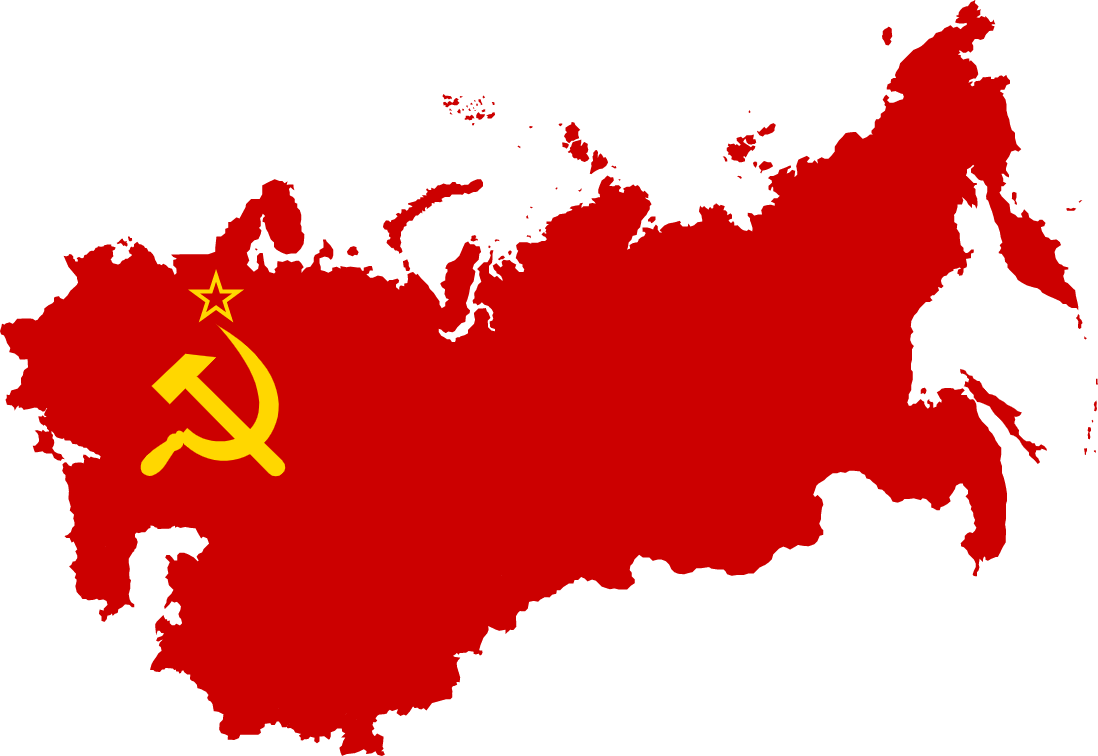
Map-Flag_of_the_Soviet_Union

“File:Map-Flag of the Soviet Union.svg” by NuclearVacuum is licensed under CC BY-SA 3.0

We hear every day how we need to get tough for our new cold war with China.  The unstated subtext is that threats and bluster are the “getting tough” that’s going to win. In fact we know exactly what won the last Cold War.  It’s worth paying attention to what that was.

The dynamism of our economy won the last cold war.   Our technological base reinvented itself many times over, and the top down economy of the USSR just couldn’t match it.  There were many individual factors behind the collapse—low growth, corrupt state enterprises, spending on defense, oil price collapse, Chernobyl.  But what it all came down to is that the Soviet economy collapsed because it just couldn’t find the resources to keep up.

Many factors made the difference—the historical strengths of the United States:

– A free market for new technologies.  A venture capital industry supported by anti-trust enforcement to protect new companies from powerful old ones.

– The US as world’s best destination for entrepreneurs from everywhere to realize their dreams.

– Openness to ideas from everywhere and active participation in international organizations of all kinds.

– Government support for pure research–to be on the forefront as new developments translated to opportunities.

– Expanding equality of opportunity, so ideas can come from everywhere.

The USSR had a well-trained population of elite engineers and scientists, but ultimately they couldn’t compete with the ability of the US model to reinvent itself and grow.

What can we say about the current situation with China?  There are three points:

  1. The rise of China actually followed the US model.

One part of this is familiar—China invested in its people:  education, infrastructure, health care, etc.  The regime tolerated no disagreements, but it put money (as we used to) into the environment necessary for success.

However the bigger part is less-discussed—what kicked off the Chinese miracle was an accidental surge of free enterprise.  As a weakening of collective economic control, Chinese municipalities were freed to carry out their own businesses once obligations to the state had been met.  That minor bit of freedom took over the economy.  Independent municipal businesses became dominant to the point that they dwarfed the hugely-corrupt state-run enterprises.  Municipal businesses grew into the independent private sector.

  1. Under Xi, China is abandoning that approach in favor of a return to central planning and control.

Xi is a princeling—a child of former revolutionaries brought up to believe he was born to rule.  All of his recent actions have been directed at crushing independent forces in the Chinese economy.  Appointments have been based on loyalty above all.

China is back to the old Soviet and Chinese world of massive state enterprises and a dictated economy.   That won’t change the immediate future, but we have no reason to despair of our ability to compete.

  1. Under Trump we are similarly abandoning our strengths.

Trump, like Xi, is an autocrat who view himself as the all-encompassing genius who needs to run everything.  He picks winners and losers with tariffs.  He awards exceptions to supporters.  He ignores real problems (such as Covid) that he doesn’t want to deal with.  Job appointments are based on loyalty over competence.  Every one of the listed US strengths is at risk:

– New enterprises are sacrificed to the existing powers that be.

– Xenophobia and nativism are pushing entrepreneurs elsewhere.

– Global participation is discouraged.

– Science is discredited and only mainstream technologies (e.g. AI) or Trump whims are funded. Climate change can’t even be mentioned.

– A political strategy of divisiveness means we’re fighting internally rather than drawing on everyone for progress.


We didn’t beat the Russians by mimicking their authoritarian control and top-down economy.  We won because they couldn’t compete with our ability to reinvent ourselves over and over again.  We have that opportunity today, but we’re losing it to the false god of dictatorship.

Democracy is not a nicety but the core of our success.

Dictatorships lose.  All-powerful leaders make disastrous mistakes that cannot be remedied.  They can ignore the well-being of the population.  They create massive corruption that cannot be contained.  All these tendencies are visible today (Covid alone shows several), and the effect is—as always—accelerating.

We still like to talk about the power of democracy and free markets, but both are slipping away.  Voter suppression is an openly-discussed goal.  Anti-trust enforcement has effectively ceased to exist.  The power of corporate lobbyists has starved the public sector (including infrastructure of all kinds) and defended the economic status quo against all comers.

Our problems today are not weaknesses of democracy but an indication of how far we’ve strayed from it.  There’s no reason to despair for our competition with China—or for the country generally.  It’s just a sign we have to get back to doing what we’ve always done best.

Lessons From the British Election

55ddfb60723389.5a56f216db0a1

“Boris” by Raymond Wang is licensed under CC BY-NC-ND 4.0

There is no way to avoid talking about the horrors of the British election.  With the confirmation of Brexit and the triumph of Boris Johnson, we have all stood witness to the disgraceful demise of a nation now left only with dreams of past glory.

For us though the important question is about what it means for our own election.  On that point the discussion has been generally limited to one question:  Does it say we should worry about the Democrats going too far to the left?  That one is hard to decide, since Labor leader Jeremy Corbyn was so unpopular for his own sake. 

However, that being said, there is still much to discuss.   We propose three points:

  1. Catastrophes not only can happen, but will happen if we don’t watch out for them.

The Democratic debates thus far have played out largely as conflict between the center and left wings of the party.  That means essentially all of it has been fought in the never-never land of post-Trump.  That’s not the same as working on viable strategies to win.

This will be a very tough election, fighting the Fox News, the Electoral College, incredible amounts of Republican money, and all the (legal and illegal) powers of incumbency.  Most candidates have done a reasonable job in providing position papers for what they stand for.  They need to tell us how they’re going to win.

  1. We need to recognize that the electorate isn’t convinced of the urgency of change.

In Britain, Corbyn’s big socialist revival was not so much wrong as a non sequitur.  What actually was all this trying to solve?  Why was it an argument for change?  It was ultimately a declaration of irrelevance.

We have a similar problem.  The very first question of the very first debate has never been adequately answered.  Elizabeth Warren was asked (more or less): “Why are you proposing all these changes when—by all polls—the vast majority of Americans think the economy is doing fine?”  That’s a question for all Democrats—what is it that’s so bad that we need change?

Warren’s answer—about radical inequality—was nowhere near strong enough.  It essentially said that all those people who answered the polls were just wrong.  But no one else has done better.  Healthcare was a great issue for the midterms—that’s something broken that we’re going to fix.  But it’s not enough to unseat Trump.  Impeachment doesn’t touch peoples’ lives directly—it’s about an abstraction called democracy.  Even climate change comes across as an abstraction, although it’s part of what’s needed.  Democrats need a short, clear reason why people need to worry that there is something that needs fixing.

That’s a bar to be passed before we can begin to get traction with specific plans for change.  Until then, like it or not, “fundamental structural change” will be a negative.

  1. We have to keep this a referendum on Trump.

Corbyn pretended Brexit wasn’t the main issue and went off with his own program.  The public was unwilling to follow.

Regardless of how broadly we see the issues, this election is about where Trump is taking the country.

We need a well-defined Trump story to challenge Republican claims of a great rebirth of the American economy.  Even on trade they’ll do what worked for George Bush on Iraq—we’ve been through all the pain, don’t miss out on the rewards!

That means we need to show what four more years of Trump will actually mean.  And how to meet the real challenges for our future.  It seems helpful to think in terms of personal and national issues for the voters:

Personal well-being

Healthcare (complete failure of vision)

Decline in good jobs (manufacturing, good jobs in general)

Education (no initiatives, no funding)

Income inequality (all growth for the rich)

Guns (unsafe to be in school!)

Climate change (what world for our children?)

Women’s rights trampled (bodies owned by the government)

Worse life for everyone but the protected few

National well-being

Eroding technology dominance (science marginalized)

New businesses sacrificed to old (Net Neutrality)

Losing out with climate change denial (ceded primary position to China)

Weakness with China and North Korea (situation is worse than ever before)

Nuclear proliferation (a danger in all directions)

Racism and divisiveness undermine our strengths (just what Putin ordered)

Demise of democracy (our major source of prosperity and power)

=>  Welcome to the Chinese century


That’s where we’re going.  For our own dreams of past glory.