The End of Democracy

14387714597_9d026aa844_b

“STATUE OF LIBERTY” by airlines470 licensed under CC BY-SA 2.0

Who knew it would be so easy?  In Sinclair Lewis’ “It Can’t Happen Here,” he needs real violence for a fascist takeover of the country.  In fact it took almost nothing at all.

We were lulled into complacency.  The institutions setup at our founding had lasted hundreds of years.  They weren’t perfect, but at least we had regular changes of power.

It turns out there was much we overlooked.  It’s easy to make a list now:

–  The Constitution functions only as it is interpreted by the Supreme Court.  A Court majority willing to exercise power can do almost anything.  For starters:  corporations are people; the first amendment precludes any control of money in politics; voting rights are not guaranteed.  Appointments are for life, and reasons for decisions are arbitrary and non-reviewable.

– The President and Senate have complete power over lifetime appointments of judges.  There are no controls on job requirements or procedures for appointment.

– The Attorney General is a creation of the President and can interpret laws in any way that the Supreme Court allows.  He, together with the Court, can quite legally be the President’s enforcer.

– Going one step farther, the impeachment process has laid bare the biggest threat of all, that there is no Constitutional check on a President whose party controls the Senate and will support him as a matter of principle.  Who is left to enforce the law?  In such a case the Constitution becomes a dead letter, supplanted by the whim of the dictator.

There is an old and probably apocryphal story that the mathematician Kurt Gödel, on reading the Constitution to prepare for his US citizenship interview, told Einstein that he was shocked to discover a path for a fascist takeover.  Einstein told him to shut up and get on with it.  It seems Gödel was right.

However institutions are only a part of what we missed.  Apparently the founding fathers were well-aware that in human history democracies have been rare and short-lived.  However as creatures of the Enlightenment, they were rather optimistic about the workings of the human psyche.

With that too there is much to go wrong.

– It turns out that people aren’t terribly rational.  They are intensely tribal and unwilling to change opinions based on facts.  Both advertising experience and economic theory have shown that there are many techniques to successfully manipulate opinions.  Two examples:  the brain confuses ease of access with truth, so that repetition works great; people process issues in bunches, so that opinions about abortion translate conveniently to opinions about tax rates.

– It turns out that even perceptions of factual reality are easily manipulated.  We no longer directly perceive reality; reality is what we glean from the information streams around us.  In the US we already made a terrible mistake (deliberately pushed through under Reagan) to remove the fairness doctrine on television—clearing the way for Fox News and other propaganda channels.  Now we have an even more serious problem with social networks.

– Finally and most fundamentally we’ve misjudged people’s commitment to democracy and fairness.  What we’ve found is that there may have been a commitment out of habit, but it was no more than skin deep.  If you can be sure of winning all the time, why even consider giving it up?  Democracy is just one more item on the list of things where “I just don’t have to care.”

Is there a way back?

Based on history, it seems we need two things:

– A unifying figure as President, to function as a creature for change.  It helps if the person is not too directly tied to factions.

– A renewed commitment to the non-legal underpinnings of democracy.   That is, to the unstated rules of cooperation that made democracy work for 200 years.  Much as you might like to, you just can’t legislate everything.

We like to think about Athenian democracy as a model (ignoring that Athens was in fact a quite unrecommendable imperialistic power).  After the rise of demagogues, they did in fact take the first step back, but they never managed the second.

We’ve been a much more successful democracy than they were, but we’re now at the same juncture.  The 2020 election is perhaps our last chance.

This is not just about an abstract idea of democracy.  With Athens it was the end of economic dominance and everything they stood for.  Same for us too.

Fixing Capitalism

44040355775_00e5b353ac_b

California Bank” by waltarrrrr is licensed under CC BY-NC-ND 2.0

There’s a lot of talk these days about fixing capitalism.   However, there’s a problem with much of it—there are so many things to fix that it all becomes a daunting task.  The point of view here is simpler.  There are a great many things that aren’t happening, because capitalism just doesn’t do them—and we can start by making sure those get done.

At its source this problem comes from our being force-fed the wildly radical idea that the private sector—capitalism—will solve all problems by itself.  So even when we realize that capitalism needs to be fixed, we tend to be overly concerned with all the patches.

However, even Adam Smith had no delusions about the limitations of capitalism.  As he pointed out:

  1. The private sector will not police itself.

On the contrary it will do everything possible to corrupt the free market with monopolies and government influence: “People of the same trade seldom meet together, even for merriment and diversion, but the conversation ends in a conspiracy against the public, or in some contrivance to raise prices.”  We’re used to hearing “private sector” and “free market” used almost as synonyms.   In fact, as Smith recognized, the free market is an ideal that can only be achieved when government holds the private sector accountable.

  1. The private sector will not provide the environment for its own success.

Smith even advocated a government program of universal literacy, quite a stretch for the eighteenth century and a pointer for us today.  This is a serious matter, because it shows how dangerous it is for the economy to punt everything to the private sector.

  1. Much of what is needed for a successful society is simply out of scope for the private sector.

Capitalism will not provide any service where there is no competitive advantage in doing it.  Public health and welfare, environmental questions, basic science, etc. are all out of scope.

Fixing capitalism strictly speaking deals only with the first category.  No amount of fixing is going to make capitalism deal with the rest.  Those issues are ours to solve.

It’s instructive to think about needs in each category.

  1. Policing the private sector

Monopolies are still with us and have become an increasing problem due to technology changes and weakened anti-trust enforcement.  The same is also true of corruption due to business influence on government.  These days no one even apologizes for it.

This is particularly true in the financial sector where banking, for example, has evolved into speculative gambling with losses covered by the FDIC.  You can even argue that the financial sector overall has evolved in directions that make it predatory on productive business.  After decades of Republican-inspired hands-off attitudes toward business, there is no shortage of serious issues.  However fixing all of them makes progress look far away.

Taking a step back, there is a single biggest problem:  legal tax evasion.  This is a gating item for so much progress that it just has to be dealt with.  Even before Trump’s tax cuts (and despite nominal tax rates), American companies paid the lowest effective taxes as a percent of income of any developed country.  That was largely a result of multinationals’ ability to move income to tax shelter countries—reducing rates or hiding income entirely.  Apple is only one egregious case.  The recent tax cuts made matters worse with drastically-reduced business rates, arcane rule changes for overseas income, and the new pass-through income treatment.  That pumped up the deficit—thereby hobbling government’s ability to respond to the serious sins of omission in categories 2 & 3.

What’s more, despite the insistent propaganda, taxes are actually not a primary issue for American competitiveness:

– Many studies have shown that in most industries today business profit levels reflect monopoly power to set prices well above historic levels of margin.  That’s a trend we can expect to continue.  In other words, businesses have considerable financial room to pay taxes.

– Further, as frequently noted, the savings from the tax cuts went primarily into stock buybacks.  That is companies decided the best thing to do with the tax cut money was to give it back to their investors in higher stock prices.

Conclusion:   Get the private sector (particularly large multinationals) and its investors to pay taxes.  Then work through all the rest.

  1. Providing the environment for economic success

If taxes aren’t the issue for American competitiveness, what is?  As we’ve noted here before, what makes for success is the technological advantage that has kept us in many areas on top of the heap.  That supports both our standard of living and our military strength.

Our technical dominance is based on three factors:

i. The dynamism of our economic system in generating new products and technologies.

ii. Broadly-based government support of research and education

iii. Remaining the preferred destination for entrepreneurs and other ambitious people from everywhere to realize their dreams

Let’s look at the current status of all three:

i. Unchallenged influence of big companies on government has favored established companies over new entrants. In part this is an anti-trust enforcement issue, but it has many other aspects.  The demise of net neutrality is one highly-visible example.

On this issue the interest of big business is strongly opposed to what makes for long-term national success.

ii. The administration is actively hostile toward science, government-sponsored research, and broad-based education. This is shown in purging of scientists from government agencies and restricting their influence on public policy.  One obvious example is in climate change.  Also the new tax law punished major research universities with a targeted tax.

Public investment in research had a major role in the prosperity of the 1950’s and 60’s and kicked off the opportunities of internet today.  The same kind of public investment has remade China as a technology powerhouse.  But our dedication to research has eroded over time:

R_D_spending

Instead we’re waiting for the private sector to do the job, which by definition means catch-up.

The story for education is similar.   In the 1950’s and 60’s we were expanding educational opportunities to whole classes of people who had never before had the chance.   Now we rank far down on the list for upward mobility.  Student loan debt tells the same story, and that’s only about the people DID go to college, not about the ones who were deterred by cost and DIDN’T.  Finally, educational funding in the states has never recovered from the 2008 crash.

It’s worth mentioning in passing that the value of research is not only for international competitiveness.  Basic research is part of the global project of raising human standards of living. Even when one worries about national competitiveness, progress is generally so international that openness is the ante for remaining at the forefront of progress.  Current policy to restrict international participation of US scientists weakens the country in the name of national security.

iii.  As a final point we need to emphasize the critical role that foreigners and their children are playing in maintaining our national strengths.  Many studies have shown their role both in starting new companies and in supplying the technical underpinning that makes for success.  As Steve Bannon noted (for his own purposes) such people represent more than half of Silicon Valley activity.  Google (cofounded by a foreigner) and Apple (by the son of a foreigner) are only the most obvious examples.

The current xenophobic backlash is wildly off-target.  Particularly with the weakened support for research and education, those are the people keeping our place in the sun.  (To be clear, an immigration plan that only accepts people with degrees is no counterweight to the nationalist, nativist rhetoric.)

Conclusions:

– This area has got to be fixed or we risk losing our standard of living and dominant role.  These are traditional US values and as important as ever for US success.   It we’re worried about competing with Chinese, this is where the battle will be lost or won.

– If we can get our act together, items i and iii should remain as our advantages going forward.  So we shouldn’t be defeatist about a future that is in our hands.

  1. Spending for the common good

This has been a bastard child for so many decades now, that there is much that needs to be caught up.  Here is one short list:

– Infrastructure (Much discussed, but with more sides to it than you might think.  See here for a good overview.)

– Climate change (Evidence has become incontrovertible, but we still need a real plan.)

– Universal health care (Needed not only as a benefit but also as an enabler for equal opportunity.)

– Opioid crisis (Much discussed, but with radically inadequate funding)

– Environmental protection (Not a luxury)

– Transitional assistance (Helping people through changes—from technology, globalization, etc.)

There is enough essential work here to pose a major challenge for government.  We need to confront the unmet needs of the society, then we need concrete plans, and finally we need to manage major operations with competence and integrity.  Despite the propaganda there is nothing unusual about effective, government-sponsored work.  However as with any other enterprises, this needs to be scrupulously well-run.  Just because good people are running it doesn’t mean there is less risk of corruption.  We have to get serious about public enterprise.

That means we have to get past the idea that there is something intrinsically wrong about working for the public good.  That’s after all nothing more than the other side of the “private sector will solve everything” coin.  We live with the continued juxtaposition of vast under-employment (3.7% unemployment doesn’t change the good union jobs replaced by Walmart) together with vast unmet needs that the private sector won’t address.  We’ve got to take the initiative to match one with the other.  This is not “make work”.  It’s essential work that isn’t getting done, because the private sector won’t do it.

Until we take that initiative, it’s hard to assess where we are as a society.  Public enterprise helps in many ways.  It helps with inequality and the middle class.  It helps with leverage for workers and standards for employment.  Many public sector jobs of their nature will be hard to outsource.  It makes no sense to talk about abstractions such as Universal Basic Income until we see how things shake out in a fully-functional economy.  The future may be less strange or scary than it seems.  (This isn’t just about public sector employment; work done by the public sector helps other trends as well.  Even in Silicon Valley each job in tech creates 4.3 other jobs as well.)

Conclusion:   We need to create the full-scale machinery for government service to do what the private sector won’t.

It’s always hard to foresee the future.  I remember when I was in high school, Prince Philip gave a commencement address at UCLA in which he spoke (as world expert!) about leisure.  Already then he was thinking that machines would take over work, leaving as us all to spend the rest of our lives at the beach.

That’s certainly not what happened, but there’s still something to be said for the positive spin.  Historically technology and even globalization have been good for living standards, except where societies have chosen to deny the benefits to large segments of their populations.  Both domestically and internationally we have every opportunity to do this right.  We can either organize our economy–and the world order–so that all can benefit, or we can go down in flames of our own making.

Let’s Just Do Immigration

28693267654_b115c18e38_b

Now that Trump has decided that the target for the total number of immigrants is unchanged, why don’t we just fix immigration:

  • Family unification is a good thing, but it has taken too much of the total, now 70%.
  • It’s sensible that some fraction of immigrants should get in based on special capabilities or other demonstrable merit.  (It’s worth noting that the current system is actually not so bad in that respect.)
  • It’s also sensible to have some fraction of immigration that is not so constrained.  You never know who’s going to be a hero, and diversity has value.  Moreover past immigrants mostly came from places where they were denied opportunities for such merit.  So a lottery system has value too.

As a default, divide it up 1/3 for each and call it even.  Otherwise negotiate the limits for a while and then call it done.  (As an interesting variant, Canada handles family unification with relationship points in the merit index.)

Additionally:

  • We need to settle DACA once and for all, because there is no value to anyone in not doing it.  Since we’re talking about merit, these are upstanding, fully-adapted, English-speaking contributors.  And their number, compared to Trump’s new annual totals, is on the order of 1%.
  • For the rest of currently undocumented immigrants, we had a bipartisan bill passed by the Senate in 2013.  That can still be a basis for work.  These people are almost all working and paying taxes.

This isn’t so hard.   It only takes the will to do it.

There remains the question of enforcement.  For that, the problem is that we’ve been postulating solutions without any serious analysis.   Politicians shouldn’t be arguing about this.  (Border control was never wild about the wall until they were told they”d better be.)  There needs to be an independent assessment of how money should be spent to enforce the law.

However one thing that is definite is that there is no excuse for mistreatment of desperate people looking to escape overwhelming problems for themselves or their families.  We can’t satisfy them all–immigration law is there to say who gets help–but that’s no excuse for treating them all as criminals or worse.


Saving the Country

6091600778_6541b71899_z

This note grows out of a comment made during the election night coverage of the midterms.  Analysts were breaking down the vote in various categories, and one of them remarked that if you just look at white voters, this seems like a completely different country:  Republican voters outnumbered Democrats 3 to 2.  They were all-in for the Trump program.

It’s worth paying attention to what that means.  Diversity is not a matter of tolerance; it’s a matter of national success.

Immigrants and their families are assets by any statistical measure.  They need to work harder to succeed, and they do it.   As the various waves of immigration entered this country, they have adapted and prospered, and the country as a whole has benefited.  It’s no accident that the most prominent players in our new economy—Google and Apple—were founded by an immigrant and the son of an immigrant.

But there is another aspect to this as well.   Outsiders (and not just immigrants) are not so easily tempted by images of an idealized past paradise.  Those siren-song images are not from their past, so they can keep focused on reality and the future.

Despite the many similarities between the Trump regime and the early stages of the “illiberal democracies” of Poland and Hungary, our diversity provides perhaps a degree of protection.  White voters have not called all the shots in the midterm election.  And it’s possible to believe that we’ve taken a first step back from the brink.

The problems of the Trump regime affect everyone.  First and foremost, we are squandering our strongest economic advantages out of ignorance and arrogance.  And we are at each other’s throats by conscious choice.  Dictatorships are not just bad for outside groups, they are historically bad for everyone.

So we should give credit where it’s due.  Three cheers for diversity in all of its shapes and colors—the saviors of the country!


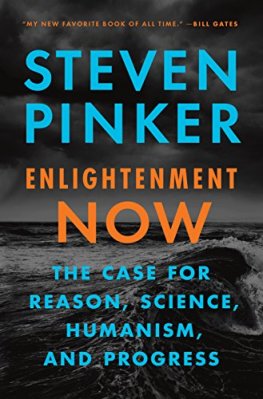
Steven Pinker’s Enlightenment Now

enlightenment

There haven’t been any book reviews on this site before, but Steven Pinker’s Enlightenment Now is something of a special case.  This is a political book with a message that doesn’t quite fit into the current political environment, and it includes a large body of relevant history.  Not surprisingly, Pinker finds Trump antithetical to the Enlightenment precepts he is defending.  But he also finds plenty of guilt to go around.

To start with, the book seems to have two competing objectives:

  1. Validating the fact of human progress and documenting how it has been achieved. This is really a call to action based on humanistic goals.
  2. Providing reasons for optimism about the future. This is different—good things that are going to happen for reasons such as demographics, outside the scope of specific human actors.

On the face of it, a reader expects the first subject to be primary, if only because (at this point in time) you expect any political book to end up with recommendations for what to do.  But that’s not quite where Pinker is going.  He’s trying to view history not just as a demonstration of what works, but also as a way to understand where things are going longer term.  Since the two objectives are different, it helps to treat them one-by-one.

On the first subject, Pinker does a remarkable job of demonstrating the successes that humanity has achieved—In the longer term, in the last century, and in the past few decades. This involves health, security, standard of living, and many other quantitative measures of human welfare.   Much of this is unfamiliar because, as he says, this kind of thing just doesn’t make news.  The book is worth reading for this part alone.  Pinker does a good job of demonstrating progress and what is responsible for that progress:  science, rationality, and a broad-based desire to create a better world for everyone.  It is hard to argue with the historical fact that prosperity is not a zero-sum game.

In passing Pinker tries to dispose of past arguments against enlightenment humanism.  As examples:  Humans are inherently irrational (except when they want to make a point).  Humanism is a white racist production (its advocates were on the anti-imperialist side).   Science ignores human values (just plain not true).

Predicting the future is harder, and overall I’d say that Pinker is not well-served by his desire to make things look positive.  He tries to say that nuclear war is improbable, but we know that just one outlier is bad enough.  He treats the climate change movement as a kind of hysteria, because science will just take care of it in time (based on mostly anecdotal evidence).  He views the populist phenomenon as a brief episode of backsliding until more liberal generations take over from the ones now on the verge of dying out.

So in the end it seems a shame that the future predictions tend to dominate discussions of the book, when it’s the first part—the defense of progress—that is its greatest contribution.

And then there is the question of the call to action.  What Pinker espouses is humanism—the broad-based, rational process that has delivered progress.  The problem is that humanism doesn’t have a political party.

Pinker points out that much of the political process just doesn’t work:  Issue-based movements systematically deny progress for fear of losing momentum (even though that means they frequently get caught in the bind of asking for more money to continue going nowhere).  Discussion of issues is based on faulty statistics and dishonest patterns of argument.  Democracy as a whole is not as rational or responsive as we would like to think (the chapter on that subject is well worth reading).  He gives plenty of examples of bad behavior on both the left and the right.  Both sides contributed to the grim view of reality that was instrumental in producing Trump.

So where do we go from here?  Individuals can learn to be more rational in their behavior and in their evaluation of what they see and read.  They can work with the flawed organizations that are fighting bad actors such as Trump.  They can involve themselves with specific issues and help to push them along.  All told—incremental change but no miracle solution.

That’s actually the optimism of the book.   There’s no silver bullet, but the process has worked thus far.  And hopefully we will keep it going.

Strange Revisionist History

You can almost call it a conspiracy.   The right and the left have decided to rewrite the history of the last election in remarkably similar ways:

The Right:  The election was a thumping rejection of everything liberals stand for.  The public was finally given the opportunity to say so, and it rejected the administrative state and all its policies, both foreign and domestic.

The Left:  The election was a thumping rejection of centrism and its coddling of the right.  Trump’s core voted for him, because the Democrats have become too close to Republicans in outlook.  Other traditionally Democratic constituencies either went to Trump or didn’t vote for the same reason.   The only way to save the country is for the party is to return to its ideological roots on the left.

For starters, one of the most outrageous events in the history of the United States has disappeared from the narrative—the FBI’s deliberate effort to throw the election.   They got away with it, and we may never know what was behind it.   What’s more, of all the elections in recent history, this has got to be the one least fought on the issues.   By all reports, Hillary Clinton’s emails were the only subject on the news for the last two weeks prior to voting.  In fact one of the many national myths that died in this election was the place of truth in our much-vaunted free press.  Finally the Trump phenomenon itself has been whitewashed out of existence.

This is not a trivial matter, because it affects where we as a country go from here.  What follows is a quick summary (from the outside) of what the election was about and what conclusions should be drawn from it.


The basic story of this election was simple.  The Clinton campaign tried to make Trump’s character the major issue in hopes of attracting bipartisan support.  Other specific issues came out primarily during the debates, where she was successful (Clinton won the first and third, and tied the second), but not so often after the debates were over.  The focus on character seemed to work well at first, in particular with the discovery of the Trump sex tape.  But it was undermined by the (unsupported) innuendo of the first FBI letter—she was just another crook.  By then it was too late to change tactics, because the press was obsessed with her emails.  More innuendo in the second FBI letter sealed the deal.

For Trump voters this election was a religious experience.  For the rest Clinton’s emails were the issue.  Republicans now voted Republican, the effect of the Russian leaks was amplified, Sanders voters and misogynists had their fears confirmed, and the belief that Clinton would win made for general Democratic complacency.   With the character issue gone, too many people bought Trump’s simplistic economics—“he’s a businessman, I’ll make a buck” or else just didn’t vote.   One example statistic—at Penn State less than half of students registered prior to the election actually voted.  In swing states Clinton lost 4.5 percentage points of advantage in the two weeks following the FBI letter and lost the election by less than 200,000 total votes in four states.  This was so close that even Jill Stein was significant in most of them. (See here for a detailed discussion of factors influencing the election.)  Republican control of Congress was another side of the same coin.

It remains to talk about the Trump phenomenon.   Donald Trump is a demagogue outside the limits of what either party has produced in the recent past.   He is a professional huckster and promised salvation.  He created scapegoats and whipped up his audiences so that they were ready to kill. You can argue that Democrats should have done more for his target population (although the Republican Congress essentially shut down the government for six years), but in the election no honest proposal would have competed with Trump’s lies.  Demagogues are a real problem in a democracy.  A chilling thought is that in Athens, our original model for democracy, once they elected a demagogue it was never possible to go back.


This is not to deny that the Clinton campaign made mistakes, but that wasn’t why she lost.  This is my list, always easy after the fact:

– Excessive focus on Trump’s character.  I would have liked more issue-oriented ads.  People needed to understand the reasons to fear Trump’s “change”.  (But that would have complicated a non-partisan appeal.)

– Handling the FBI letters.  Clinton should have taken the high ground—welcomed the examination of her letters as a way to settle the email issue once and for all.  Contrast with Trump’s taxes.  (But the innuendo was still there, and at the time no one could believe that the FBI itself was corrupt.)

– Despite Trump’s comment, Clinton wasn’t nasty enough.  She and the Obamas liked to say “when they go low, we go high”.  This was not a time for class.  She should have gone after Trump as a businessman, with testimonials from the people who denied him financing.  At the end of the campaign Clinton talked about bringing the country together; Trump talked about locking her up.

– Countering Trump’s tweets.  This is a strategy problem going forward.   Tweets seemed to keep Trump on people’s minds much better than traditional grass-roots organizing.

– Top-down campaign.   As canvassers we were told not to change a word of the canvassing scripts, and there was little interest in our impressions of the voters’ concerns.  Trump’s people had ears to the ground.


Some Conclusions

– This was not a campaign on the issues, and we shouldn’t pretend it was.  There was no mandate to take the country to the land of the alt-right, and also no proof that the Democratic Party does or doesn’t need ideological changes.

– A major influence on this election was corruption in the FBI—an unimaginable failure of our criminal justice system—and we had better worry about what that says.  The concern is not just for elections but more generally how governments can use the FBI against opposition.   (Anyone who questions the corruption should reread the Comey letters. There have been many explanations of why the letters were written, but none explain the carefully crafted—and unsupported—”she’s a crook” innuendo.)

– The core Trump supporters are not going to change allegiance any time soon regardless of what we propose.  They’ve been promised salvation, and they’ll wait a long time for it.   As one book on group violence puts it, fanatical allegiance may grow out of economic issues, but once it gets going it has a life of its own.  We should understand their problems,  but they’re not going to help in 2018.

– Not all Trump voters are the same.  Those is a good chunk of traditional Republicans who were given a reason to ignore what he is.   Those people are harder to get now that they voted for Trump, but they’re not like the Trump core.  For 2018 if they are worried enough—and they ought to be even on economic grounds—they will come.

– Many things had to go wrong for Democrats to lose this election, starting with the FBI.  The election was so close, just about any one of them effectively decided the vote.   Here is one list:

– First FBI letter

– Russians and Wikileaks

– Misogyny

– Bitter Primary fight

– Second FBI letter

– Obama’s decision not to mention the Russian investigation of Trump

– Belief that Clinton would win (further suppressed vote)

There is no question that an inclusive Democratic party can win.  The biggest issues going forward are voter restrictions (Kobach) and gerrymandering.

– We should not take this election as proof that we need to remake the Democratic Party based on what made Trump successful.  Trump won by lying, not because he had a better solution.  What we do need to do is be preemptively sensitive to all constituencies who have problems.   By the time there is a Trump in the picture he will be hard to beat.

– We have a responsibility to address the problems of Trump core voters, and those problems are both hard and pervasive.   Trump’s win is clear evidence that this is fertile ground for demagogues (here and elsewhere).  It is a real challenge to develop workable, salable economic policy.

– Finally, on a more mundane level, there is clear evidence that campaigns have changed.  The effectiveness of Twitter shows we need to go back to first principles about what works.  This has become a scary, high-tech business, and we had better be sure we’re equipped for the fight.