
Saving the Country

6091600778_6541b71899_z

This note grows out of a comment made during the election night coverage of the midterms.  Analysts were breaking down the vote in various categories, and one of them remarked that if you just look at white voters, this seems like a completely different country:  Republican voters outnumbered Democrats 3 to 2.  They were all-in for the Trump program.

It’s worth paying attention to what that means.  Diversity is not a matter of tolerance; it’s a matter of national success.

Immigrants and their families are assets by any statistical measure.  They need to work harder to succeed, and they do it.   As the various waves of immigration entered this country, they have adapted and prospered, and the country as a whole has benefited.  It’s no accident that the most prominent players in our new economy—Google and Apple—were founded by an immigrant and the son of an immigrant.

But there is another aspect to this as well.   Outsiders (and not just immigrants) are not so easily tempted by images of an idealized past paradise.  Those siren-song images are not from their past, so they can keep focused on reality and the future.

Despite the many similarities between the Trump regime and the early stages of the “illiberal democracies” of Poland and Hungary, our diversity provides perhaps a degree of protection.  White voters have not called all the shots in the midterm election.  And it’s possible to believe that we’ve taken a first step back from the brink.

The problems of the Trump regime affect everyone.  First and foremost, we are squandering our strongest economic advantages out of ignorance and arrogance.  And we are at each other’s throats by conscious choice.  Dictatorships are not just bad for outside groups, they are historically bad for everyone.

So we should give credit where it’s due.  Three cheers for diversity in all of its shapes and colors—the saviors of the country!
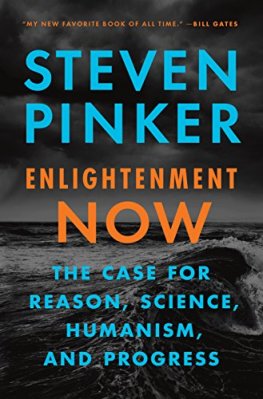
 

Steven Pinker’s Enlightenment Now

enlightenment

There haven’t been any book reviews on this site before, but Steven Pinker’s Enlightenment Now is something of a special case.  This is a political book with a message that doesn’t quite fit into the current political environment, and it includes a large body of relevant history.  Not surprisingly, Pinker finds Trump antithetical to the Enlightenment precepts he is defending.  But he also finds plenty of guilt to go around.

To start with, the book seems to have two competing objectives:

  1. Validating the fact of human progress and documenting how it has been achieved. This is really a call to action based on humanistic goals.
  2. Providing reasons for optimism about the future. This is different—good things that are going to happen for reasons such as demographics, outside the scope of specific human actors.

On the face of it, a reader expects the first subject to be primary, if only because (at this point in time) you expect any political book to end up with recommendations for what to do.  But that’s not quite where Pinker is going.  He’s trying to view history not just as a demonstration of what works, but also as a way to understand where things are going longer term.  Since the two objectives are different, it helps to treat them one-by-one.

On the first subject, Pinker does a remarkable job of demonstrating the successes that humanity has achieved—In the longer term, in the last century, and in the past few decades. This involves health, security, standard of living, and many other quantitative measures of human welfare.   Much of this is unfamiliar because, as he says, this kind of thing just doesn’t make news.  The book is worth reading for this part alone.  Pinker does a good job of demonstrating progress and what is responsible for that progress:  science, rationality, and a broad-based desire to create a better world for everyone.  It is hard to argue with the historical fact that prosperity is not a zero-sum game.

In passing Pinker tries to dispose of past arguments against enlightenment humanism.  As examples:  Humans are inherently irrational (except when they want to make a point).  Humanism is a white racist production (its advocates were on the anti-imperialist side).   Science ignores human values (just plain not true).

Predicting the future is harder, and overall I’d say that Pinker is not well-served by his desire to make things look positive.  He tries to say that nuclear war is improbable, but we know that just one outlier is bad enough.  He treats the climate change movement as a kind of hysteria, because science will just take care of it in time (based on mostly anecdotal evidence).  He views the populist phenomenon as a brief episode of backsliding until more liberal generations take over from the ones now on the verge of dying out.

So in the end it seems a shame that the future predictions tend to dominate discussions of the book, when it’s the first part—the defense of progress—that is its greatest contribution.

And then there is the question of the call to action.  What Pinker espouses is humanism—the broad-based, rational process that has delivered progress.  The problem is that humanism doesn’t have a political party.

Pinker points out that much of the political process just doesn’t work:  Issue-based movements systematically deny progress for fear of losing momentum (even though that means they frequently get caught in the bind of asking for more money to continue going nowhere).  Discussion of issues is based on faulty statistics and dishonest patterns of argument.  Democracy as a whole is not as rational or responsive as we would like to think (the chapter on that subject is well worth reading).  He gives plenty of examples of bad behavior on both the left and the right.  Both sides contributed to the grim view of reality that was instrumental in producing Trump.

So where do we go from here?  Individuals can learn to be more rational in their behavior and in their evaluation of what they see and read.  They can work with the flawed organizations that are fighting bad actors such as Trump.  They can involve themselves with specific issues and help to push them along.  All told—incremental change but no miracle solution.

That’s actually the optimism of the book.   There’s no silver bullet, but the process has worked thus far.  And hopefully we will keep it going.

Our President of China

There has been a lot of talk recently about China’s growing presence on the world stage and how the US as predominant power should react to it.  With that in mind we go to China, just outside the Forbidden City, where the Chinese are planning their strategy…

Xi Jinping: There are many factors we need to consider, economic and political.  Today we are an economic servant to the West, building their iPhones and other toys.  We need to learn to take their place.

Planner: The Americans have many advantages.  They have excellent universities and their pick of talent from all over the world.  They have an interlocking system of university, government, and private research labs.  It’s hard enough to catch up, much less to lead.

Xi: We have to go step by step.  I’ve heard that many of their new companies are led by foreigners.  We can cut into that and certainly lure our own people home–a little xenophobia would help.   As for education and research, we know that government money is critical both in government labs and in the universities.  We have to find a way to slow down that money and then duplicate their system here.

Planner: Sounds like a lot of work, but we’ll start on it.  They’ve been working for decades to get where they are.

Xi: We need to get more specific now.  What are the lead technologies we can use to establish our dominance?

Planner: It’s hard to answer that question.  Software is always there; the particular new twist seems to be Artificial Intelligence.  That ties in with robotics.  Biotech.  Probably the biggest thing is energy–climate change means the whole world will have to convert.

Xi: The Americans are big players in all of those, but progress is very international.  If we can get them to isolate their people we can win.  Energy is too big–we need to limit their role.

Planner: They were a driving force behind the Paris Climate Agreement.  Maybe we can sabotage that.

Xi: Great.  Good first step!

Xi: The next subject is politics.  The Americans have been leading the so-called ‘free world’ forever.  Everybody works with them; no country wants to be left out.  All major international agreements of any kind go through them.  They’ve done very well that way–they are the richest, most dominant country in the world.  Our presence is tiny compared to theirs–how can we match their influence?

Planner: The only way I can think of is to get them just to quit. Get out of our way so we can take over.

Xi: I don’t understand.

Planner: It seems that over the years the Americans have come to believe their own propaganda–that all of their international agreements and institutions were setup out of pure beneficence!  Nothing to do with remaining the richest, most dominant country in the world.  They even think that about foreign aid.

Xi: You’ve got to be kidding.  No one else thinks that.

Planner: All we’ve got to do is push them over the brink:  No international institutions, no foreign aid–all unaffordable charity and a foreign plot.

Xi: You really think you can pull that off??

Planner: Well, just a minute.  We need some kind of slogan.  Something catchy…

Planner: I’ve got it!!  AMERICA FIRST.

Xi: Welcome to the Chinese Century.