Women in Mozart’s Operas

It’s hard to think about anything other than politics these days, but sometimes it helps to think about something completely innocuous.

For what it’s worth, I’m going to talk about Mozart operas.  There are reasons to do that.

First of all, the four big Mozart operas (Marriage of Figaro, Don Giovanni, Cosi Fan Tutte, Magic Flute) represent an incredible level of artistic achievement.  They are part of everyone’s cultural patrimony, and anyone who hasn’t had the experience is missing out.   (This version of the Marriage of Figaro is free on YouTube, and this DVD is both good and cheap.)

Next is the fact that opera is an unusual discipline in that different composers have had such different ideas about it, that the results are simply not the same thing.  Opera goes way back as a formalized way to combine music and drama, but the modern notion of a fully-formed musical drama was created by Mozart with the Marriage of Figaro in 1786.  The nineteenth century took that form and ran with it, but in quite a different direction.  While Mozart operas are about people, the nineteenth century went mythic.  With Wagner and even Verdi the characters and spectacle become larger than life, and that became a primary model.  In that sense the four big Mozart operas represent an unsurpassed peak of form.

Those four big operas are about—respectively—rape, murder, love, and religion.  That covers a lot of territory, but there are certain common threads.  The primary one that I want to talk about here is the presentation of the woman’s point of view.   The reason to do this is that generations of male opera producers have frequently lost track of this thread, to the detriment of their productions.   It is an odd fact of the opera business that the fixation on spectacle is such that people don’t seem to look for common threads.  So there can be whole traditions of wrong-headedness!

We’ll start with the Marriage of Figaro.  Why is a “marriage” opera about rape?  Because the plot turns on the so-called “droit de seigneur”, the right of a noble master to get a first night with any female subject who gets married.  That’s one good definition of rape, and the opera is concerned with the efforts of master’s wife and the coming bride to avoid it.  For this opera it’s their game and the several men in the picture mostly just get in the way.  There’s no way to misinterpret this one.  There’s even a minor aria (Act 4 Scene 4) on unequal justice in male-female relations.

However things already get confused with the second opera Don Giovanni.  Don Giovanni is Don Juan, a brave and powerful nobleman who accepts no constraints on his behavior and is infinitely successful in seductions of women.   In the opera he kills the father of one of them and is eventually dragged down to Hell for it. 

Opera productions and criticism tend to focus on the power and heroic amorality of the title role, and you can argue that position by noting the contrasting weakness of the other male characters.  But that’s ignoring most of the opera.   What’s remarkable about this retelling of the Don Juan story is that it spends much more time with the women than the men.  

The Don Juan character is here with all his personal strengths, but at the same time this is also a retelling of the Marriage of Figaro story (exchanging the “droit du seigneur” for power- and class-based seduction), and it’s the women in this opera who have to pick up the pieces.  To see Mozart’s intent you just have to follow the music.  The women are the ones onstage trying with difficulty to live in the world that the male characters have created, and you can even say they’ve all had bad luck with their lovers.   The power relationships are made clear in both words and music for the seduction scenes.   And all of the women have stature; Donna Elvira’s second aria is a particularly remarkable example. She starts as a comic character, and grows until she gets one of the most striking pieces in the opera. Don Giovanni may be dragged down to hell for murder, but the women have to go on.

It is wrong to view this opera as Don Giovanni’s story exclusively.  Despite many productions and much music criticism to the contrary, the women’s stories are equally important.  As examples of the opposite, I’ve seen productions where all three female characters were undercut:  It was not Mozart’s idea that Donna Anna was merely another conquest making a fuss, or that Zerlina was a slut, or that Donna Elvira was flat out ridiculous.  There’s a Metropolitan Opera DVD version where the women’s major arias are treated as about their men! We’ve had centuries of eager male egos producing the opera they wanted; I’ve even read many comments that the point of Don Giovanni is how boring the world is without him.  Sound familiar?

Things get even more complicated with the next opera, Cosi Fan Tutte.  The core of the story is a joke, possibly from an event that really happened.  Two men swear to an older cynic that their (very young) girlfriends will be loyal forever, and he bets them he can break them down.   He sends the men off to an imaginary war and then has them return disguised to woo each other’s girlfriend.  At the end the women succumb, the men unmask, and the cynic proclaims his triumph.   It’s a very dark joke, since the 18th century consequences for the women would have been disastrous, and the manipulated wooing of the women involves increasingly horrifying violations of ethics and trust.  Unsurprisingly the story is difficult to end, and you can find half a dozen variations of the ending on Amazon.  There are even versions that treat this as a story about sexual awakening—though the sexual manipulation of the women is anything but benign!

Again for Mozart’s intent one again only needs to follow the music. In that there is no question. The two women are more carefully drawn and ultimately more sympathetic than the two men—who are only fitfully in the spotlight—and the cynic is unambigously repugnant.  With the elaborate violations of trust the opera turns the joke upside down: the primary betrayal is of the women by the men.  Such stories are not unique—there’s a lengthy Cosi Fan Tutte story in Don Quixote for example with even more dire consequences. What is unusual here, though, is presenting the story from the women’s point of view. In a manner analogous to what happens in Don Giovanni, Mozart made his opera out of the consequences to the women.

Nonetheless many productions buy the joke.  A recent Boston Lyric Opera production, for example, was most interested in which of the possible lovers the girlfriends would choose! By contrast the most coherent production I’ve even seen was done by the New England Conservatory a few years ago.  The action took place on a resort set named for the cynic: “Hotel Don Alfonso”.  The women did what no one in the eighteenth century could even imagine—get up and leave Hotel Don Alfonzo.

Finally there is Mozart’s last opera “The Magic Flute”.  The plot here is complicated and functions as a kind of initiation story for a society modeled on the 18th century Masonic movement.   Mozart was a Mason and believed in its goal of a rationally-ordered enlightenment society.  However, there were no women Masons, so the Masonic movement itself doesn’t fit with what we’ve been talking about.

The opera both is and isn’t Masonic.  There are plenty of statements of Enlightenment goals.  And the libretto has quite a lot of organizational mumbo-jumbo, including comments from speakers about “being a man” and not listening to “jabbering women.”  But when you follow the music, the mumbo-jumbo gets parodied, and by far the strongest character is a woman (Pamina).  The initial male lead becomes a minor character in the second act and has to be guided through his trials by her. We’re even told at the end that she should be among the ruling elite. It’s hard to find much else in the 18th century to match that.  Mozart was serious about the goals of the Masons, but he didn’t to stick to the party line.

It seems that the Masons weren’t happy about that.  There is a trio late in the second act (where Sarastro drags Tamino away from Pamina and off to war) which makes no sense in its current context.  The only place where it would make sense is near the beginning of the act, where it sets up the rest of the second act as Pamina’s story.  Many current productions actually do the opera that way. (You can see a version like that here.)  It’s clear something happened, and it’s hard to avoid the conclusion that Mozart’s plan for the female lead went beyond what the Masons could take, so they toned it down at the last minute.

What does all of this come down to?  Mozart was certainly not producing feminist propaganda, but he was very systematic about respecting the feminine roles in his operas.  And it is fundamentally wrong not to recognize that consistent thread.  Mozart went to great pains to make you respect his women and understand their problems.

We can only speculate why.  Mozart had lived his life from childhood on the wrong side of the ruling nobility’s class divide, which may or may not have to do with sensitivity to the position of women.  Further the opera world was different—women were of prime importance, and he was satisfying the sopranos who were his stars.  Finally we know that Mozart was influenced by the rediscovery of Shakespeare (in translation) during his time in Vienna, and that was certainly art that respected its characters. 

Perhaps none of that is relevant.  But the thread of concern for women’s issues is undeniable and should be recognized in any performance that wants to do justice to these operas.

We’re Wrong About Divisions

The most important division in American society is not between Republicans and Democrats.  It’s within the Democratic Party itself.

As an indication of what I’m talking about, I think about an episode of the program Peaky Blinders.  In that episode the hero Thomas Shelby’s sister’s boyfriend is a communist, and the hero has to figure out how to keep him alive.  When the subject comes up with the police, the answer is “Normally we don’t have to worry about those people.  They’re so busy killing each other that they’re just not a problem.”

The Republicans can say amen to that for our tamer version of the left:

  • We’re still living down “defund the police”
  • We’ve had an endless supply of articles about how privileged, racist whites just have to get used to taking a well-deserved hit, including for education.
  • Virtually any statement made about “neo-liberals” is a whitewashing of Republican failures so that chosen Democrats can be blamed instead. One hopes George W. Bush is duly grateful.
  • We had a chance to pass a Biden agenda, but the Democratic Party spent so much time posturing and pretending that Manchin and Sinema didn’t exist that when they finally got around to voting it was too late–inflation was THE issue and it was easy for Manchin to hide. The left wing of the party is gleefully blaming Biden, without any alternative policy or blame for Republicans.
  • Democrats are actually fighting over whether Biden will be the nominee in 2024—when the real issue is the 2022 midterm election.  The only result of this fight is weaking the remaining days of the Biden administration and undermining the Democrats’ message for 2022.

With friends like this who needs enemies.  As in the Peaky Blinders quote, they hate each other so much that it trumps any desire to do anything good for anybody. It’s hard even to count the self-inflicted wounds.

Just think about it.  That Democrats can do anything good at all—given this nonsense—means that they could perhaps do something really big if they could get organized and stop the knife stabbing. If they stopped providing amunition to Republicans, they might just be able bridge the other divisions we hear so much about.

Guns are Money

After the latest outrage of gun violence in Texas, the newspapers are full of articles about guns. However when people talk about Republicans and the gun lobby they tend to get things backwards. The gun lobby sounds like a rather limited thing, maybe financed by the manufacturers. It’s sort of odd the power they exercise over the Republican Party.

Not so odd. The reason guns are untouchable in this country is that guns are a potent identity issue used by the Kochs and the Mercers and the Thiels and the mainline Republicans to put money in their pockets. It’s core Republican money driving the gun lobby, not the other way around. That’s why there’s so much of it. The only legislative achievement of the Trump years was the monumental tax cut for the rich. Bought by guns.

Thirty years ago we didn’t have this problem with hysteria around gun ownership. It was recognized that there was a need for gun control, and there was no notion of evil liberals just looking for a chance to take away all your guns. The sense of grievance around guns was deliberately created as a means to a financial end with the active assistance Murdoch and Fox News. Why is the Supreme Court also supporting this stuff? Well all of the so-called conservatives on the Court come from the Federalist Society—which was created and managed by the Koch Organization (an indisputable fact).

Guns are money. That’s the only real story. It will continue as long as we let them get away with it. (As for what to do about it, there’s an old piece here that’s still relevant.)

The One Million Covid Victims Have a Message

At least half of these deaths were due to deliberate misinformation from political interests calling the whole pandemic a left-wing plot.  For month after month the most popular story in the Wall Street Journal was the latest reason why there was really nothing going on:  it was just like normal flu; it was worst in New York because it was only in disgusting cities full of disgusting people.

Everyone in the country suffered, including very many who bought into the party line because they thought the propagandists were on their side.  Since vaccines were coming, deaths delayed could be deaths avoided. What’s worse, almost of half the people who died were unvaccinated when they could have been, convinced by the arguments of people like the Fox hosts-who were actually vaccinated for themselves.

This Covid story is unfortunately typical of what’s happening in this country.  The “populists” are the Kochs and the Mercers and the Thiels—people with the money to fill newspapers with issues they don’t care about (abortion, guns) so they can ride them all the way to the bank.  The only major piece of legislation passed in the Trump years was the monumental tax cut for the rich.  As with Covid, the supporters drawn in with identity issues are the ones who will suffer—in jobs, healthcare, education, climate, you name it.

Taking this one step further, it is worth noting that the damage with Covid was not from action but from inaction.  Most of the endless discussions of our fractured political system are missing the point.  The country is ungovernable because they want it that way.  If government can’t act, the powers that be are running things.  As Steve Bannon put it, all we need to do is create chaos. 

This story isn’t complicated, just lost in the cacophony of bought media.

A Serious Climate Scenario

It seems to me more important than ever that we think about real scenarios for dealing with climate change.  There’s so much religion here that we can be missing the boat.  I’m going to take an extreme position in this piece, both because I think it should be on the table and because I think it’s more likely than a lot of what is taken for granted. 

I believe that fusion is going to work and be deployable in about the next ten years.  We’re going to know quite soon where that stands.  Both the Commonwealth Fusion people and Helion (among others) plan to generate net positive energy by 2025. There are also regularly new developments: more powerful magnets, longer plasma retension times, higher energies attained, even AI-based methods for controlling stability of reactor plasmas.  Higher temperature superconductors have been game-changers.  It is time to be serious about fusion.

The consequence is that we are entering (in the relatively near term) into an era not of energy scarcity but of energy abundance.  That’s not just a matter of fusion—solar, wind, and better in-network storage also contribute—but fusion represents real abundance. That’s a different mindset with different conclusions than most of what gets discussed.  I’ve argued earlier that it’s the proper mindset for the long-term, because it is the only serious way to address our worldwide problems.  The difference is that progress in fusion has been such that we can move that indefinite future to the nearer term.

With that point of view, we can view the response to climate change as two distinct issues:

– Keeping things from getting too bad in the interim while the new energy sources get up to speed.

– Deploying abundant energy to combat climate change.

It’s important to look at the second issue first, because the first (assuming we can solve it) is temporary.  The architecture for the second issue is relatively straightforward.   We’re going to have generation stations of significant size with high-capacity interconnection for distribution to users.   Electricity will be the basic form in which energy is delivered, but we’re going to have to deal with significant applications (industrial processes, air travel) where electricity itself is not the answer.  For such applications we’ll need ways to convert electricity to other forms of energy.  That may involve using electricity to make hydrogen or using electricity to achieve climate neutrality by pulling carbon dioxide out of the atmosphere for synthetic fuels. (It’s interesting that carbon capture has value even without large-scale CO2 storage.)

The most important conclusion is straightforward:  we’re going to have to vastly increase and improve the facilities to generate and distribute electricity!  That is job number one and the most essential thing to be spending money on.  Existing technology will contribute to but not solve that problem.  We also need to figure out how to move everything that isn’t currently electric onto that network.  Note that ultimately it is much less important how efficiently we use electricity than that electricity is what’s used.  We’re not getting rid of air conditioners, and we’re not making sure that every electric hot water heater has a heat pump.

As to how we’re going to survive until then, the most important message is that survival means focusing on heavy hitters.  It is not the case that every little bit helps.  I’ve given this chart before for energy use in the US:

The key sectors are transportation, industrial, and electric power—not residential.  Electric cars are clearly an important contributing technology, but even they are only an infrastructure investment until the underlying power plants are converted.

For the rest of the world, the corresponding charts can be quite different, often tilted toward industrial uses. Focusing exclusively on the US distorts the issue.   We have to get world CO2 emissions down overall, regardless of where it comes from.  This is not a question of “every country needs to do its part”.  It’s a question of the most effective way to get the CO2 total down fast

We have to think about where all the sources are and how to get at them.  Carbon pricing schemes such as CCL are particularly helpful because of their wide impact. In this country a simple calculation tells you that the current annual subsidy to fossil fuel interests is about a trillion dollars, so we’re a long way from a rational economy. Putting solar panels on suburban roof tops—however useful—is not commensurate with the problem.  Furthermore, as the following chart indicates, we rich countries need to get used to the idea of helping the others in a big way or the job will never get done!

s11_2018_Projections

As the latest IPCC report (2/28/2022) put it: “Rich governments must quickly and dramatically scale up the level of adaptation finance for low-income countries.”

Or else—there’s no getting around it—we’ll end up stuck with geoengineering and hope for the best.  Simply stated (for those who haven’t heard) geoengineering delays global warming by filling the atmosphere with chemicals that put the whole world in shade. That can stop most (but not all) aspects of climate change, but with many known and unknown risks. 

It’s hard to come to a proper judgment of geoengineering. On one hand, it’s exceedingly scary to start messing with the whole world’s atmosphere, but on the other hand we don’t yet have all the technologies we need and we’ve been slow to deploy the ones we do have, so we may well need to be buying time. One can argue that geoengineering reduces the motivation for alternative energy progress, but that work today seems to have its own motivation. So in the end there is nothing immoral about geoengineering, and we may have to use it.  But given the risks and the fact that all that extra CO2 has to come out before we can quit, we had better do as little of it as possible. (These systems require regular replenishing, so turning them off isn’t a big issue; getting rid of the extra carbon dioxide is.)

You might wonder at this point why we brought up geoenginerring instead of the much-discussed topic of carbon capture? There’s a good reason. Despite all of the publicity around it, there’s no near-term silver bullet with carbon capture. For the yearly CO2 production in the US we would need huge infrastructure of processing plants full of giant fans—a multi-trillion dollar project using enormous amounts of energy to build and run it. And that’s before you even start to talk about where to put the output. The main reason carbon capture has such prominence is that it plays to the fossil fuel companies’ delaying tactics—if we can get rid of the carbon dioxide later, why worry about creating it now? Carbon capture is a project of energy abundance, AFTER we have somehow managed to survive. Going forward, unburning everything you burn is only sensible in particular application areas (e.g. air travel) where there is nothing else to be done.

Climate change unavoidably means a huge, expensive project—which is why it is important to be clear about what we’re doing.  As general principles, conservation for conservation’s sake is wrong, a focus on local issues is wrong, and an exclusive focus on current technology is wrong.  What’s right is to recognize that the future requires an electrical infrastructure capable of driving everything and that in the near-term we have to avoid distractions and focus on heavy hitters—worldwide—to keep from going over the edge.  Near-term and long-term projects are not necessarily the same. Finally we should realize that despite our current concerns, we are actually moving toward a period of abundant energy with enormous benefits for all—if we can stop fighting over the pieces of a pie that will become much bigger.

As an analogy I remember the early days of voice over IP networks, where the whole focus was how we would ever meet the realtime performance needs of speech.  It wasn’t so many years later that those same networks were handling realtime video to hundreds of millions of people worldwide—and voice was an almost invisible blip.   That’s the kind of transformation we’re talking about.  Limitless clean energy will change the world.

Ukraine in Our Future

The dangers in Ukraine are enough to make one wonder about the current world order.  We’d like to believe that it’s beyond the pale for one country to invade and take over another on the flimsiest of pretexts.  Despite some current rhetoric, Crimea was not that:  it had been an essential part of the Russian military infrastructure for centuries.  Ukraine is different—what does it mean?

Regardless of how the Ukraine affair ends, the change it signifies is enormous.  In the wake of the horrors of World War II, the US as remaining unscathed power helped put together a system of rules and organizations aimed at preventing another one.  The idea was to prevent economic collapse and to resolve conflicts before they became wars.  We got a UN, an IMF, and rules to govern international trade.  The result was an extended period of world prosperity.  The communist bloc stood outside all of that, but even in the days of the Cold War overt seizures of other countries were avoided.

Over the intervening years much of that liberal economic system remained, even as the world became much more complicated.   Standards for permitted behavior lived on.   In some sense, the Paris climate agreement was a kind of last hurrah.  There was no enforcement mechanism, but the idea was that unanimity would shame the cheaters into compliance.

Trump broke that idea in a way that only an American President could.  He asserted that there was no reason to obey any of those (US-initiated) international rules, and he got away with it.  Until Trump people cared about WTO trade rules, climate progress, and democracy worldwide.  Now essentially all of that is off the table.  And the powerlessness behind many international institutions has been laid bare.  If Putin decides to invade Ukraine, we’re in a world where the only consequences are the ones we manufacture for the event.  The UN is manifestly irrelevant. Shaming has no force. There are no rules, and your friends can cover for you.  It’s just the way things are. Military threats can be the first not the last of options.

This is a problem generally and for us in particular. Under Trump we developed adversarial relationships with just about everyone, with the view that they were all against us, and we had to show who’s boss. That limits our power. Most serious is what happened with China. Xi may be a megalomaniac and an autocrat, but we empowered Chinese hardliners and contributed to his nationalistic program by delivering threats echoing the imperialist past. When Trump said he would destroy the Chinese economy they took it seriously. The newly-revived alliance with Russia—a thorn in our side for Ukraine—was at least in part our own doing.

We have replaced our successful efforts for peace and stability with a new world view where we need no one, and any constraint on our ability to act is unacceptable. It’s easy to say (and many do say) so much the better. Every country needs to stand up for itself, and all of that international stuff just gets in the way. That’s an appealing slogan. It wasn’t just Trump’s line; it was behind Brexit and all the populist movements of the both the left and the right. However we’re not the only ones playing that game. That “freedom” is a freedom for any country to do anything, and the Ukraine affair is an early indicator of where that goes. We seem to have forgotten World War II and the Depression, and that’s just for starters.

Our own history gives an excellent example of what happens. That ocurred after the American Revolution, under the so-called Articles of Confederation.  It took only a few years for the American states that had fought the British together to be at each other’s throats, torpedoing economic progress for everyone.  Things got so bad that the states had no choice but to give up power to a new Constitution and a national government.  In Europe there were centuries of wars that only ended when cooperation became manditory in the post World War II recovery.

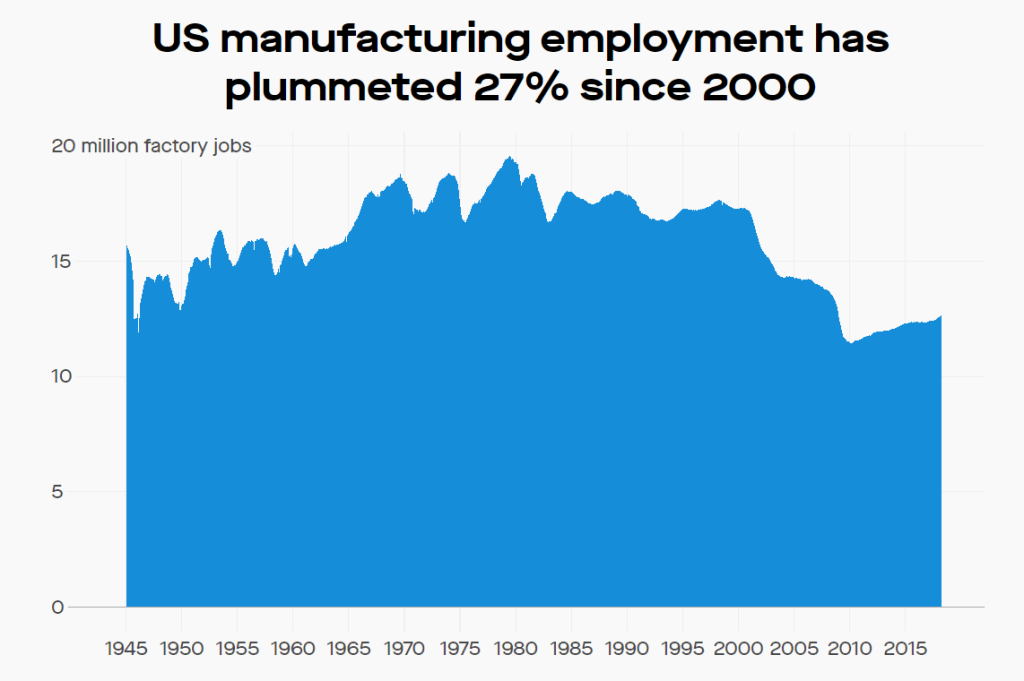
It’s a fact that the liberal economic system has gotten a bad name in this country—”Bill Clinton let China in the WTO and there was nothing we could do about the Chinese assault on American jobs”—but that universally-repeated story is false. (It’s one example of what you might call bipartisan revisionist history—the left and right united against the center!)  The main issue raised with China’s behavior has always been currency manipulation, which was in no way permitted under WTO rules.  And as the following job loss chart makes clear, the loss of American jobs was 100% a phenomenon of the George W. Bush presidency:

That’s no accident.  The radical neocons had us preoccupied with fighting a $3T war, and the same deregulation mania that produced the 2008 crash had us actually encouraging outsourcing abroad.  For the business-friendly Bush people cheap off shore labor was good. All subsequent efforts to help the people hurt by that process were blocked by Congressional Republicans bent on sowing dissatisfaction ahead of the 2016 election.  The liberal order conspiracy is a convenent fiction for both the right (to cover its tracks) and the left (to attack the center).

If we’re going to avoid economic and even potentially military disaster, we’ve got to get past the electoral propaganda and understand what we’ve done right and wrong.  In particular we’ve got to wean ourselves from the siren-call of nationalism.  We’re not going to “win” the future, but we can certainly all lose it.   The real challenge is getting internationalism right, so that everyone has a stake in the action.  We built unprecedented peace and prosperity after World War II.   That job needs to be done again before we give it all up—in a way that has happened many times before. Both prosperity and peace are in question.

One important lesson of history is that economics precedes politics.  The EU, for all its imperfections, is a vast improvement over centuries of status quo.   What got that going was a step-by-step economic union, long before there was anything political on the table.  In that sense, strangely enough, you can argue that the WTO is more important than the UN.  Getting the WTO back on track is going to take considerable doing, but it has to happen. And perhaps climate change can yield an appropriate model.

Climate change is an unusual situation in that practically every country has veto power of the result.  We all share the same atmosphere, and the CO2 concentration is only controlled when everyone cooperates.  So the solution has to get a buy-in from everyone, rich countries and poor.  In fact it can only work when rich countries recognize that—like it or not—they’re going to have to help the poor ones.  Everyone will have to get used to the idea of an international project where the focus is less on who gets the best deal than on whether it delivers the necessary benefit for all.

A functioning WTO is a similar balancing act.  As starting point there is one basic reality to be acknowledged:  self-sufficiency is not a desirable or realizable goal even for large countries.  Despite all the discussion of the evil Chinese, we would be vastly worse off if they just went away.  Just in general, we are not always going to be the best at making everything, and our own industry will be crippled if we can’t build on what’s best.

Furthermore discussions of self-sufficiency tend to include a strong dose of the always-dangerous delusion “my people aren’t like that.”  In fact domestic manufacture does not guarantee availability, quality, price, or appropriate technology.  The single worst problem during the first stage of the Covid crisis was a lack of testing equipment—because the American manufacturer with a CDC contract to produce the tests had decided they could make more money doing something else.  Similarly, self-sufficiency can do little to guarantee the well-being of the national workforce, as there is no substitute for government dealing with all relevant labor issues. Trade is more like climate change than it seems—it’s something we’ve got to make work.

The balancing act is in the many factors that have to be taken into account for fair trade:  labor conditions, environmental rules, government involvement, and so forth.  Those are both impediments and opportunities—they make the negotiations harder, but they are also leverage opportunities for a better world.  Elizabeth Warren in her Presidential campaign made a long list of items she wanted to make as preconditions for trade with the US.  Her standards were very high—it was pointed out at the time that no country met them—but her list was an indication of potential opportunities. Also, it is important that these rules should apply to everyone—including to us.

What this comes down to is that globalization, despite the rhetoric, is only anti-labor if we make it so—which is precisely what happened under George Bush. Instead of using it to establish worldwide labor standards, we used it deliberately to undermine workers everywhere. In other words thus far we’ve had globalization exclusively for the rich. If we don’t step in to control it, it will stay that way—populist movements or not. And if we don’t start learning how to create a world order for the benefit of humanity, no amount of national chest-beating will save us.

The Ukraine affair is dangerous in its own right, but even more dangerous as a symbol of a world out of control.  What the world needs now is neither uncontrolled chaos nor world government, but a set of mutually-agreed rules to forestall a fight to the bottom.  As with climate change, there is no way out other than to acknowledge we are now one interconnected world, and we will all either stand or fall together.

Elon Musk as Time’s Person of the Year

There is nothing wrong in celebrating Elon Musk, who has achieved much of real value.  There are even good messages to be drawn from those achievements.   However there are also plenty of wrong conclusions that can and are being drawn about Musk.  So it’s worth thinking about what’s wrong and what’s right.

Wrong message #1:  We don’t need government involvement in the economy; the private sector can be counted on to get the job done.

Fact:  Tesla was started with Obama-era seed money and Obama-era price subsidies for electric car sales.   SpaceX got going with NASA contracts.  Without government involvement we would have had neither. The major US automakers had to be dragged kicking and screaming to electric cars.   The private sector is not good at supporting novel projects without a near-term payoff.

Wrong message #2:  We can count on smart people like Musk to tell us what to do.

Fact:  High achievers have their limitations and blinders just like everyone else.  Musk’s statement that we don’t need “Build Back Better” because he himself never needed help from anyone is actually typical blindness of the class.  I worked for a successful startup where the four principals fell out with each other almost immediately after we went public—because each was sure he was the reason for success!

Wrong message #3:  In the end we can always count on American ingenuity.

Fact:  Musk is one more example of the importance of immigrants and children of immigrants to the American economy.   Same for Apple and Google.

Wrong message #4:  A few big heroes are what makes for national success.

Fact:  Musk was important as a technical visionary.  No one else recognized that the technological basis existed for an electric car company.  However he also fostered an environment where he could attract the best and brightest to his companies.   The achievements of Tesla and Space X have that broader basis.

What’s more, the Person of the Year could equally well have been given to the many scientists and technologists who gave us the Covid vaccines.  There are more than a few single heroes in our midst.  Big achievements reflect individual contributions of many able people.

I’ll limit the right messages to two:

Right message #1:  Technology matters, and things really can change

Both Tesla and SpaceX are fundamentally new businesses, rethought from the bottom up.  In a very few years they have changed the US economy.

As contrast, a recent book about the Boeing 737 MAX shows what happens a company loses track of the reality of its business in a blind race for profit.

Right message #2:  At all levels individuals can make a difference and should be rewarded accordingly

This is particularly important in technology-driven companies, but not only there.  As noted, that was important not just for Musk himself but also within Musk’s companies.   For contrast, my contacts at NASA and even JPL have described them as stiflingly bureaucratic.  The difference between the SpaceX and the SLS project is undeniable.

Both companies and countries have a tendency to ossify into hierarchical structures that declare themselves to be meritocracies.  Equality of opportunity—including opportunity for real success—is necessary both for individuals and for the success of the overall enterprise.   For society as a whole, we need both a safety net and true opportunities for individuals to succeed.

That, not the pronouncements of Elon Musk, is what makes for success as a nation.

The Hijacking of Race

The Democratic Party owes black people a debt of gratitude for their organized commitment in the last election.   Even if that weren’t true, the United States owes black people what it has never delivered—real, functional equality of opportunity.  It’s worth restating what never made it into any textbook I ever had—slavery in this country didn’t end in 1863.  With Black Laws and then Jim Crow, the substance of slavery in this country persisted well into the twentieth century.  It’s no surprise that we live with a pervasive legacy of slavery.

What is owed here is progress—on everything that makes for personal and family prosperity and life satisfaction.  A recent NY Times piece does a good job of getting at what that means. However it’s worth recognizing that this objective gets hijacked every day in favor of other more exciting agendas, as examples:

– Anticapitalism.  This is a kind of knee-jerk on the left that gets applied to all issues (climate change is another one).  Get rid of capitalism, let me and my morally-certified friends run everything, and racism will vanish in an instant.  Otherwise there’s not a chance. Somehow the dictatorship of the proletariat (like trickle-down economics) survives in the face of all evidence.

– Violence.  It’s amazing how attractive violence is for people who spend their lives far from it.  That’s not just for the classic case of British Nazi intellectuals prior to World War II.  Two very good books The Good Lord Bird and The Underground Railway end with ringing endorsements of violence as a necessary way to get things done.  In context that’s not really a call to action, but it indicates a willingness to forgive violence as a tactic—a significant mistake supported only by rewriting history. 

There’s not going to be a revolution on the left in this country, so we’ve got to work with the flawed political process we’ve got.  Violence hardens opposition—end of story.  If you want to get things done, there’s no greater mistake than believing you have powers you don’t have.

– Cultural superiority.  This has many manifestations.  The good guys are immune from racism, create better artistic productions, are more moral and humane to each other, etc.

If you get past all of that, objectives here are not so different from what we owe to everyone else—a fair chance to succeed and a viable safety net.  What it takes to get there must be adapted to the history of anti-black racism, but adaptation is the rule for every other group also.  Our task as a society is to get the job done for everyone.

It is hijacking the race issue to

– Use it as a justification for anti-democratic behavior.

– Use it as a reason to justify any departure from the rule of law.  We are not doing anyone a favor by asking for an understanding of mob violence.

– Engage in ridiculous exercises of cultural superiority. That includes, in particular, anti-racism competitions.  I’d even say everybody is racist; the important question is who is doing damage and how to stop it. Anti-racism crusades may feel good, but they are not progress. And if they lose elections they are nothing more than destructive vanity.

Even if you think this is an oversimplification, you have to admit that the objectives here–a fair chance to succeed and a viable safety net–are worth pursuing.  You’d think they would be universally popular.  After all, as many have pointed out, essentially any social program has more white than black beneficiaries.  So why aren’t they universally popular?  The reason goes all the way back to What’s The Matter with Kansas.  Republicans have been convincing people for decades that all those measures are not for them.  It’s just giving the country away to the shiftless blacks.  People in Hillbilly Elegy and Strangers in their own Land are astonished that any of their own would waste time applying for such benefits.

Why are Republicans so successful?  BECAUSE WE KEEP HELPING THEM.  With all the discussion of white racists who just have to get used to giving up the advantages of white privilege (and deservedly take the hit), what else would you expect them to believe?  We’re not spending our time saying we’re committed to what it takes to achieve equality of opportunity for everyone—with all the benefits that entails.  Too often we’re playing the Republicans’ game.

You don’t have to agree with everything here, but one thing is indubitably true.  Fighting racism is about results, not morality contests.  It is about jobs, safety, and education for your kids.  It is a pragmatic issue.  Anything that doesn’t produce results is hijacking, regardless of how good it feels.