We should be explicit about the path we’re on. We are engaged in a winner-takes-all fight for AI supremacy. The operative assumption is that whoever wins will rule the world, because that country will control a version of AI so powerful that it can improve itself to be invincible. Whoever wins will liquidate all opposition, so there can be no challenge to its power. That’s the story, true or not. We’ve got to win.
There are many consequences to this. To start with, no effective regulation of AI is possible, because it is impossible to say what constraints on AI development would get in the way of the fight to the death. In particular some of the most obviously risky issues—such as autonomous military decision making—are the most untouchable. This the worst kind of arms race, where it’s not just a matter of parity. Only victory is good enough. There are no effective limits to the amount of money it can take.
But even that is just the beginning. Once you’re in a fight-to-the-death, any form of international cooperation becomes extraneous. You can’t think too seriously about common interests when everyone is a mortal enemy. That mindset is all too easy in any case, since common interests are always a hard sell (even for climate change). So we fall back on the world view we now get everyday—whoever has power deserves what he can get. With the Iran war we’ve gone a step farther, asserting that (with the closing of the Strait of Hormuz) we have absolute freedom to inflict damage on the rest of the world whenever we perceive gain for ourselves.
That this view is acceptable without much pushback is a matter of ultimate hubris. It’s all okay, because we’re going to win. In fact we’re not actually much interested in how international competition works or what it will really take to win. We’ve been on top for so long that we’re entitled. God will make us win. That’s not an exaggeration of where we are.
There’s a lot that we don’t know about the end to this story. The future is never clear. But there is one thing that is definitely true—we’re stumbling our way into real danger. The risks are everywhere. For technology we’re certainly not necessarily on top—even today China is a serious competitor—and we’re burning bridges to the future by killing research investments and attacking all foreigners as parasites. Even for AI we’re a long way from the finish line, and it’s unclear whose paths will get there first. More generally we’re in a wildly unstable arms race with many new technologies, proliferating nuclear weapons, and no good way even to know who is ahead. Yet we’re using war as if it’s a regular element of national policy.
The only workable way to forestall conflict is viable common interest. You don’t have war or countries laid waste if all parties recognize there’s a lot to lose. (You can still have homicidal maniacs, but shared prosperity helps keep them out.) The world needs order, starting with recognition that interdependence, economic and otherwise, is not going away. So we had better fix it. Start with economic issues—trade, climate change, AI—and then do something about war. A fight to the death ends with just that, and who knows how many—both here and abroad—could pay.
We’ve been there for more than 75 years, since the end of World War II. We are the power that maintains the world order. As such we’ve overseen a remarkable period of growing global (and our own) prosperity. People from both political parties agree that we are the ones that make things happen. We’re so comfortable with that role we’ve come to believe it is ours by right and permanent.
Recently though our attitudes toward that role have changed. We’ve now decided that since we’re in position to run the world, we ought to be able to keep more of the benefits for ourselves. So instead of maintaining that world order, we’re now in it for everything we can get—confident that the sky is now the limit.
However we have found there’s a hitch. We attacked a medium-sized country—Iran–to put them in their place, and we didn’t win. Not only that, an even more minor power—Ukraine—has shown itself more capable of defending our allies than we are. We still have more bombs and aircraft carriers than anyone else, but somehow that doesn’t do the job anymore. And the problem is getting worse. We’ve been so preoccupied with China, we haven’t noticed that the problem is not just that.
With nuclear proliferation, computer-controlled drones, and rapidly evolving AI the past pecking order no longer holds. Instead the future looks considerably more chaotic—with murky and changing notions of international strength and weakness and risks of conflict from both overconfidence and paranoia. When we tell everybody our new story—that powerful countries should be able to do anything they want to everybody else (because that’s the way it ought to be)—it not always so clear which side of the story is us. And lowering the threshold to war isn’t necessarily such a great idea either.
Whether we want to admit it or not, we were pretty stupid in the Iran war. We ignored obvious issues when we attacked, and we were so overconfident that we didn’t do even the most basic job of preparing for the fight. We didn’t win. But that’s not the end of it. Our changed notion of international roles was equally stupid and blind. We gave up on the idea of international order just when we actually need it, when we can no longer count on always ruling the roost.
Neither problem has a simple solution. We’re going to come out of the Iran war worse off than when we started. It’s hard even to guess what we’ll have to give up. For the world order things are different. We have proven that a reasonable world order can benefit everyone (at least generally). We don’t have to be able to shakedown everyone else. We just have to participate in recreating and inventing conditions for international success. That must now include addressing climate change, for example, in addition to preventing war. The job is not simple but the choice itself is: we can either help to create a livable world or suffer in nuclear-armed chaos.
One of the biggest problems with politics in this country is assumed connections that simply don’t exist. DOGE and the closing of USAID and other government programs were money in the bank for the Trump base (instead it went to tax cuts for the rich). Getting rid of immigrants would leave more of the pot of gold for everyone else (but growing the pot is the big issue and immigrants are contributors). The reason we can’t have free public college here is that the Europeans didn’t contribute enough to NATO (though the Republican Party has consistently blocked any such public services). And of course the big one—making rich people richer will trickle down to everyone else (which has never happened anywhere—they just get more power to help them keep it).
You have to be really careful with anyone’s tacitly-assumed connections. Even if they existed in the past, there’s no guarantee they’re going to continue as before. The particular case I want to talk about is the assumed link between national power (military and corporate) and population well-being. For most of the 20th century that link was real. That’s Trump’s factory economy with good jobs and the corporate might that won two world wars. But that’s not the reality today–manufacturing is 8% of GDP, unions cover 10% of workers, and many service sectors are low-wage and dead-end. It’s going to be even less the reality going forward. The AI world is simply not going to supply that kind of employment-linked prosperity—there will be good jobs but not so many of them for a good long while. Experts spill ink arguing about the impact of AI, but the desperation of new college graduates (and current students) is the real world.
Many people have compared AI to the industrial revolution of the nineteenth century. Britain at the time was the most powerful and prosperous country that had ever existed. It was a world of fabulous wealth and horrendous destitution, both domestically and in its empire. Eventually the world was able to adapt to the new reality, but that took a whole century of well-documented horrors. Economies can’t adapt overnight. The private sector will not miraculously solve the problem. The only way is for government to create the link that is broken. (Note there is another side of this picture–we are all increasingly dependent on a relatively limited group who make the difference for rest of us. There is no alternative to spending money on education and research and also restoring our standing for the best and brightest from everywhere.)
Despite all the propaganda to the contrary, government needs a bigger role in employment. This isn’t charity. Government needs to finance work that needs to be done but won’t get done by the private sector alone. An obvious case is climate change, which will require monumental transformations well beyond the cost of the new equipment. (In this country we have the dubious distinction of currently paying for a huge, debt-financed, fossil-fuel-powered datacenter expansion–that will end up being reworked in short order for a cheaper sustainable successor that meets the actual needs of the 21st century.) There are also many other parts of the public sector that have been starved for years–for example in healthcare and education. All of that sounds like a recovery plan from a depression—how to put people to work–but there’s a big difference: we have the money. As with the industrial revolution the problem is not a shortage of work or a shortage of money—it’s making the link. This time we need to do it.
That isn’t a trivial problem, but it’s worth understanding it as THE economic challenge of our era. The wealth growing out of the new AI economy has to benefit societies overall. In this it’s worth recognizing that the companies we’re talking about are not in cut-throat price competition with each other–if anything our problem today is too much consolidation and sector monopoly behavior. Tech companies operate with profit margins that would have been unthinkable in competitive industries. Google’s operating margin runs over 25%. Apple’s over 30%. Microsoft’s over 40%. But we do need to be careful to make taxation work effectively, and we need to avoid an international race to the bottom. I’m not going to attempt to solve all of that here. But I will note that the prevalence of stock buybacks is an indication that companies have more money than they know what to do with, and also that some kind of equity participation by the government in business is consistent with the value of the infrastructure provided. Fitting this wealth distribution into international trade rules isn’t simple, but we’ve done that sort of thing before–with labor standards and environmental regulations.
To end here I’d like to take the international part a step farther. There are many reasons why the world today needs new forms of cooperation–including tough problems like nuclear proliferation and war. This economic issue is everyone’s problem, and (as opposed to many other issues) it can be rationally addressed. It would also be stabilizing for the welfare of national populations. So if we can make progress with this one, perhaps it is also a step towards the rest. We need to do it.
We all know about the huge US trade deficit with the rest of the world. Most of us know this is just about trade in goods, so that it does not include the trade surplus in services—which historically compensates for roughly 40% of the total deficit. So services are large and growing but nowhere near the size of the problem. What’s less obvious is just how wildly incomplete this story is.
It’s straightforward to see why. Look at the iPhone. iPhones imported into the US are a significant (but of course not decisive) contributor to the deficit. It’s an expensive item and we get lots of them. However what’s imported is the hardware—which is what counts for the balance of payments. But great majority of the profit goes to Apple, because most of the product value is from the software written here. The balance of payments calculation is backwards—it’s a win recorded as a loss.
It’s worth noting a historical parallel. Early in the Industrial Revolution the British insisted that India only export raw cotton to Britain, so that all the value-added would be captured there. All parties recognized this as an example of colonial exploitation. We’re in exactly the same position, and we’re worried about the balance of trade!
We can even go a step farther. Consider an iPhone made in India and sold in Korea. It shows up nowhere in balance of payments calculations, despite the profits earned by Apple on every such sale. There is no reality to the balance of payments statistics at all.
And this isn’t a one-off. Here is a list of the top ten US companies by market valuation.
🏆 Top 10 U.S. Companies by Market Capitalization (2026 estimates)
JPMorgan Chase & Co. – ~$0.6–0.7 trillion (approximate, rounding into the top decade range)
The #1 is now Nvidia. Perhaps surprisingly it’s just like Apple. They don’t make the hardware either. What they provide is another kind of software—detailed specifications embedded in a form for transfer to TSMC for fabrication. The high-value contribution is made by developers in the US, which is where the profit is realized as well. (It’s interesting to compare Nvidia with TSMC. Both companies have monopoly positions in their markets, but Nvidia avoids the huge capital expenses of hardware, and makes much more money by being on top of the production stack.) There is something more than a little disturbing about national policies based on numbers that are completely off-base for the two biggest companies in the world.
The problem here is that the goods versus services distinction doesn’t mean what we think it does. We want to think about that distinction as somehow capturing hardware versus software, but it doesn’t work that way. More and more software is getting embedded in products, so it’s counted wrong. It’s more correct to think about software (broadly-defined) as highly-skilled manufacture. The same kind of thing happens with pharmaceuticals. More and more of the value creation is not in building the product hardware, but in defining content. So the value-added enabled by the imports is not captured anywhere in trade statistics.
And the software business is great—fewer capital requirements and you’re on top of the heap for revenue. There is also a strong trend to monopoly from network effects and software’s built-in economies of scale. Most of the businesses on the top 10 list—one way or another—are software businesses and many are effective monopolies in their sectors. It’s not surprising our economy has evolved in that way, and the top 10 list is anything but a sign we don’t know how to make money. However since the statistics have not kept pace, we end up deluding ourselves about both the present and what matters for the future.
We can put some numbers on that. What are the actual revenue impacts of the balance of payments deficits? For Apple and Nvida the calculation is straightforward from available product costs. For the iPhone the ratio of enabled revenue to the balance of payments deficit contribution is 5 to 1. For Nvidia the ratio is 6 to 1. Those are big wins, and perhaps less exceptional than you might think. It’s harder to get numbers for US companies overall, but arguing from both S&P 500 foreign sales numbers and OECD value-added statistics gets the ratio of unacknowledged revenue linked to trade to the deficit at about 4 to 1. (The argument is not complicated. Both approaches yield US foreign sales of about $5.5T which means $2.3T of foreign revenue above all reported exports, both goods and services. That’s real value not captured by the trade stats. Further as a conservative estimate we can assume that same uncaptured value for US domestic revenue by the same companies. That’s now $4.6T of extra revenue linked to international trade. Divide by the goods deficit of $1.2T and you get 3.8, and the more correct goods + services deficit of .9T gives 5.1). This is of course not the same as the Apple or Nvidia calculation, but it is a comparison of the supposedly evil deficit to the missing wins brought by trade. Our true global trade balances are a resounding plus.
So what do we conclude about the balance of payments deficit? First of all it’s NOT a problem. It’s a reflection of the way our economy works, and that’s a proven productive direction. The unbalance is not because we are losing out but because the trade statistics don’t see where we make money. Furthermore this is not a picture of everyone taking advantage of us; on the contrary we have much of the world competing with lower-margin items to supply us in our higher-margin activities.
That’s not to say there are no issues—we obviously need to talk about jobs and security of the supply chains. Jobs are the more pressing item. However the only reason jobs are in this discussion is the assumption that people are hurting because other countries are stealing our prosperity through trade. That story is false. People are not poor because we as a nation are not making money—we are–they’re poor because the distribution of wealth in our society has left them behind. The idea that we’re going to solve that problem by having our people substitute for the workers in the low-margin industries that feed our companies was never more than a smokescreen to hide that reality. Those aren’t manual labor jobs, and they can only be good wage jobs in this country if the government basically pays their wages. There’s no other way they are going to meet the price targets for the final products. Even then it’s hard to imagine anything practical about these half-governmental uncompetitive companies. What we should do for disadvantaged populations is part of a bigger story about government responsibilities—we’ll return to that later. But this story—solving poverty by bringing low-margin, low-wage factories here—was never more than populist gloss. No one ever cared enough to work it out at all.
There is also a more general question—why don’t we just squeeze every other country in the world (and in particular our allies) and bring all of those jobs here? Let them all go to hell, and then we’ll be rich! In fact that simple-seeming argument is grotesquely wrong. Those other countries are major contributors to our success. As we’ve just seen they are enabling our companies to be as successful as they are. Also their security is our security, and they are on the front lines in both Europe and Asia. Finally (as we’ll discuss more later) their people are major contributors to our technological dominance—the fundamental source of our wealth and power. We are the technological center of the whole free world, drawing strength from everywhere is a way that is historically vital.
For supply chain security, the argument seems to be that we need to bring all supporting activities in-house to make sure that supply chains are under control. That argument is also false. You’re never going to bring it all home, and even the supply chains in-house are no guarantee. During Covid the CDC had a contract to provide M95 face masks prior to the pandemic. However, the contracting company got acquired, and the bigger company noticed there was no health emergency and no real business. So they spent their money elsewhere and no single mask was ever delivered. Running an artificial, uncompetitive business for reasons of security is anything but a sure thing, and providing a second such business for redundancy is even worse. And again if the business is to be price competitive lots of money needs to be pumped in. It’s an expensive bad solution. Instead what is most useful is real multi-sourcing. We need diversified supply chains with production spread across Taiwan, South Korea, India, Vietnam, and Mexico, so that no single disruption can choke off supply entirely. Instead of competing with those real, productive companies, our interest is in making sure they keep it up.
Just about everything involved with the balance of payments discussion is out of touch with the realities of US economic strength and the needs of the population. Thus far it’s too early to see the full dangers of the mismatch of policy and reality: The final tariffs were significantly lower than originally proposed, so that supply chains have been able to adapt, but multiple studies have shown that the tariffs for more than 90% are paid by us (regressively). And there has been only pain—not benefits—to the people Trump is nominally saving; it’s the billionaires cleaning up left and right. (But at least today we can celebrate the Supreme Court’s blocking Trump’s ill-conceived and illegal tariffs!)
However the future is the main story, which is where we need to go now.
For that we need to recognize just how dynamic the world economy is becoming. There is every reason to believe the trends we discussed for the top 10 list—software (broadly-defined) and monopoly—will continue and even accelerate. AI makes it ever easier to build software that interworks with all kinds of products. And robotics in particular can be revolutionary. As robots become software platforms, rather than individual products, a greater range of businesses can be imagined primarily as software applications. That way the iPhone business model can extend to all kinds of physical devices. AI has already made it possible for small teams to do things that used to require many more people with distinct specialties. We’ve already seen companies come from nowhere in a very few years—there will be more and faster.
How do we prepare for success in that future? The balance of payments view of the world doesn’t help, because it is static and already out of touch with the present. Fixing that gets us nowhere. Further Trump’s rhetoric about bringing back the good old days of factory jobs mixes up corporate value-added with imagined low-skill job creation—for jobs that largely no longer exist! He may want to think about people standing in front drill presses all day, but we had better not take him too seriously. We have to deal with the future as we see it coming
To begin we need to talk just about business competitiveness. If we’re going to succeed in the kind of business environment just described we need three things:
We need innovative types able to start the new businesses which will make up the rapidly evolving landscape we just described
We need people who will provide the kind of value-added needed by such businesses
We need government to support innovation. In practice that means not choosing winners and losers and protecting innovators from the powers that be.
Those are absolute requirements. Before we can talk about anything else, we have to satisfy those. At the same time however we need to provide for the well-being of the population and the national security of the country. Those two types of requirements seem distinct, but as we’ll see they are closely linked.
On the innovation side we have traditionally been well-positioned here. The single most legitimately-true feature of American exceptionalism has been our openness to enable people from anywhere and with any background to find a home where they can thrive and fit in. We have been the place for the best and brightest from everywhere to come and build success. Immigrants and children of immigrants have been prominent for Nobel prizes, in founding companies, and more generally in staffing the high-tech companies driving the US economy. It’s true for AI today. And the strong network of research universities and government labs has meant that the latest technologies could be counted on to be supportable for new businesses.
US openness has been perceived as unique worldwide—which matters for all of us. Because we draw from the whole world, the US achieves levels of technological dominance and wealth that are hard to match. China may be big, but the whole world is a lot bigger—and so are we. It matters in every domain. That not everyone experiences that wealth is a different issue—a political problem (as we’ll discuss later) not a national wealth problem.
The bottom line is that the overall well-being of the population is not just a matter of decency—it’s intrinsic for national success. Our dominance is in a very basic way a reflection of what we as a nation represent.
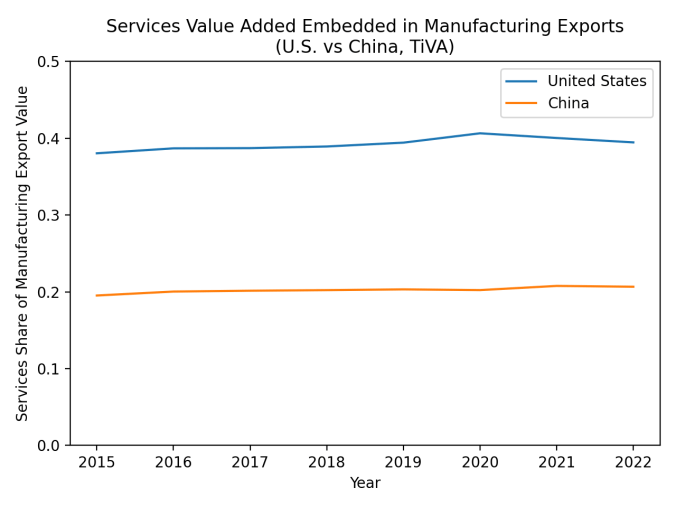
It’s interesting that China is a kind of opposite pole from us—a huge inwardly-focused country whose export businesses are primarily in hardware with hard-won price advantages. That’s not to say they can’t move in our direction, but thus far their focus has been different, with less emphasis on software value added. As the following chart indicates, China’s exports have been considerably less oriented toward added services than ours. If we’re worried about competition we have to recognize and play to our strengths. Our big world of economic as well as political allies has been of major importance. As in the discussion of imported inputs for Apple and Nvidia, they do their jobs for us better than we would do for ourselves.
All of that is why it is so serious that we have recently decided to relinquish many of those traditional advantages in a burst of self-destructive nationalism. We now have overt hostility to foreigners, attacks on universities, and cancelled research money. We’ll throw lots of money into today’s hottest development item—the current version of AI—but we have chosen to be deliberately blind to whatever comes next. In addition we’ve decided to choose winners and losers in technology based entirely on “intuition”. Since climate change is now officially non-existent, all technologies associated with it are removed from our national consciousness. Unless some of this is reversed we will be like the British after World War II, living in past and lost grandeur.
Beyond competitiveness, we need to talk about national security and population well-being. For both the most important message is a simple one: there are a great many important problems that the private sector will not solve by itself. That may seem obvious (it was to Adam Smith) but it’s contrary to the endlessly restated ideology of the last decades: that the unfettered private sector just needs to be left alone to work its magic. I’ll start with security. We need to be clear—we’re talking about national security here, not the reliability of value chains as before.
Government needs the professional competence to decide what actions have to be taken in the economy for reasons of national security. That includes what products and capabilities we need to have here and what needs to be done proactively to prevent the kind of dependencies we have with rare earth elements today. We have to be able to think ahead in a way that the private sector won’t. So government needs professional competence protected from political persecution. After all, the Chinese clearly were able to think ahead; a primary reason we couldn’t was the ever-present private sector mantra just mentioned. We were too smart to think about government telling businesses what to do.
In addition government needs to think more broadly about security. As we noted earlier we will never be able to take everything in-house, and even domestic suppliers have their own interests. So complete self-sufficiency is a chimera, and security is intrinsically concerned with international relations and the world order overall. That’s a big subject worth discussing but out of scope here.
Returning finally to the well-being of the population, the most important thing to say is that the businesses that form the basis of US economic strength won’t necessarily fix it. They’re not going to employ everybody. To some extent the overall wealth of the country will translate to general prosperity in the domestic economy (e.g. entertainment, home services)—but there’s no way, particularly with AI, that will be enough. It isn’t enough now, which is why we get Trump’s fairy tale with 1950’s jobs. Government will need to be involved with things like an adequate minimum wage as well as a bigger role in infrastructure of all kinds. There is no shortage of work that needs to be done—in physical infrastructure or healthcare for example. Also climate change will require significant near-term modifications all over the country.
That takes money, but national wealth is not the issue. The companies in our top ten list aren’t low-margin businesses even if they’re happy to get tax cuts. And going forward, we’re talking about sector-dominant software companies for even more of the same. The challenge instead will be to restore the idea that shared prosperity is ultimately for everyone’s benefit, so that progress can happen.
It’s a truism that we have to grow the economy and ensure that wealth is broadly shared. But it’s important to recognize the two aren’t the same thing, and we need both to make the economy work. (Stephen Miller’s much-repeated slogan—getting rid of immigrants means more of the pot for all the rest of us—is a good way to fail at both.) This isn’t easy, but it’s not as if we haven’t done it before. Trump talks about the good old days of the 1950’s, but he doesn’t talk about how we got there. That broad-based prosperity was most assuredly not achieved by liberating the miracles of the unfettered private sector; it was by doing what we’re talking about here.
Last time we had to go through the Depression and two world wars to get there. This time we need to do better—both the risks and rewards are too great not to.
As an indication of where the economy is going, someone should calculate permanent jobs created per dollar of capital expenditure for all the new datacenter construction. That’s probably a new low for expenditures of this magnitude. It’s more complicated to predict the effect on jobs in the rest of the economy, but that’s most probably negative.
It’s hard for me to think this doesn’t say something about the world we’re going toward. It’s not so much that there will be a shortage of jobs overall as of good jobs. What is it that we are going to use to bargain with employers? Traditional education is about knowledge and capability. In our familiar world it takes years to put together the package that an employable person represents, and there are many distinct niches that need to be filled. In the new world, knowledge is more readily accessible, the capabilities required are more generic, and staffing levels may be reduced by efficiencies. We’re only beginning to see how that will shake out.
As we noted last time, the private sector is not good at managing effects of radical change—on people and on the environment. On the other hand, we’re talking about really significant productivity improvements, so in principle that should be a good thing. But that’s not going to happen by itself. It sure didn’t happen at the start of the industrial revolution—for most of humanity that meant misery and war.
In this anniversary of the American Revolution there is a relevant quote from the signing of the Declaration of Independence: “We must, indeed, all hang together, or, most assuredly, we shall all hang separately.” That’s now true worldwide. In this time of economic ferment, climate change, and nuclear weapons we had better learn to work together for global well-being or there may be nothing left at all.