A few weeks ago I did a piece on making democracy work. It strikes me now that I need a broader context for this—about governance generally.
The point of departure for any such discussion is the role for the powers-that-be, the rich and powerful in society. That group has built-in power by virtue of its economic clout, as well as a conviction that it is superior and ought to rule. However it also has built-in limitations for such a role. Generally speaking:
– It is uninterested in the well-being of the population (its inferiors). On the contrary these are defenders of privilege.
– It wants to protect itself through monopolies, tariffs, corruption, and the like.
– It discounts the future in pursuit of immediate profit.
– It assumes all knowledge or issues outside its purview are worthless.
All of these sound familiar, but it is important to recognize they aren’t just for Trump. This is the overweening confidence of privilege.
For that reason one of the most fundamental problems of national governance is managing relations with the rich and powerful class. It will always want to govern and must be kept healthy but in check—a difficult balancing act. And the issue is not just for sake of the less fortunate. The short-term and generally myopic focus mean that this group will not provide even for its own longer-term success. Adam Smith himself understood all of that perfectly.
The prior piece on democracy was mostly about addressing the first point. The other points are different, about institutional competence and recognition of the jobs that government must do. That’s worth emphasizing—if government doesn’t address those points, the job won’t get done. Government has to take responsibility for the success of the country. The private sector will not do it.
Such work cannot happen without the institutional competence to get it done. That’s why it was an enormous step forward when this country created a civil service with agencies protected from politics. The Supreme Court’s repudiation of agencies shows the danger we’re in.
Successful balancing delivered the huge success of this country. We were technology innovators, looking for new ways to expand the economy. We educated all our people to a degree unheard-of before. We funded universities and pure research. We strengthened our military and economic position through alliances. (It is worth stating explicitly that NATO is and always was a vehicle to defend us—with multiple forces always under US command.) We developed the interstate highway system and other internal infrastructure second to none. We protected our health and resources.
That successful role of government was established here following the recovery from the depression and then World War II. No one then was arguing about the role for government. And that attitude persisted through the postwar success. At that time we were united as a middle class society with what we felt were common goals.
The widely-agreed turning point was the Reagan administration, when the powers-that-be realized that there was a path to a future where they could buy elections and win. It’s no accident that Reagan repealed the so-called “fairness doctrine” for TV political coverage, removing constraints on what money could buy as propaganda. Plato (in his “Republic”) warned that democracy provides the tools for autocrats to seize power. Democracy capture by oligarchy is a perpetual threat. And here the US Constitution proved particularly fertile ground.
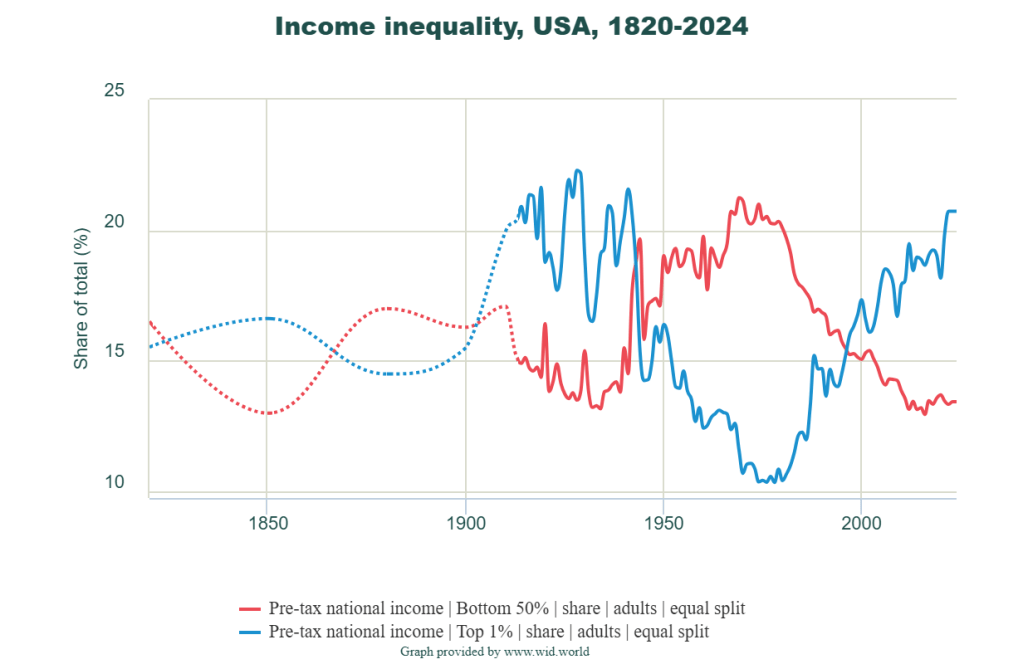
In the end the Supreme Court has been the “Achilles heel” of American democracy. With undemocratic nominations and lifetime appointments it was only a matter of time (and luck) before the Court was bought. The Koch organization people devoted decades to that task. The Citizens United decision essentially sealed the deal. Almost immediately it enabled elections to be bought and legislative districts gerrymandered. The final stage came with the death of Ruth Bader Ginsberg, so that the Court had an unbeatable majority of members whose Koch-nurtured careers had prepared them for their roles. We have now reached the stage of historically unique (for the US) inequality—and diminished expectations for all .
Influence of money on politics is a given. It is present to a greater or lesser degree in particular issues and administrations. Capture of government by privilege is qualitatively different. There is no one left who needs convincing and effectively nothing standing in the way. So incomes on top can keep growing while fundamental needs remain unmet.
Trump is their vehicle. He is erratic, narcissistic, and vicious, but he’s on board with the program. And he’s a phenomenal salesman. On voting he’s a virtuoso with the most basic of sales techniques: when your product has a defect you tell the world your opponents have it. Looking to steal an election and with no examples of fraudulent voting, he tells Republicans to “try and cheat like hell like they do”. And much of the country believes it.
With Citizens United the Court played a big role in Trump’s election, and since then it has awarded him extraordinary powers, even putting him above the law. Calling Trump a populist confuses his carefully-tailored image with reality. Think instead of Trump in his element at his recent celebratory dinner for Xi. It’s not just Trump. We are living the triumph of privilege.
Democracy is inherently fragile. The powers-that-be will always think they deserve to rule, and they know how to profit when they get it. But as noted before, however much they celebrate—they are victims too. For all the reasons we’ve discussed their win turns into a loss for everyone. Let’s look at some of what we’ve got:
– Future compromised (research funding limited and politicized, huge deficit in good times)
– Government competence undermined (“unified executive” = loyalty is the only qualification)
– Military weakened (loyalty purges and posturing, alliances attacked, losses of all kinds from the Iran war)
– Infrastructure development neglected (no upgrade plan for antiquated and insecure electrical power, attacking universities instead of strengthening education, nothing for the housing shortage)
– Economy hamstrung (fossil fuels only, ever-changing trade wars, no anti-trust, attacks on contributing foreigners)
– Personal security diminished (pervasive financial insecurity, expensive chaotic healthcare—even measles! Social Security squeezed and threatened)
– Closed mind society (media consolidation and control, xenophobia, overt racism)
– Real catastrophes brewing (nuclear proliferation, AI, climate change)
We have an election coming. We have to hope no amount of money can conceal the enormity of the truth.