We read regularly that many of our traditional strengths as a nation are being undermined in this administration. But frequently such pieces end up tempering their concerns with a belief in America’s fundamental dynamism and vision, as contrasted with (say) the central control of the Chinese regime. I’m all for believing in progress, but we’re not going to make any if we refuse to recognize how deep a pit we’ve fallen into. Like it or not we are living with an administration that has deliberately attacked precisely those “American values” we want to believe in.
Here is a notion of what we’ve lost and need to find.
- Americans used to believe in the future.
It was our future, and we did all we could to own it. Our research institutions were the peak of the world, and people came from everywhere to participate. The list of Nobel Prizes records our success. Part of that enterprise was to understand what was possible, and we built science into the functioning of government, so we knew where we were going.
All of that is now by the wayside, replaced by Trump’s “intuitions”. He knows everything there is to know, and what he likes is by definition truth. That holds for climate change, for research grants, and even (incredibly) for airplane launchers on aircraft carriers. Even for NIH—a critical source of US competitiveness—grant money has been reduced and RFK’s decision logic hidden. We’re not looking for truth, we’re looking for loyalty.
We still have the fruits of past successes in AI, SpaceX, and BioTech (all started with pre-Trump government money) and we even have a venture capital community to help fund it. But all of that is today. VC’s may sound future-looking, but they’re not going to fund anything that doesn’t pay back big and soon. All of our present investments are at risk, because we’re too busy selling the present to think more than a step ahead. The idea that we’re going to win with bigger and bigger investments in AI hardware sounds like the Maginot Line from pre-World War II France. That was a huge defensive investment based on their experience with World War I, but the German Blitzkrieg just went around it. In our case the Chinese, with a broader view of AI applications, may do the same. In addition the obligatory government payoffs from big corporations mean that new entrants face vested interests with government-protected monopoly powers. It’s like the old joke that someone in the nineteenth century patent office proposed to close it down because everything important had already been invented. We just did that.
The Chinese have built up their universities and research institutions to be world class. They figured out the coming importance of rare earths, solar cell and battery technologies, and medical research. They may have government-defined five-year plans, but at least they have competent technical input and in many areas they have more internal competition than we do. By contrast our focus now seems to be on the past—strong-arming our friends in hopes of delivering the jobs of the 1950’s. What we call American dynamism comes not just from individuals, but also from the opportunities for such people to succeed. For our current leadership that dynamism is unwelcome competition for its own all-embracing genius—something to be stamped out ASAP.
To succeed we must work to see the future and provide means to go there.
- Americans used to believe in our people
The American belief in its people goes all the way back. The whole point of American democracy was to capture the strength of the population. That’s why George Washington stepped down as President from the dictatorship that most of the world expected to see. That’s why Lincoln talked about how “government of the people, by the people, for the people, shall not perish from the earth.” The democracy was far from perfect, but it was still a big step forward.
Coming out of that mindset was the revolutionary idea of education as essential to the role of the population in a democratic state. This country pioneered the idea of educating the whole population, first at the high school level and then for colleges. The power of the country expressed the capabilities of its people. Even the “robber barons” of the nineteenth century recognized the need to in some sense or other give back to the society to which they belonged. Immigration has always been a tricky issue, but we have learned that a multiplicity of people can participate in the democratic experiment and that diversity can be a source of strength.
Today we have replaced all of that with a dramatically different model. We live in an age of self-declared superheroes. We have a President who thinks he is infallible (and spends much of his time on monuments to himself), and business leaders who are convinced they belong to a different race.
Nothing in the Big Beautiful bill shows government has a role to play specifically for the population. We’re running a huge deficit and cutting desperately-needed benefits to poor people so we can have big tax cuts for businesses and rich people. There’s more detail on who gets benefits here. When Trump talks about the golden future, there is no mechanism for it other than to make rich people richer. When he attacks Social Security (e.g. with bogus claims of fraud) he’s attacking the whole idea of direct government support for the welfare of the population. Crucially government has no role in protecting the population from the powers-that-be running everything for themselves. Government of, by, and for the people should perish from the earth.
People don’t necessarily see things that way, but one way or another they understand that there is no one protecting them from the abyss. So the AI future looks pretty damn scary, and they’re not so enthusiastic about those datacenters either. Owning the future sounds ridiculous.
To succeed we must support our people.
- Americans used to believe in our role in the world.
Coming out of the horrors of the Second World War, we and everyone else hoped for a better future, a new world where this horrible thing would never happen again. America, as the major power of the age, took its responsibilities seriously. A world at peace was a world where everyone could prosper. That meant rules and responsibilities for everyone and institutions to support them. It was easy for the US to want to be magnanimous; we were the richest, most powerful nation hands down.
We’re actually much richer now than we were then, but something else has also happened. On an international front we are no longer so dominant, with China specifically challenging us in just about any dimension of wealth and power. That’s our primary subject of discussion for international affairs these days, but in fact that’s only part of the picture.
The other part is about American society. After World War II our nation was as equitable as it had ever been, with prosperity widely shared and new opportunities for personal success, particularly through the GI bill and expansion of education. In the years since then that equality has been eroded until today, we have reached unheard-of levels of wealth and poverty, beyond even the Gilded Age of the nineteenth century. The following charts show the magnitude of the changes to both wealth and income:

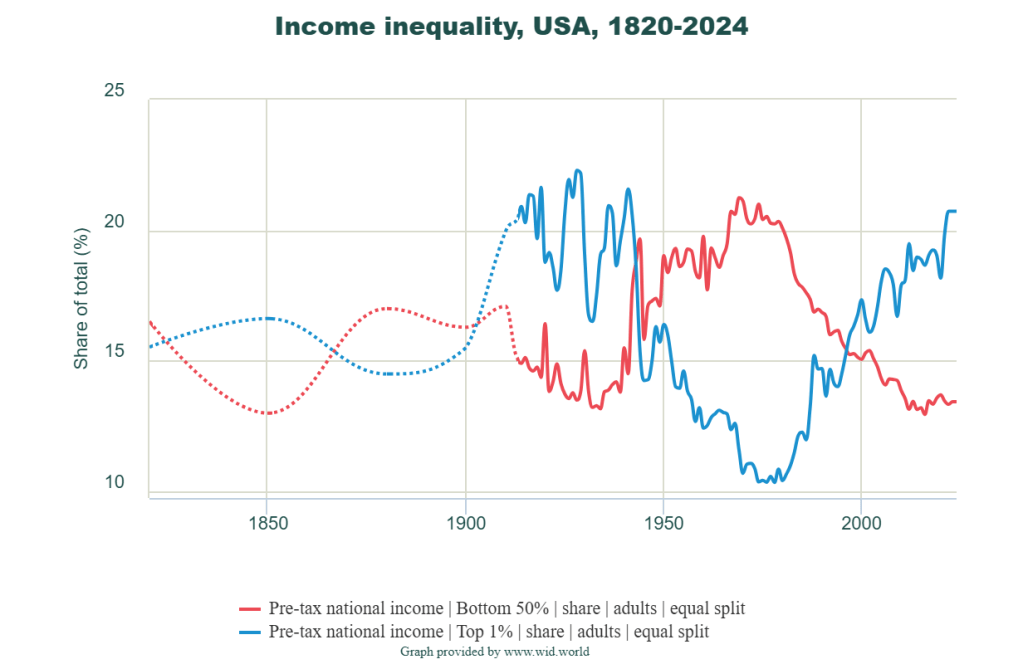
There is no question that the quality of life for many people has deteriorated. And it is conventional to say that the international idealism of the post-war years has been replaced by a grubbier reality where we are no longer dominant and every country struggles to compete with all others. And the quality of life issue reflects that grubby struggle, in particular with the Chinese. So the post-war idealism makes no sense anymore—we just have to win.
It is no accident that this conventional picture elected Trump. That’s what it was created to do. There is no shortage of money in this country, but in the years since World War II the powers-that-be have learned to protect their wealth from the population at large. And electing Trump has enabled a pillaging of the country without precedent. You have to blame someone, and it’s always the foreigners and the immigrants.
We certainly do have competition with other countries. But the idea that all our economic problems are because we are under assault from the rest of the world is patently false. Trade deficit numbers simply don’t tell today’s true story. An example is the Apple iPhone—a big winner for the USA but counted as a trade deficit loser. Much of the economy works like that. And the quality of life issue is unquestionably something we have done to ourselves. This is a prosperous country, but not everyone has felt that prosperity.
In other words we as a nation are in the curious position of carrying out a foreign policy designed to protect domestic inequality! Of course it’s all about those foreigners! In that we are doubly hurt. We are unable to deal with the actually tractable problem of population insecurity. And we have lost our essential (and historical) role of helping worldwide stability in the face of the huge problems of climate change, nuclear proliferation, and the unclear consequences of AI.
To succeed we must—especially now—be able to recognize our broad interest as a nation in the world, above and beyond any corruption or special interests.
We (and everyone else) need a stable, prosperous, and peaceful world for our success. That is a worthy and achievable goal. We used to understand these three keys to doing that, and we can do it again. Our challenge is to recapture them—for ourselves and for our children.


