US Competitiveness—Hiding in the Numbers

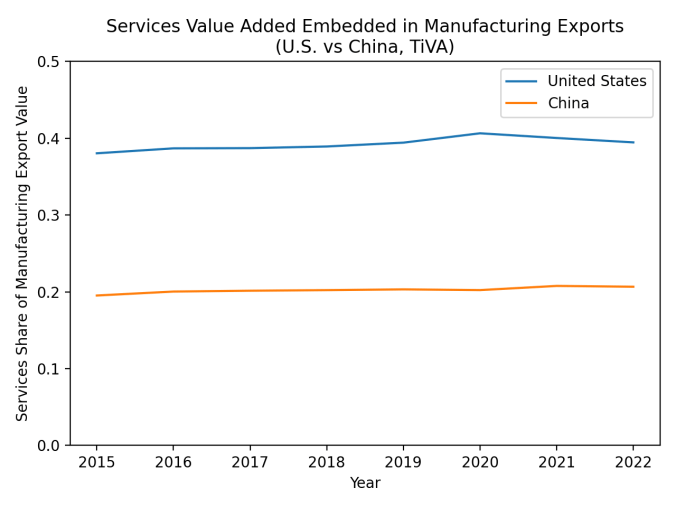
We all know about the huge US trade deficit with the rest of the world.  Most of us know this is just about trade in goods, so that it does not include the trade surplus in services—which compensates for roughly 40% of the total deficit.  So services are large and growing but nowhere near the size of the problem.  What’s less obvious is just how incomplete this story is.

It’s straightforward to see why. Look at the iphone.  Iphones imported into the US are a significant (but of course far from decisive) contributor to the deficit.   It’s an expensive item and we get lots of them.  However essentially all of the profit from that item goes to Apple, and in fact most of the value-added is from software written here.  From a functional point of view it is a US-manufactured item, because that’s where the software is written.  The balance of payments calculation is backwards.

This isn’t a one-off.  Here is a list of the top ten US companies by market valuation. 

🏆 Top 10 U.S. Companies by Market Capitalization (2026 estimates)

  1. NVIDIA Corporation – approx. $4.5 trillion (currently world’s largest)
  2. Apple Inc. – ~$4.0 trillion
  3. Alphabet Inc. – ~$3.8 trillion
  4. Microsoft Corporation – ~$3.6 trillion
  5. Amazon.com, Inc. – ~$2.5 trillion
  6. Meta Platforms, Inc. – ~$1.4 trillion
  7. Broadcom Inc. – ~$1.7 trillion
  8. Tesla, Inc. – ~$1.3 trillion
  9. Berkshire Hathaway Inc. – ~$1.0 trillion
  10. JPMorgan Chase & Co. – ~$0.6–0.7 trillion (approximate, rounding into the top decade range)

The #1 is now Nvidia.  Perhaps surprisingly it’s just like Apple.  They don’t make the hardware either.  What they provide is another kind of software—detailed specifications embedded in a form for transfer to TSMC for fabrication.  The high-value contribution is made by developers in the US, which is where the profit is realized as well. (It’s interesting to compare Nvidia with TSMC.  Both companies have monopoly positions in their markets, but Nvidia avoids the huge capital expenses of hardware, and makes much more money by being on top of the production stack.)

The problem here is that the goods versus services distinction doesn’t mean what we think it does.  We want to think about that distinction as somehow capturing hardware versus software, but it doesn’t work that way.  More and more software is getting embedded in products, so it’s counted wrong.  It’s more correct to think about software as highly-skilled manufacture.  The same kind of thing happens with pharmaceuticals.  More and more of the value creation is not in building the product hardware, but in defining content.  And the software business is great—fewer capital requirements and you’re on top of the heap.  There is also a strong trend to monopoly from network effects and the built-in economies of scale. Most of the businesses on the top 10 list—one way or another—are software businesses and many are effective monopolies in their sectors.  It’s not surprising our economy has evolved in that way.

Going forward there is every reason to believe this trend will continue and even accelerate.  AI makes it ever easier to build software that works with all kinds of products.  And robotics in particular can be revolutionary. As robots become software platforms, rather than individual products, all kinds of businesses can be imagined primarily as software applications.  Al has already made it possible for small teams to do things that used to require many more people with distinct specialties.  We’ve already seen companies come from nowhere in a very few years—there will be more and faster.

What does that say about the future?  On the face of it that sounds terrible—people are not adding value by standing in front of drill-presses all day, so what happens to them?  Certainly Trump’s idea of building a future for the US depends on the drill-presses, so what is the right picture?  We need to follow through to a logical conclusion.

To begin we need to talk just about business competitiveness.  If we’re going to succeed in the kind of business environment just described we need three things: 

  • We need innovative types able to start the new businesses which will make up the rapidly evolving landscape we just described
  • We need people who will provide the kind of value-added needed by such businesses
  • We need government to support innovation.  In practice that means not choosing winners and losers and protecting innovators from the powers that be.

Those are absolute requirements.  Before we can talk about anything else, we have to satisfy those.

At the same time however we need to provide for the well-being of the population and the national security of the country.  These two types of requirements seem distinct, but as we’ll see they are closely linked.

On the innovation side we have traditionally been well-positioned here.  The single most legitimately-true feature of American exceptionalism has been our openness to enable people from anywhere and with any background to find a home where they can thrive and fit in.  We have been the place for the best and brightest from everywhere to come and build success.   Most recently this was true for AI, where many of the key players come from Chinese backgrounds.  US openness was perceived as unique worldwide.  Many company founders and employees have been immigrants and children of immigrants. Additionally the strong network of research universities and government labs meant that the latest technologies could be counted on to be supportable for new business. 

(Note that China is a kind of opposite pole—a huge inwardly-focused country whose export businesses are primarily in hardware with hard-won price advantages.  That’s not to say they can’t move in our direction, but thus far their focus has been different, with less software value added.)

It’s significant that the overall well-being of the population counts for plenty here—it’s not an additional extra goal.  Many important contributors didn’t come rich.  Recently we’ve been less successful in that, as we’ll talk about later.

What we do have to note here is that we have recently decided to relinquish all of those traditional advantages in a burst of self-destructive nationalism.  We now have overt hostility to foreigners, attacks on universities, and cancelled research money.  We’ll throw lots of money into today’s hottest development item—the current version of AI—but we have chosen to be deliberately blind to whatever comes next.  In addition we’ve decided to choose winners and losers in today’s technology based entirely on “intuition”.  Since climate change is now officially non-existent, all technologies associated with it are removed from our national consciousness.  Unless some of this is reversed we will be like the British after World War II, living in past and lost grandeur.

As for the well-being of the population and national security, the most important message is a simple one:  there are a great many important problems that the private sector will not solve by itself.  This may seem obvious (it was to Adam Smith) but it’s contrary to the endlessly restated ideology of the last decades.  I’ll start with security. 

Government needs the professional competence to decide what actions have to be taken in the economy for reasons of national security.  That includes what products and capabilities we need to have here and what needs to be done proactively to prevent the kind of dependencies we have with rare earth elements today. We have to be able to think ahead in a way that the private sector won’t.   So government needs professional competence protected from political persecution.  Government also needs to think broadly about security.  We will never be able to take everything in-house, and even domestic suppliers have their own interests.  So complete self-sufficiency is a chimera, and security is intrinsically concerned with international relations and the world order overall. 

As for the well-being of the population, the most important thing to say is that the businesses that form the basis of US economic strength won’t necessarily fix it.  They’re not going to employ everybody.  However the overall wealth of the country will translate to general prosperity in the domestic economy (e.g. entertainment, home services).  That will help—but still won’t be enough to fix it.  To go further will require things like an adequate minimum wage as well as a bigger role for the government in infrastructure of all kinds.  There is no shortage of work that needs to be done—in physical infrastructure or healthcare for example.  Climate change will require significant near-term modifications all over the country.   The margins you get in sector-dominant software companies should provide the money to do it.  The challenge will be to restore the idea that shared prosperity is ultimately the best thing for everyone’s benefit.

National well-being isn’t charity; it’s a key part of making the whole system work.

Climate Change is Jewish Physics

It goes with the territory. Fascist leaders are convinced they are always right and therefore empowered to make correct judgments about anything that comes their way. For Hitler that meant denial of most of 20th century physics, especially relativity and quantum mechanics, as Jewish physics. There was a direct line from that to the Germans’ inability to mount any significant challenge to allied development of nuclear weapons. In the end the Germans were defeated without such weapons, but it was only a matter of luck that it happened in time. Hitler defeated the entire German war machine, because he was always right.

The parallels to climate change are exact. Climate change is real, and the technological underpinning for the rest of the world is being built about combatting it. We’re either part of that future or we’re not. It affects not only how energy is generated and distributed but also how major applications use it. We sit around talking about how to “win” our competition with China when we have ceded all of that to them.

In our own power network the situation is beyond ridiculous. The many new mega-datacenters demand vast increases in electrical power to run them. We could use that opportunity to upgrade our (outdated and insecure) electrical infrastructure nationwide in a way that would serve the datacenters, the public, and the evolution to new energy sources. That would buy benefits for the datacenters themselves, and would certainly improve public attitudes about their construction–and that’s in addition to the benefits as we address climate change and new energy sources come online. (See what China is doing here.) In fact we have refused to do any such thing, leaving the implementation as a bunch of point solutions based primarily on fossil fuels and an outright prohibition on wind and solar. When you’re never wrong, there’s no limit to the damage.

We the human race may or may not succeed in avoiding real climate disaster, but any successes we achieve will be despite Trump’s sabotage. Whatever international order comes out of it all will reflect the interests of those who build it. And the status of the US will recognize that Trump’s sabotage was in literal terms a crime against humanity.

Jobs per Dollar

As an indication of where the economy is going, someone should calculate permanent jobs created per dollar of capital expenditure for all the new datacenter construction.  That’s probably a new low for expenditures of this magnitude.  It’s more complicated to predict the effect on jobs in the rest of the economy, but that’s most probably negative.

It’s hard for me to think this doesn’t say something about the world we’re going toward.  It’s not so much that there will be a shortage of jobs overall as of good jobs.  What is it that we are going to use to bargain with employers?  Traditional education is about knowledge and capability.  In our familiar world it takes years to put together the package that an employable person represents, and there are many distinct niches that need to be filled.  In the new world, knowledge is more readily accessible, the capabilities required are more generic, and staffing levels may be reduced by efficiencies.  We’re only beginning to see how that will shake out.

As we noted last time, the private sector is not good at managing effects of radical change—on people and on the environment.  On the other hand, we’re talking about really significant productivity improvements, so in principle that should be a good thing.  But that’s not going to happen by itself. It sure didn’t happen at the start of the industrial revolution—for most of humanity that meant misery and war.

In this anniversary of the American Revolution there is a relevant quote from the signing of the Declaration of Independence: “We must, indeed, all hang together, or, most assuredly, we shall all hang separately.”  That’s now true worldwide.  In this time of economic ferment, climate change, and nuclear weapons we had better learn to work together for global well-being or there may be nothing left at all.

We’re Wrong About Divisions

The most important division in American society is not between Republicans and Democrats.  It’s within the Democratic Party itself.

As an indication of what I’m talking about, I think about an episode of the program Peaky Blinders.  In that episode the hero Thomas Shelby’s sister’s boyfriend is a communist, and the hero has to figure out how to keep him alive.  When the subject comes up with the police, the answer is “Normally we don’t have to worry about those people.  They’re so busy killing each other that they’re just not a problem.”

The Republicans can say amen to that for our tamer version of the left:

  • We’re still living down “defund the police”
  • We’ve had an endless supply of articles about how privileged, racist whites just have to get used to taking a well-deserved hit, including for education.
  • Virtually any statement made about “neo-liberals” is a whitewashing of Republican failures so that chosen Democrats can be blamed instead. One hopes George W. Bush is duly grateful.
  • We had a chance to pass a Biden agenda, but the Democratic Party spent so much time posturing and pretending that Manchin and Sinema didn’t exist that when they finally got around to voting it was too late–inflation was THE issue and it was easy for Manchin to hide. The left wing of the party is gleefully blaming Biden, without any alternative policy or blame for Republicans.
  • Democrats are actually fighting over whether Biden will be the nominee in 2024—when the real issue is the 2022 midterm election.  The only result of this fight is weaking the remaining days of the Biden administration and undermining the Democrats’ message for 2022.

With friends like this who needs enemies.  As in the Peaky Blinders quote, they hate each other so much that it trumps any desire to do anything good for anybody. It’s hard even to count the self-inflicted wounds.

Just think about it.  That Democrats can do anything good at all—given this nonsense—means that they could perhaps do something really big if they could get organized and stop the knife stabbing. If they stopped providing amunition to Republicans, they might just be able bridge the other divisions we hear so much about.

What Matters for Climate Change

Last year this blog had an overview of the major factors involved in fighting climate change.  Most of that is still current, but it has also become clear that there is a lot of confusion—even in the climate movement—about consequences.  So this piece is not about the basics; it’s about the reality of what it takes to combat climate change.

To start with, Here is a list (off the top of my head) of widely-believed nonsense.  There is probably something to annoy everyone.  You can see if I’ve made a case for it by the end.

– Conservation is a primary issue

– It’s important to get solar cells on rooftops everywhere

– Recycling is important

– Local initiatives are important

– State initiatives are important

– The main game is getting our house in order

– We don’t need to do anything, since technologists will solve it by themselves

– We’re ready for electric cars to take over the transportation sector

– Current solar and wind are ready to take over everything

– Winning is simple, we just have to stop the oil companies and start deploying the good stuff.

– For climate change employment, we need local communities to decide what they really need

– The private sector is doing it all by itself

– Carbon pricing is optional

– Carbon pricing is all it takes

– We need to get a better deal than the Paris Agreement

– We’re in control of our own destiny

– We all need to change our lifestyles

– Fighting climate change will tank the economy

– Economic dislocation means taking care of miners

– Since poor people get hurt worse, climate action is a matter of charity—for social justice

– Same thing for racial justice

– Same thing for regional justice

– Internationally, this is a matter of everyone taking care of their own

– With China and India, the important thing is to stand tough to get what we want

– We have to insist that any new technology developed here gets manufactured here


Let’s start this off with item #1—conservation.  From within the US it’s easy to believe the fight against climate change is all about conservation.  After all, we’re up against a hard limit on tolerable levels of carbon dioxide in the atmosphere, so we’ve just got to cut down on burning in all ways.  And we’ve got to learn to behave differently in the future.

However that logic breaks down quickly.  What about all the people in China and India?  Our conservation is a blip compared with them, but we share the same atmosphere.  Do they just have to get used to the idea that cars and air conditioning aren’t for them?  They should accept permanent sacrifice for the good of mankind?  Even in the US, no amount of conservation will move people to electric cars or eliminate the CO2 production from heavy industry.

So even for the near-term we have to recognize that the fight against climate change is not primarily about conservation but about alternative energy sources.  Worldwide, we need to evolve energy sources, so that there will be enough to take care of people everywhere.  As noted in the prior piece, there is in fact no reason to fear we will ultimately lack for power.  This isn’t about learning to live with energy scarcity—it’s about creating a future for all people, all countries, and all life styles.

For that reason we need to focus on the transition to alternative sources of power.  There are two quite different types of problems to be solved:

– Generating and distributing power

The first thing to recognize is that (despite some obfuscation from the oil companies) the future is electric.  That’s the common currency for the energy to be used everywhere, in factories, in homes, in cars.  It’s what all the renewables produce today, and what will be produced by all future candidate technologies.  Electricity is easily transmitted over long distances, and can be stored for later use (although there is much still to be done for high-volume, in-network storage).

So this work includes the electrical network, the sources of energy, and the means to store it.  Since everything will move to the electrical grid, its capacity will need to grow significantly and fast.  This is a huge project, but this is ultimately just a matter of national will.  That makes it the easier part.

– Adapting applications to use it

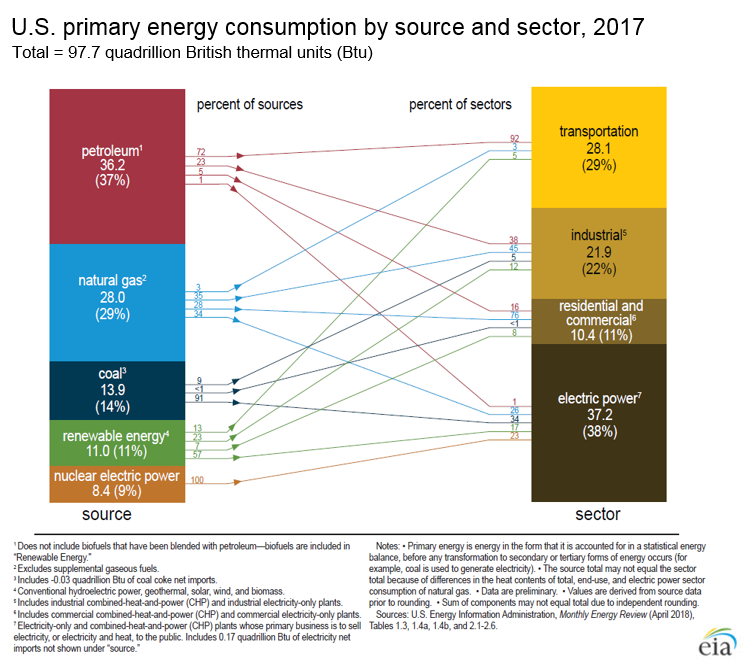
For that you need to work through the major sectors of energy usage.  Here is the chart for the United States.

consumption-by-source-and-sector

This is a larger and more complex undertaking, requiring careful planning for each sector.  Carbon pricing is one of the few actions that can be done across the board.   As we noted previously, assuming the atmosphere is free amounts to an annual subsidy of $1 T to the US fossil fuel industry.  Even low-level initial pricing (as with CCL) sends a message for corporate planning.  However, it is naïve to believe that carbon pricing will just take care of all sectors in time to avert disaster.  Note also, for priorities, that the residential and commercial sector is the smallest by far.

We also have to think about this problem not just for the US but for the rest of the world as well.  The US Energy Information Agency has released a document that helps in thinking about that task.  (A short summary of conclusions is available here.)  It has projections of energy use throughout the world going out to 2050.  With that it includes variants of the US energy use chart (just given) for other countries.  A significant fact is that many developing countries have a proportionally much larger industrial segment than we do, as high as 70%.

The report shows some influence of climate concerns, particularly in the US and China, but overall it describes the dimensions of a disaster.  The following chart taken from the report shows a continuing growth of CO2 emissions for the entire period.   While the report itself doesn’t explicitly call out the bottom line, the numbers from the report imply that the world will hit a point of no return already by 2035—with a CO2 concentration of 482 ppm and a temperature rise of 1.6 degrees C.

eia1

In the EIA scenarios, the world does a pretty good job of migrating electric grids to renewables (or to some extent gas)—but a terrible job of moving applications to electricity.  In developed countries this translates to business as usual, but in the developing world it’s much worse.  India, for example, is seen as growing exponentially with much of the increase powered by coal.  This isn’t just a question of forcing them to meet our standards.  Heavy industry is a particular problem everywhere.

So the application area is a big job with many industry-specific issues.  The world desperately needs focused research efforts with results that can be applied large-scale worldwide.  This can’t be a matter of everyone guarding discoveries for national advantage.  Cooperative international arrangements will be key to meaningful progress.


Even at this high level there are a number of conclusions to be drawn:

– There is no do-nothing alternative.

Technology will deliver a viable future, but we’ll have to work to get there.  There’s no silver bullet that makes it all go away.

– Technology development is important and has to be figured into any planning, but technology concerns are not the barrier to success.

It is perfectly possible to put together a plan to get the US where it needs to be by 2030.  That’s not saying all technology problems have been solved (after all electric cars are still much too expensive), but we can see a path to success.  We shouldn’t trivialize the effort and sophistication required, but based on where we are, and given financing, it appears that the technical side can get done.  The next point is less clear.

– Changes are huge and have to be dealt-with politically.

This isn’t just a matter of coal-miners losing their jobs.  Electric cars alone will have pervasive consequences.  We have to understand that worries about change are rational, so an important part of domestic climate policy has to be an assurance everyone will be made whole.  Otherwise we will continue to face the push back seen most recently in the Australian election.

In the US there is every reason for the less advantaged to distrust the political powers that be.  In the developing world it’s even worse—you’re talking about giving up on the benefits of development for some unknown duration.  The situation is necessarily difficult.   It’s only going to work if wealthy people and wealthy countries realize it’s in their own interest to come up with the goods.  No one will escape the consequences otherwise.

– The international side is unavoidable.

There is only one atmosphere.   Every country in the world has to cooperate, or we all lose.  When the US opts out, everyone loses faith in the future—as was evident in the recent Madrid meeting.  We have to restore international unity in order to make progress.  And that will only come when every country sees a just role for itself individually.  As for the terms of the Paris Agreement—it is only a first step and actually better for rich countries than will ultimately be workable.

We cannot go into this with the attitude that the objective is to come out a winner at the expense of everyone else.  If everyone doesn’t win, we all lose.

– This is not a matter for incrementalism.

We’re not going to get there with well-meaning people insulating their houses or businesses putting solar cells on the roof.

It’s worth putting some numbers on this.  With current technology, the power output of a solar cell is 20 watts per square foot.  From that you can calculate how many solar cells would be needed to meet current US electrical demand.  The answer is about 2500 square miles, assuming they’re all in brilliantly-lit, weather-free Arizona.  (And there are serious problems in managing that one too.)  All of it gets an order of magnitude worse if we decide to go piecemeal in random, less promising locations–and that’s just for today’s electrical grid, not where we have to get to.

That’s not to say that Arizona is necessarily the solution.  The point is that there has to be a rational national policy that will actually get the job done.


Greta Thunberg is right—there is no substitute for major political action.  Anything less is delusion, regardless of who says it.  The 2020 election is the single, deciding climate issue today.

Perhaps we need the right metaphor.  The fight against climate change is a war.  We’re all in it together—losing is losing for everyone.  The countries of the world are allies in the sense that each of them is necessary for success.  National economies will be affected, but through national climate efforts with no shortage of jobs.

Right now we’re like the US in mid 1941.  We can see and understand the enemy, but we’re not convinced we really have to be involved.  That situation only got resolved when the Japanese attacked Pearl Harbor, and it was clear there was no other choice.  You can make a case we were lucky that it wasn’t too late.  Without the Nazi’s disdain for “Jewish physics”, they might even have gotten the bomb.

For climate, if we act today we have the elements of victory.   We also have ample evidence it’s a near thing.  A climate Pearl Harbor may well be too late—and beyond anything we want to live to see.

Reasons For Pragmatism

44590252562_fa8baf6626_b

“COD Volunteers Give Back to the Community During COD Cares: Roll Up Your Sleeves Service Day 103” by COD Newsroom is licensed under CC BY 2.0

Ideology can be inspiring, but it’s never the same as a plan to get a job done.  For now it’s getting in the way on many issues.  Here are a few examples:

  • Healthcare

ACA is an imperfect compromise with known issues—in part because it was a non-final version enacted in the wake of Scott Brown’s Koch-funded victory for Ted Kennedy’s Senate seat.  All attempts since then to improve ACA have been blocked by anti-healthcare Republicans.

That being said ACA has enabled tens of millions of people to be covered for the first time, and it is supported by a non-regressive tax—the ACA surcharge.  It also attempts to get around some of the worst problems private insurance by covering pre-existing conditions and regulating how much of premiums must be paid out in benefits.  In fact insurance profit margins in healthcare are well-below margins in every other insurance category.

The most critical issues today are to improve coverage, pricing, and the range of offerings for ACA plans.  Some of this is just a matter of rolling back Trump efforts to destroy ACA.  The rest is more complicated, but nonetheless well-studied.  This needs to happen independent of long-term plans.

“Medicare of All” is an ideological choice—to get healthcare away from the insurance companies.  It’s a good slogan but something of a misnomer, because the changes from Medicare are decidedly non-trivial.  The Sanders bill optimistically assumes all private insurance will be gone in four years, but without a real plan to make it happen.  While virtually all developed countries have some form of universal healthcare, the systems are dramatically different from country to country, and many keep some form of private insurance.  Even current Medicare has many roles for private insurance.

Focusing on Medicare for All does nothing for current problems, and puts us in an ideological battle for the future.  As Krugman recently pointed out “Not many people love their insurance companies, but that doesn’t mean that they’re eager to trade the coverage they know for a new system they don’t.”  Additionally—for current Medicare recipients—Medicare for All is easily posed as a threat to Medicare itself.  That worked (using ACA) in the Scott Brown election and could well work again.

The long-term objective is affordable, universal coverage.  And the first steps start now.

  • Climate Change

If anything should ever be non-ideological it’s climate change.  Facts are facts, and the solutions are primarily matters for science and engineering.  The main political issues are how much money to spend and who is going to pay for it.

Both sides, however, have turned this into a culture war.  That the Kochs have dishonestly challenged the basic science is by now almost beside the point.  “Bad science” is just an epithet thrown out in the culture war.

We need to stop the culture war and make sure we take care of the people who will be hurt as the economy goes off fossil fuels.  Green New Deal makes some things better and some things worse.  There’s so much political deal-making thrown into it, that it can’t possibly be viewed as anything other than a left-wing grab bag.  Maybe that helps in defeating Trump—which is of course necessary for any progress—but there are too many distractions from the climate change goal.

We need to make sure that everyone realizes that the new post-climate-change world is a good world for all—even people who want to drive AV’s and Chevy Suburbans.  And we need to commit to protect everyone—coal miners, car mechanics, people hit by carbon pricing—who might otherwise be hurt in the process.  That’s the objective.  We can refuse to play the Koch’s culture war game.

We have to get away from the notion that we need to create a kind of “socialist new man” of conservation.  We’re not repealing the industrial revolution.  We just changing the technological underpinning of how things work.  That’s not to say there aren’t other environmental issues, but they’re not the same.  We shouldn’t expect fixing climate change will put the EPA out of business.

  • Jobs

This whole area is filled with so many wrong and misleading ideologies that we can start with a catalog of wrong ideas.

Manufacturing is the basis of economic strength.

The Chinese have gutted manufacturing in the US.

Balance of payments is a good measure of economic strength.

A strong private sector will provide everything necessary for economic success.

Tariffs protect and strengthen the domestic economy.

Low business tax rates build national competitiveness.

Taxing businesses hurts everyone.

Strong unions and strong anti-trust enforcement will preserve the middle class.

Public sector jobs aren’t real jobs, they just pull money out of the private sector.

In the future there just won’t be jobs for everyone.

From the list it’s clear this isn’t a matter of left versus right (even if you discount the lunatic fringe running things today).  The world is moving into new territory (more and more companies with 0 cost of production, tighter and more automated international links).  So the challenge is to see things as they actually are.

Ideologies can get in the way of understanding.  No candidates seem willing to talk about the transition from a manufacturing to a service economy.  Unions and antitrust enforcement are still good ideas, but they buy less than they used to.   As the last of the points indicates, futurists tend to provide more ideology than reality, so nothing beats experience and pragmatism.

For ourselves we see government challenges as:

Supporting education and research to keep ahead of technology change.

Managing the continuing transition from a manufacturing to a service economy.

Taxing and regulating dynamic international corporations with monopoly power.

Building and maintaining a bigger public sector to provide necessary services the private sector won’t.

Maintaining quality of life for all who live here.

Consciously working at creating and managing the international institutions that make the world work.  We used to recognize this responsibility (and avenue to exercise power), and no one else is stepping into the gap.

Overall we need to recognize the problems we do have—not the ones of the 1930’s—and look what will actually be effective to fix them.

There are many other areas where the same kind of story plays out—where an ideological war masks a more tractable, practical problem.  I’d even put immigration in that category.

It’s hard, given the daily atrocities of the Trump era, to focus on anything less than epic changes.  But if we’re going to put the pieces back together afterwards, it’s pragmatism that will get the job done.

Thinking About Manufacturing

There seems to be a lot of confusion about manufacturing.

We’ll start with a few slogans that pass for generally-accepted truth:

  • Manufacturing is the core of the US economic base.
  • Restoring manufacturing is key to the viability of the US working class.
  • The Chinese have gutted manufacturing in the US.
  • The continuing decline of manufacturing is another indication of the failure of Trump’s economic policies.

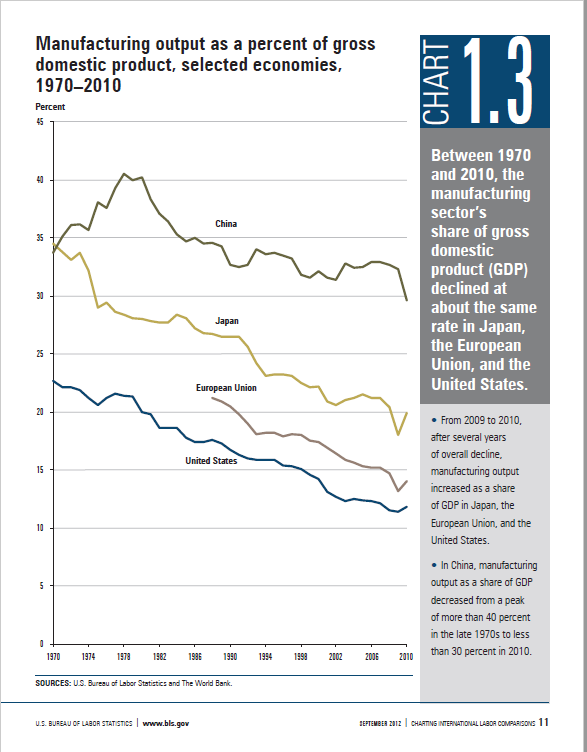
One indication that something might be fundamentally wrong in all of that comes from looking at trends in the service and manufacturing sectors over the past twenty years:

mfg_in_gdp_wbsvcs_in_gdp_wb

To say the least, it looks like there is something more fundamental going on than politics or even globalization.   Manufacturing has been declining relative to services for many years and in a big way.  It’s not just because of China, and it’s not even just in the US:

mfg_in_gnp

The US has been undergoing a massive migration from a manufacturing-oriented economy to a services economy. One problem is that we don’t really have a good vocabulary to talk about that situation.  The term “services” goes from McDonald’s to Google.  But in any case manufacturing is no longer the core of national economic success.  Think about television.  The sets have become so cheap that only huge volumes can cover the low margins.  But every major company you can think of wants to get into content to run on those sets.  There are hardly even any DVD’s manufactured for that stuff anymore!

We’ve talked here before about software.  All of the leading high tech companies (including Apple) are software companies.  Software companies produce product without manufacturing.  And that’s only one of the reasons such companies can be very profitable:

– They typically sit on top of the value chain (or even, like Facebook, have only software as output)

– They tend to have monopoly power (because dominant players can afford to spend more on R&D)

– They tend to have high barriers to entry and effective customer lock-in

The world economy today has increasingly many highly-profitable dominant software companies.  Some like Google produce software; others like Apple rely on a world-wide agglomeration of highly-competitive businesses producing to their specs.  Our current national success is that we have lots of them.  Our military strength depends on their technology.  The Chinese are sensible enough to understand that’s where they want to be too.  Even in biotech—where there has to be manufacturing—you’re still talking about largely high-skilled operations in companies with a large emphasis on R&D.


It’s a little strong to say it, but it’s closer to reality than most of what we hear:  mass employment in manufacturing is like mass employment in agriculture—it has had its day.  The migration is as extreme as what happened a hundred years ago.  And we’re better off thinking about the consequences than blaming it all on the Chinese or trying to outdo each other with promises to make it go away.

That point of view is widely held (based on the figures), but somehow it hasn’t managed to penetrate public discussion.  That’s not surprising for the Trump people, since they’ve been making it all up from the beginning.  For the left it’s different.  Traditional socialism has always had an industrial flavor that is hard to give up.  Unions and trust-busting are good, but they won’t bring back the past.  Forcing businesses that take federal research money to do manufacturing here will help some but not enough to reverse the trends.

(For the left, one particular paper has been frequently cited to show manufacturing job loss is reversible.   That paper concluded that the large manufacturing job losses from 2000 to 2010 were not due to automation here.  However, for its purposes it only examined companies that remained here and checked how many robots they had.  Nothing was said about the reasons any single company had left.)

The question then is what we should do.  The key is to start considering what we see around us as reality:

  • A long-term trend of decline in manufacturing
  • Very profitable, highly technical, non-manufacturing monopolies
  • Complete neglect of domestic services for the public good

We’ve talked about those trends here before.  As we’ve noted, some of the monopoly power is structural, so it’s not clear how far we’ll get with breaking them up.  However, monopoly power means companies are far from cost-sensitive, so the last thing we need to give them is more tax breaks.  On the contrary what’s crucial is learning to tax them, and we’ve got Apple as proof of how tough that can be.

In this picture the public sector has two important roles:

  1. Preparing the country for success in the world economy. That means infrastructure of all kinds, including education and child care as much as roads and bridges. The private sector won’t do it.  But—with an appreciation for the role of government derived from the second world war—we used to do a better job of it ourselves.
  2. Making sure the wealth of the monopolies gets translated into benefits for the population. This is another case where the private sector can’t act for its own good. Henry Ford famously wanted his employees to be able to buy his cars, but that’s certainly not the ethos of today. This doesn’t mean free money, it means employing people for the unfilled tasks needed for the public good.

We need the public sector to be the means of addressing the country’s unmet needs with resources from gilded-age inequality.

It’s worth pointing out that we have been wasting resources on a spectacular scale.  Under George W. Bush we fought a $3T war with no identifiable benefit and underwent a privatization effort (including tax cuts) that ultimately produced a near-depression.   Under Obama the Republican Congress shut down government, retarding recovery and preventing the public sector from doing any of the jobs just described.  Under Trump the primary achievement has been another $2T of tax cuts, with a jump in inequality and a deficit big enough to prevent any of the infrastructure work from getting done.  That the tax cuts went straight into stock buybacks is a clear indication of irrelevance.

It is instructive to think back to the time when the country underwent the last such a drastic economic change, when we went from an agrarian to an industrial society.   People had a hard time then thinking about it.  They got tied up in an irrelevancy—the silver monetary standard—and it took a long time before the real problems of corporate power and inequality were addressed.  A contemporary Henry Demarest Lloyd expressed his frustration this way: “The free silver movement is a fake. Free silver is the cow-bird of the reform movement. It waited until the nest had been built by the sacrifices and labor of others, and then it lay its own eggs in it, pushing out the others which lie smashed on the ground.”

We have something of that problem today.  The long-standing decline in manufacturing is a continuing but unacknowledged reality.  Instead we spend our time blaming it on the immigrants, or the Chinese, or the elites, or some combination of everyone else.  Until the blame game stops we can’t begin to decide how our economy really needs to work in the world we’ve got.  For climate actions we worry about coal miners, but there are many others in the same boat.  There is an international aspect too:  we’re too busy looking for villains to spend time on making the system work for global prosperity.

For our part we think it’s time for the public sector to come in from the cold.   In any case it’s time to stop talking about free silver.


Fixing Capitalism

44040355775_00e5b353ac_b

California Bank” by waltarrrrr is licensed under CC BY-NC-ND 2.0

There’s a lot of talk these days about fixing capitalism.   However, there’s a problem with much of it—there are so many things to fix that it all becomes a daunting task.  The point of view here is simpler.  There are a great many things that aren’t happening, because capitalism just doesn’t do them—and we can start by making sure those get done.

At its source this problem comes from our being force-fed the wildly radical idea that the private sector—capitalism—will solve all problems by itself.  So even when we realize that capitalism needs to be fixed, we tend to be overly concerned with all the patches.

However, even Adam Smith had no delusions about the limitations of capitalism.  As he pointed out:

  1. The private sector will not police itself.

On the contrary it will do everything possible to corrupt the free market with monopolies and government influence: “People of the same trade seldom meet together, even for merriment and diversion, but the conversation ends in a conspiracy against the public, or in some contrivance to raise prices.”  We’re used to hearing “private sector” and “free market” used almost as synonyms.   In fact, as Smith recognized, the free market is an ideal that can only be achieved when government holds the private sector accountable.

  1. The private sector will not provide the environment for its own success.

Smith even advocated a government program of universal literacy, quite a stretch for the eighteenth century and a pointer for us today.  This is a serious matter, because it shows how dangerous it is for the economy to punt everything to the private sector.

  1. Much of what is needed for a successful society is simply out of scope for the private sector.

Capitalism will not provide any service where there is no competitive advantage in doing it.  Public health and welfare, environmental questions, basic science, etc. are all out of scope.

Fixing capitalism strictly speaking deals only with the first category.  No amount of fixing is going to make capitalism deal with the rest.  Those issues are ours to solve.

It’s instructive to think about needs in each category.

  1. Policing the private sector

Monopolies are still with us and have become an increasing problem due to technology changes and weakened anti-trust enforcement.  The same is also true of corruption due to business influence on government.  These days no one even apologizes for it.

This is particularly true in the financial sector where banking, for example, has evolved into speculative gambling with losses covered by the FDIC.  You can even argue that the financial sector overall has evolved in directions that make it predatory on productive business.  After decades of Republican-inspired hands-off attitudes toward business, there is no shortage of serious issues.  However fixing all of them makes progress look far away.

Taking a step back, there is a single biggest problem:  legal tax evasion.  This is a gating item for so much progress that it just has to be dealt with.  Even before Trump’s tax cuts (and despite nominal tax rates), American companies paid the lowest effective taxes as a percent of income of any developed country.  That was largely a result of multinationals’ ability to move income to tax shelter countries—reducing rates or hiding income entirely.  Apple is only one egregious case.  The recent tax cuts made matters worse with drastically-reduced business rates, arcane rule changes for overseas income, and the new pass-through income treatment.  That pumped up the deficit—thereby hobbling government’s ability to respond to the serious sins of omission in categories 2 & 3.

What’s more, despite the insistent propaganda, taxes are actually not a primary issue for American competitiveness:

– Many studies have shown that in most industries today business profit levels reflect monopoly power to set prices well above historic levels of margin.  That’s a trend we can expect to continue.  In other words, businesses have considerable financial room to pay taxes.

– Further, as frequently noted, the savings from the tax cuts went primarily into stock buybacks.  That is companies decided the best thing to do with the tax cut money was to give it back to their investors in higher stock prices.

Conclusion:   Get the private sector (particularly large multinationals) and its investors to pay taxes.  Then work through all the rest.

  1. Providing the environment for economic success

If taxes aren’t the issue for American competitiveness, what is?  As we’ve noted here before, what makes for success is the technological advantage that has kept us in many areas on top of the heap.  That supports both our standard of living and our military strength.

Our technical dominance is based on three factors:

i. The dynamism of our economic system in generating new products and technologies.

ii. Broadly-based government support of research and education

iii. Remaining the preferred destination for entrepreneurs and other ambitious people from everywhere to realize their dreams

Let’s look at the current status of all three:

i. Unchallenged influence of big companies on government has favored established companies over new entrants. In part this is an anti-trust enforcement issue, but it has many other aspects.  The demise of net neutrality is one highly-visible example.

On this issue the interest of big business is strongly opposed to what makes for long-term national success.

ii. The administration is actively hostile toward science, government-sponsored research, and broad-based education. This is shown in purging of scientists from government agencies and restricting their influence on public policy.  One obvious example is in climate change.  Also the new tax law punished major research universities with a targeted tax.

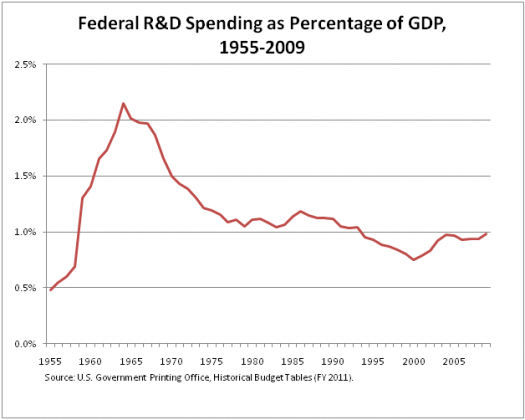
Public investment in research had a major role in the prosperity of the 1950’s and 60’s and kicked off the opportunities of internet today.  The same kind of public investment has remade China as a technology powerhouse.  But our dedication to research has eroded over time:

R_D_spending

Instead we’re waiting for the private sector to do the job, which by definition means catch-up.

The story for education is similar.   In the 1950’s and 60’s we were expanding educational opportunities to whole classes of people who had never before had the chance.   Now we rank far down on the list for upward mobility.  Student loan debt tells the same story, and that’s only about the people DID go to college, not about the ones who were deterred by cost and DIDN’T.  Finally, educational funding in the states has never recovered from the 2008 crash.

It’s worth mentioning in passing that the value of research is not only for international competitiveness.  Basic research is part of the global project of raising human standards of living. Even when one worries about national competitiveness, progress is generally so international that openness is the ante for remaining at the forefront of progress.  Current policy to restrict international participation of US scientists weakens the country in the name of national security.

iii.  As a final point we need to emphasize the critical role that foreigners and their children are playing in maintaining our national strengths.  Many studies have shown their role both in starting new companies and in supplying the technical underpinning that makes for success.  As Steve Bannon noted (for his own purposes) such people represent more than half of Silicon Valley activity.  Google (cofounded by a foreigner) and Apple (by the son of a foreigner) are only the most obvious examples.

The current xenophobic backlash is wildly off-target.  Particularly with the weakened support for research and education, those are the people keeping our place in the sun.  (To be clear, an immigration plan that only accepts people with degrees is no counterweight to the nationalist, nativist rhetoric.)

Conclusions:

– This area has got to be fixed or we risk losing our standard of living and dominant role.  These are traditional US values and as important as ever for US success.   It we’re worried about competing with Chinese, this is where the battle will be lost or won.

– If we can get our act together, items i and iii should remain as our advantages going forward.  So we shouldn’t be defeatist about a future that is in our hands.

  1. Spending for the common good

This has been a bastard child for so many decades now, that there is much that needs to be caught up.  Here is one short list:

– Infrastructure (Much discussed, but with more sides to it than you might think.  See here for a good overview.)

– Climate change (Evidence has become incontrovertible, but we still need a real plan.)

– Universal health care (Needed not only as a benefit but also as an enabler for equal opportunity.)

– Opioid crisis (Much discussed, but with radically inadequate funding)

– Environmental protection (Not a luxury)

– Transitional assistance (Helping people through changes—from technology, globalization, etc.)

There is enough essential work here to pose a major challenge for government.  We need to confront the unmet needs of the society, then we need concrete plans, and finally we need to manage major operations with competence and integrity.  Despite the propaganda there is nothing unusual about effective, government-sponsored work.  However as with any other enterprises, this needs to be scrupulously well-run.  Just because good people are running it doesn’t mean there is less risk of corruption.  We have to get serious about public enterprise.

That means we have to get past the idea that there is something intrinsically wrong about working for the public good.  That’s after all nothing more than the other side of the “private sector will solve everything” coin.  We live with the continued juxtaposition of vast under-employment (3.7% unemployment doesn’t change the good union jobs replaced by Walmart) together with vast unmet needs that the private sector won’t address.  We’ve got to take the initiative to match one with the other.  This is not “make work”.  It’s essential work that isn’t getting done, because the private sector won’t do it.

Until we take that initiative, it’s hard to assess where we are as a society.  Public enterprise helps in many ways.  It helps with inequality and the middle class.  It helps with leverage for workers and standards for employment.  Many public sector jobs of their nature will be hard to outsource.  It makes no sense to talk about abstractions such as Universal Basic Income until we see how things shake out in a fully-functional economy.  The future may be less strange or scary than it seems.  (This isn’t just about public sector employment; work done by the public sector helps other trends as well.  Even in Silicon Valley each job in tech creates 4.3 other jobs as well.)

Conclusion:   We need to create the full-scale machinery for government service to do what the private sector won’t.

It’s always hard to foresee the future.  I remember when I was in high school, Prince Philip gave a commencement address at UCLA in which he spoke (as world expert!) about leisure.  Already then he was thinking that machines would take over work, leaving as us all to spend the rest of our lives at the beach.

That’s certainly not what happened, but there’s still something to be said for the positive spin.  Historically technology and even globalization have been good for living standards, except where societies have chosen to deny the benefits to large segments of their populations.  Both domestically and internationally we have every opportunity to do this right.  We can either organize our economy–and the world order–so that all can benefit, or we can go down in flames of our own making.