What We’ve Lost and Must Find

We read regularly that many of our traditional strengths as a nation are being undermined in this administration.   But frequently such pieces end up tempering their concerns with a belief in America’s fundamental dynamism and vision, as contrasted with (say) the central control of the Chinese regime.  I’m all for believing in progress, but we’re not going to make any if we refuse to recognize how deep a pit we’ve fallen into.  Like it or not we are living with an administration that has deliberately attacked precisely those “American values” we want to believe in.

Here is a notion of what we’ve lost and need to find.

  1. Americans used to believe in the future.

 It was our future, and we did all we could to own it.  Our research institutions were the peak of the world, and people came from everywhere to participate. The list of Nobel Prizes records our success.  Part of that enterprise was to understand what was possible, and we built science into the functioning of government, so we knew where we were going.

All of that is now by the wayside, replaced by Trump’s “intuitions”.  He knows everything there is to know, and what he likes is by definition truth.  That holds for climate change, for research grants, and even (incredibly) for airplane launchers on aircraft carriers.  Even for NIH—a critical source of US competitiveness—grant money has been reduced and RFK’s decision logic hidden.   We’re not looking for truth, we’re looking for loyalty.

We still have the fruits of past successes in AI, SpaceX, and BioTech (all started with pre-Trump government money) and we even have a venture capital community to help fund it.  But all of that is today.  VC’s may sound future-looking, but they’re not going to fund anything that doesn’t pay back big and soon.  All of our present investments are at risk, because we’re too busy selling the present to think more than a step ahead.  The idea that we’re going to win with bigger and bigger investments in AI hardware sounds like the Maginot Line from pre-World War II France.  That was a huge defensive investment based on their experience with World War I, but the German Blitzkrieg just went around it.  In our case the Chinese, with a broader view of AI applications, may do the same.  In addition the obligatory government payoffs from big corporations mean that new entrants face vested interests with government-protected monopoly powers.  It’s like the old joke that someone in the nineteenth century patent office proposed to close it down because everything important had already been invented.  We just did that.

The Chinese have built up their universities and research institutions to be world class.   They figured out the coming importance of rare earths, solar cell and battery technologies, and medical research.  They may have government-defined five-year plans, but at least they have competent technical input and in many areas they have more internal competition than we do.  By contrast our focus now seems to be on the past—strong-arming our friends in hopes of delivering the jobs of the 1950’s.  What we call American dynamism comes not just from individuals, but also from the opportunities for such people to succeed.  For our current leadership that dynamism is unwelcome competition for its own all-embracing genius—something to be stamped out ASAP.

To succeed we must work to see the future and provide means to go there.

  1. Americans used to believe in our people

The American belief in its people goes all the way back.  The whole point of American democracy was to capture the strength of the population.  That’s why George Washington stepped down as President from the dictatorship that most of the world expected to see.  That’s why Lincoln talked about how “government of the people, by the people, for the people, shall not perish from the earth.” The democracy was far from perfect, but it was still a big step forward.

Coming out of that mindset was the revolutionary idea of education as essential to the role of the population in a democratic state.  This country pioneered the idea of educating the whole population, first at the high school level and then for colleges.  The power of the country expressed the capabilities of its people. Even the “robber barons” of the nineteenth century recognized the need to in some sense or other give back to the society to which they belonged. Immigration has always been a tricky issue, but we have learned that a multiplicity of people can participate in the democratic experiment and that diversity can be a source of strength.

Today we have replaced all of that with a dramatically different model.  We live in an age of self-declared superheroes.  We have a President who thinks he is infallible (and spends much of his time on monuments to himself), and business leaders who are convinced they belong to a different race.

Nothing in the Big Beautiful bill shows government has a role to play specifically for the population.  We’re running a huge deficit and cutting desperately-needed benefits to poor people so we can have big tax cuts for businesses and rich people.  There’s more detail on who gets benefits here.  When Trump talks about the golden future, there is no mechanism for it other than to make rich people richer.  When he attacks Social Security (e.g. with bogus claims of fraud) he’s attacking the whole idea of direct government support for the welfare of the population.  Crucially government has no role in protecting the population from the powers-that-be running everything for themselves.  Government of, by, and for the people should perish from the earth. 

People don’t necessarily see things that way, but one way or another they understand that there is no one protecting them from the abyss.  So the AI future looks pretty damn scary, and they’re not so enthusiastic about those datacenters either.  Owning the future sounds ridiculous.

To succeed we must support our people.

  1. Americans used to believe in our role in the world.

Coming out of the horrors of the Second World War, we and everyone else hoped for a better future, a new world where this horrible thing would never happen again.  America, as the major power of the age, took its responsibilities seriously.  A world at peace was a world where everyone could prosper.  That meant rules and responsibilities for everyone and institutions to support them.  It was easy for the US to want to be magnanimous; we were the richest, most powerful nation hands down.

We’re actually much richer now than we were then, but something else has also happened.  On an international front we are no longer so dominant, with China specifically challenging us in just about any dimension of wealth and power.  That’s our primary subject of discussion for international affairs these days, but in fact that’s only part of the picture.

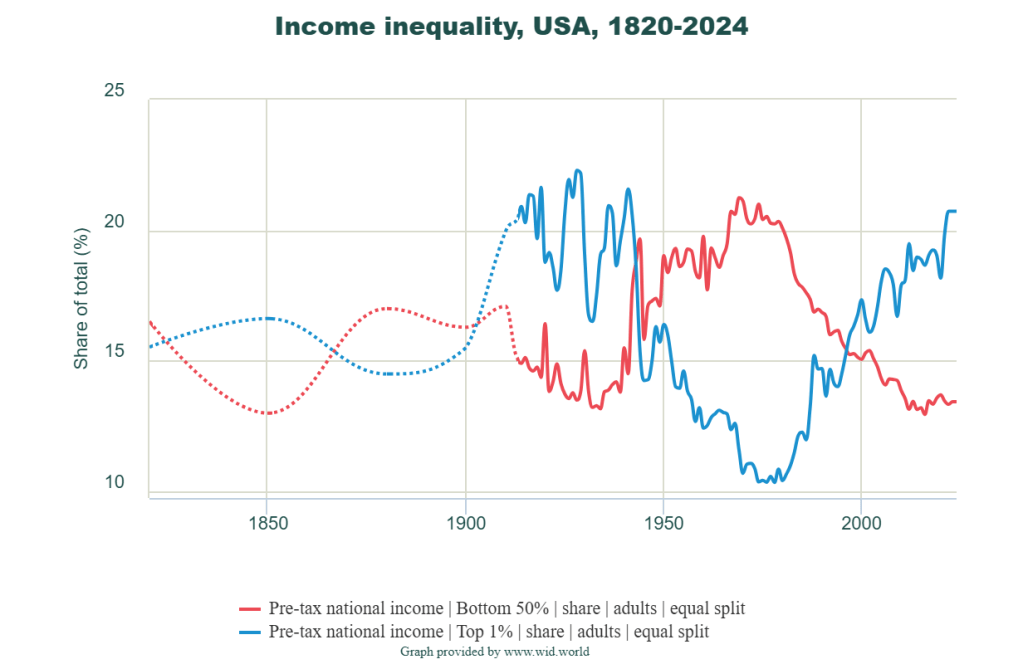
The other part is about American society.  After World War II our nation was as equitable as it had ever been, with prosperity widely shared and new opportunities for personal success, particularly through the GI bill and expansion of education.  In the years since then that equality has been eroded until today, we have reached unheard-of levels of wealth and poverty, beyond even the Gilded Age of the nineteenth century.  The following charts show the magnitude of the changes to both wealth and income:

There is no question that the quality of life for many people has deteriorated.  And it is conventional to say that the international idealism of the post-war years has been replaced by a grubbier reality where we are no longer dominant and every country struggles to compete with all others.  And the quality of life issue reflects that grubby struggle, in particular with the Chinese.  So the post-war idealism makes no sense anymore—we just have to win.

It is no accident that this conventional picture elected Trump.   That’s what it was created to do.  There is no shortage of money in this country, but in the years since World War II the powers-that-be have learned to protect their wealth from the population at large.  And electing Trump has enabled a pillaging of the country without precedent.  You have to blame someone, and it’s always the foreigners and the immigrants.

We certainly do have competition with other countries.  But the idea that all our economic problems are because we are under assault from the rest of the world is patently false.  Trade deficit numbers simply don’t tell today’s true story.  An example is the Apple iPhone—a big winner for the USA but counted as a trade deficit loser.  Much of the economy works like that. And the quality of life issue is unquestionably something we have done to ourselves.  This is a prosperous country, but not everyone has felt that prosperity.

In other words we as a nation are in the curious position of carrying out a foreign policy designed to protect domestic inequality! Of course it’s all about those foreigners! In that we are doubly hurt.  We are unable to deal with the actually tractable problem of population insecurity.  And we have lost our essential (and historical) role of helping worldwide stability in the face of the huge problems of climate change, nuclear proliferation, and the unclear consequences of AI.

To succeed we must—especially now—be able to recognize our broad interest as a nation in the world, above and beyond any corruption or special interests.   

We (and everyone else) need a stable, prosperous, and peaceful world for our success.  That is a worthy and achievable goal.  We used to understand these three keys to doing that, and we can do it again.  Our challenge is to recapture them—for ourselves and for our children.

The Crisis of Democracy

It’s common to speak of our current politics as a crisis of democracy.  We still have some features of democracy, but it doesn’t really work that way.  So the question that tends to get asked is how to address issues with our democracy to make it better.

If we’re going to fix things, it’s important to recognize that’s not quite right.  We don’t have a democracy anymore, and the government works exactly as intended. 

The first thing to emphasize that the functional Constitution is not a document; it is a construct enforced by the Supreme Court. The law is what the Court says it is.  There are no constraints on its interpretations, and in our current environment they don’t necessarily even give reasons for decisions.

Our current Supreme Court was put together over decades by the Koch organization with the objective of creating an authoritarian state, a dictatorial oligarchy for the benefit of big business and rich people.    This is no wild conspiracy theory—Jane Mayer’s Dark Money from 2016 documents what has always been hidden in plain sight.  The Kochs recognized early on they could take over the country through the Court, and they put together an organization funded by oligarchs to get there.  Their project produced Citizens United in 2010 and was essentially complete with the death of Ruth Bader Ginsberg in 2020. They aren’t fans of the whole Trump program–not tariffs for example–but the tax cuts and cuts in government services excuse all other sins.

They created and managed the Federalist Society and nurtured a community of lawyers to do the work.  All six so-called conservative justices have had careers in their service. The Koch organization at times has had a bigger operataing budget than the Republican Party.  They created institutes and named professorships in law schools. They have an organization to provide text for bills in Congress.  They recognized the extreme importance of the 2010 midterm state elections, because of redistricting after the 2010 census combined with new powers under the Citizens United Supreme Court decision. With the demise of spending limits they put unheard-of money into state-level campaigns and created the gerrymandering problems we have today.

(As a Massachusetts resident what I remember is the 2010 Scott Brown Senate election. You couldn’t turn on the television with seeing an ad from a PAC named something like “The Committee to Protect Social Security”. No one understood the avalanche of new money. That election effectively made Obama a lame-duck President–killing his filibuster-proof majority in the Senate, just as the emboldened Republican Party announced it would block all Presidential initiatives in the service of a Republican return to power. Citizens United was an effective anti-democratic tool from day 1.)

We now have the government they wanted—dictatorial and ready to be bought.  What we call corruption is intended behavior.  It’s how the powers-that-be get what they want.

Changing this is not going to be easy.  As Paul Krugman in particular has pointed out, the wealth and power of our domestic oligarchs have reached unprecedented levels.  Also by unlucky circumstance they now own a large chunk of domestic media channels—CBS and soon CNN together with Musk’s X plus the long-term ally Fox News.

So what is going on is not one or another problem with democracy.  We’ve experienced a well-planned and carefully-executed coup.  They’re pillaging the country.  As it turns out they’re also making a mess of things, even for their own interests, but thus far that hasn’t mattered to them.  And they’ve got the other media too scared to offer anything but token resistance. 

The 2026 election is of course critical. It can’t fix everything, but it would give a basis to start.  If we can win there, we can think about 2028 and the Court.  Otherwise all we can say is that 250 years was a good run RIP.

Effective Democracy

Let’s start with facts:  we live in a failed democracy that has transitioned to incompetent dictatorship. Given that kind of mess, it is worth going back to first principles to think about effective government.

First of all it should be noted that there is an intrinsic conflict of interests in any national government.  This isn’t complicated; it is basically parallel to what goes on in any corporation between the interests of labor and interests of management.  Near term they are dividing up profits, but longer term both have a common interest in the success of the company.   Successful companies are able to manage the conflict.

In government you have the economic powers-that-be versus the population as a whole.  Both have to benefit for success, but immediate interests are opposed in much the same way.  It should be emphasized that here too exclusive power to one or the other is disastrous. We’re accustomed to hearing one side of that story—uncontrolled spending on government benefits for the population will bankrupt the economic engines of the country. But an exclusive focus on the business side is equally bad and it’s not just a matter of living standards:  business interests are myopic both in terms of time scales and in terms of the environment needed for success.  You won’t have the technologies, or the people, or the physical environment necessary for the economy (and as we’ve seen recently, business people can risk bankrupting the country too!). Government has to speak for the whole picture. Even the patron saint of free enterprise—Adam Smith—was well aware of this issue.  “The government of an exclusive company of merchants is, perhaps, the worst of all governments for any country whatever.” There is nothing sacred or proven about claims that government should never interfere with the marvelous natural workings of the marketplace—that’s just self-serving propaganda for the “haves” side.

This intrinsic dichotomy is very important for effective government.  Both sides must be present but neither side can win.  That’s one of the reasons we’re in such bad shape right now.  What we have today is business capture of government—exactly what Adam Smith worried about.  To be effective government needs to provide means for functional negotiation and cooperation between both sides.  Those sides don’t map exactly to the Republicans and Democrats, but that’s pretty much what it comes down to.  Bipartisanship is not about being nice; it’s working out fundamental tradeoffs between the two sides.

That is precisely what we have lost–structurally.  There are three immediately obvious issues.  The first is the primary system.  Since primaries are partisan, candidates are chosen exclusively based on appeal to one side or the other.  That guarantees extreme positions and more importantly disenfranchises the center of the voting population.  A second example is the way partisan power is used to control legislation offered in Congress.  In the House the so-called Hastert rule only allows on the floor measures that are supported by a majority of Republicans.  In the Senate the majority leader Mitch McConnell routinely blocked anything he disagreed with—regardless of overall support.  Both rules disenfranchise the center and make the country effectively ungovernable except in extremes—so whiplashing policies are a matter of course.  Finally there is the Supreme Court: lifetime appointments plus limitless power give a huge incentive for partisan appointees.

All of this is bad news and good.  The bad news is that it isn’t clear when we’ll be in a position to fix any of it. The good news is that there are significant items that really aren’t so hard to fix.  For primaries, there are a number of possible variants, including non-partisan primaries with rank choice voting.  For the Congress, you don’t need to change the constitution to change the rules.  And there are many proposals to fix the terrible mistake that is the Supreme Court—an undemocratically-chosen body with lifetime appointments and no constraints on its power.   With a decent Supreme Court we should be able to fix gerrymandering, for example.  That is a math problem we chose to turn into a political mess.

Bipartisan cooperation is fundamental, and we can stop going out of our way to make it hard.  That way we can make the tradeoffs for the country to be governable.  Then we can move on to two other necessary and straightforward matters:  direct election of the President (the current system is grossly inequitable and invites fraud) and adding the few extra Senate seats needed to compensate the ill-represented largest states. Such measures won’t solve everything (not control of media for example), but we can make things quite a lot better.  We can make our democracy work.

It’s not so complicated–if we ever get a chance to do it.

Message for Business

We’ve spoken here before about how the evangelical community needs to understand that Trump is not their guy.

However the issue is more general.  It’s too easy to dismiss evangelicals as disconnected from reality and perhaps swayed by self-interested leaders. In fact all of us have spent lifetimes insulated from the reality of authoritarian government.  The US elections and democratic system are certainly not perfect, but we the people still do have power.  It’s hard to recognize that once that goes, the world is different.

Even the well-heeled and well-educated business community has that problem.  Much was made of Jamie Dimon’s comment at Davos that Europeans in particular should stop worrying about Trump, because ultimately nothing serious was going to happen.  A recent Edsall piece pointed out that many other business leaders believe the same thing.  Like the Evangelical’s focus on abortion, the business focus on the Trump tax cuts has convinced business people that he’s their guy.

As Edsall’s article points out, the history of authoritarian takeovers tells another story.  Once government is unaccountable, what follows is massive corruption and shakedowns of all players.  That’s in addition to the whims and the uncorrectable mistakes of the leader.  Businesses–and in particular their leaders–have much to lose, as their counterparts elsewhere have found out to their shock and surprise.

For now Trump’s threats–combined with the taxcut carrot–seem to hold sway with much of the business community.   But the Trump people have made no secret of their plan to end democracy in favor of an  Viktor Orban-like regime.  As a threat, there is nothing in Biden’s program that comes close to matching that one.