There are lots of arguments for and against world governance. The negatives are easy: there is no enforcement, there are any number of ways to cheat for advantages, rules are always going to reflect the interests of the countries with the power to dictate them. Any rule gets in the way of our ability to work for our advantage. What’s more, anything imposed worldwide is a straitjacket—there is no way to hide, no way to escape it.
However historically the opposite of order has been worse: instability, imperialism, slavery, and war. The post-World War II period has been far from perfect, but still a record period of prosperity and at least relative peace. Furthermore we have a specific example of a corner of the world (Europe) that ended centuries of conflict by relinquishing power to an international body—the EU—that brought peace and prosperity (despite all those negatives). Humans have managed to graduate from small tribes to cities to nation states, so why not farther?
Much has been written on that subject, but what is undeniable is that peace and prosperity go together. Why is it so hard, when we’ve seen examples of success? In fact there’s an answer but only if we ask the question right. The problem with a world order is not that it can’t be made to work—that’s what has been done. It’s that there are too many forces that want it to fail.
Today’s USA is a case in point. Trump rose to power with the slogan of “America First”—the idea that all problems were due to immigrants and foreigners taking advantage of us, so untrammeled American power was the highway to everyone’s success. It was a great story—we know exactly what to do to get rich, and what’s more we can enjoy the pain we inflict on all the bad guys. So the right vision for international relations is might makes right. That’s the natural order of things, and of course we’ll win.
Two years later the problems are still around (or worse), billionaires and insiders are collecting benefits, and even the idea that we’re always on top is not so clear. We live in a complicated interconnected world, and however much we bluster about national self-sufficiency, we have no idea how to do it. “Rare earths” are more the norm than the exception in a world with choke points everywhere. After all the technological underpinning of a very large chunk of our current and future economy is at TSMC, 80 miles off the coast of China. (Their US production won’t change that.) What’s more the main target of all the tariffs and other economic weapons we’re rolling out is precisely the one country against whom we have essentially no defense! The Democratic successes in the recent election show that some part of the population now realizes the story was always a con, but the issue is how reliably that argument works.
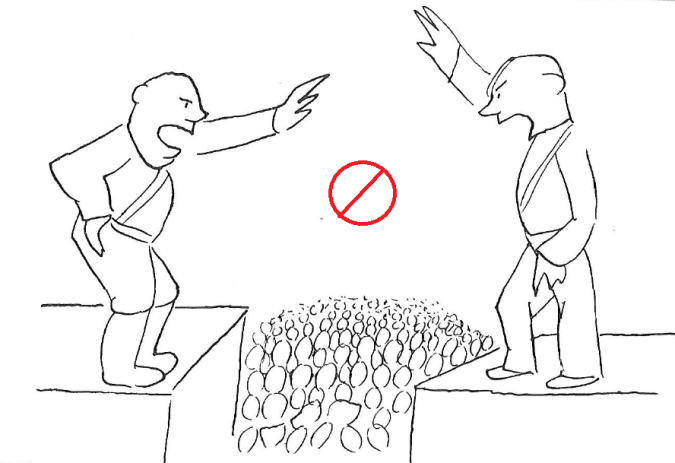
Every nationalist movement tells that same story. It appeals to something fundamentally tribal in the human makeup: “My people aren’t like that.” Get rid of the others, and all will be fine. Humans may have managed to graduate to nation states, but the tendency to division and conflict remains. (Thurber’s little storybook (The Last Flower) comes to mind. “Liberators” as in the picture are the worst.)
So how do we get past this? What’s different now is that we cannot continue to believe that the rest of the world simply doesn’t matter. The dangers are worldwide, too pressing, and too great. Let’s make a list. I’d put nuclear weapons at the top—we’re encouraging nuclear proliferation at the same time that prohibitions on use of such weapons seem to be weakening in both Ukraine and Iran, and finally as we’ve embarked on new rounds of an AI-based arms race. Then there is climate change—where there is still no appreciation of the dangers of waiting, the Covid-demonstrated inadequacy of response to epidemic, and the still unclear consequences of AI itself. A recent novel set in 2119 delivered a clear verdict on our times: the young people of that future world had no interest in history—why should they care about people whose craven negligence had produced world war and climate catastrophe!
The only way out is to start working on solvable problems. The EU started with common trade rules for base products: coal and steel. Economics is the necessary first step. Trade relations come before politics. Unfortunately in this country there is whole false mythology on that subject: “Bill Clinton let China in the WTO, and that lost 5 million jobs.” Clinton did let China in the WTO, but the President who lost all those jobs was George W. Bush. Bush had no interest in acting against China in the WTO and instead promoted offshoring of jobs, because that was what American business wanted. Bush even removed buy-American rules for government purchases. Walmart was the smiling US face of “evil China”. As a recent paper pointed out, the WTO continues to have an important role and is the single first place to start getting international relations right. Our current tariff policy, by contrast, hurts us and our allies and has weakened our leverage with China to nothing.
Similarly we need to get back into the World Health Organization (where our absence puts us at risk) and we need to return to an active role in international efforts to address climate change. As it is, our climate denial is bad for its own sake and contributes more to China’s industrial dominance every day (helped on by the Iran war).
None of this is enough to pull the world together to address all the dangers, but these activities are doable and start to address what it means to work together. That’s what worked for the EU. Anything more is beyond the scope of this piece. But the dangers of nationalist divisions and conflict remain. For that there are no silver bullets. The best hope is progress toward global prosperity—which remains, despite all slogans to the contrary, in the interest of all.

