What Matters for Climate Change

Last year this blog had an overview of the major factors involved in fighting climate change.  Most of that is still current, but it has also become clear that there is a lot of confusion—even in the climate movement—about consequences.  So this piece is not about the basics; it’s about the reality of what it takes to combat climate change.

To start with, Here is a list (off the top of my head) of widely-believed nonsense.  There is probably something to annoy everyone.  You can see if I’ve made a case for it by the end.

– Conservation is a primary issue

– It’s important to get solar cells on rooftops everywhere

– Recycling is important

– Local initiatives are important

– State initiatives are important

– The main game is getting our house in order

– We don’t need to do anything, since technologists will solve it by themselves

– We’re ready for electric cars to take over the transportation sector

– Current solar and wind are ready to take over everything

– Winning is simple, we just have to stop the oil companies and start deploying the good stuff.

– For climate change employment, we need local communities to decide what they really need

– The private sector is doing it all by itself

– Carbon pricing is optional

– Carbon pricing is all it takes

– We need to get a better deal than the Paris Agreement

– We’re in control of our own destiny

– We all need to change our lifestyles

– Fighting climate change will tank the economy

– Economic dislocation means taking care of miners

– Since poor people get hurt worse, climate action is a matter of charity—for social justice

– Same thing for racial justice

– Same thing for regional justice

– Internationally, this is a matter of everyone taking care of their own

– With China and India, the important thing is to stand tough to get what we want

– We have to insist that any new technology developed here gets manufactured here


Let’s start this off with item #1—conservation.  From within the US it’s easy to believe the fight against climate change is all about conservation.  After all, we’re up against a hard limit on tolerable levels of carbon dioxide in the atmosphere, so we’ve just got to cut down on burning in all ways.  And we’ve got to learn to behave differently in the future.

However that logic breaks down quickly.  What about all the people in China and India?  Our conservation is a blip compared with them, but we share the same atmosphere.  Do they just have to get used to the idea that cars and air conditioning aren’t for them?  They should accept permanent sacrifice for the good of mankind?  Even in the US, no amount of conservation will move people to electric cars or eliminate the CO2 production from heavy industry.

So even for the near-term we have to recognize that the fight against climate change is not primarily about conservation but about alternative energy sources.  Worldwide, we need to evolve energy sources, so that there will be enough to take care of people everywhere.  As noted in the prior piece, there is in fact no reason to fear we will ultimately lack for power.  This isn’t about learning to live with energy scarcity—it’s about creating a future for all people, all countries, and all life styles.

For that reason we need to focus on the transition to alternative sources of power.  There are two quite different types of problems to be solved:

– Generating and distributing power

The first thing to recognize is that (despite some obfuscation from the oil companies) the future is electric.  That’s the common currency for the energy to be used everywhere, in factories, in homes, in cars.  It’s what all the renewables produce today, and what will be produced by all future candidate technologies.  Electricity is easily transmitted over long distances, and can be stored for later use (although there is much still to be done for high-volume, in-network storage).

So this work includes the electrical network, the sources of energy, and the means to store it.  Since everything will move to the electrical grid, its capacity will need to grow significantly and fast.  This is a huge project, but this is ultimately just a matter of national will.  That makes it the easier part.

– Adapting applications to use it

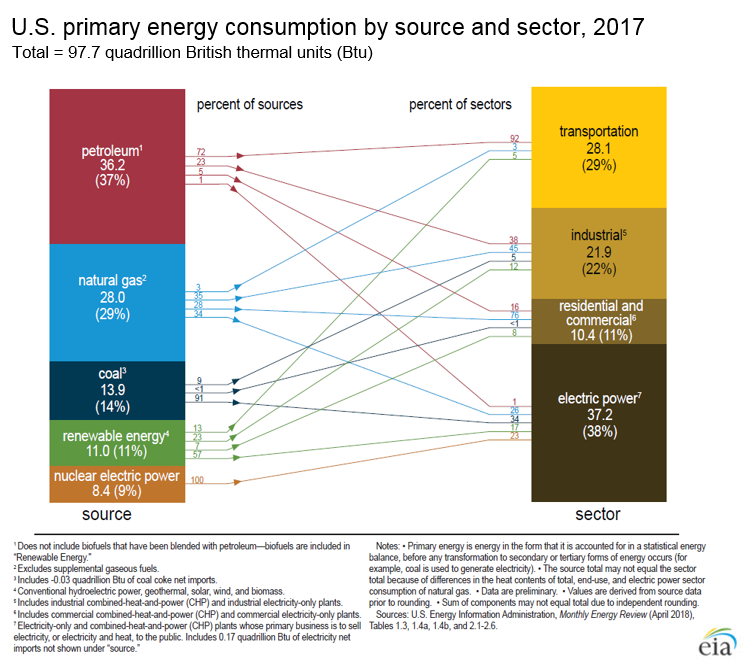
For that you need to work through the major sectors of energy usage.  Here is the chart for the United States.
consumption-by-source-and-sector

This is a larger and more complex undertaking, requiring careful planning for each sector.  Carbon pricing is one of the few actions that can be done across the board.   As we noted previously, assuming the atmosphere is free amounts to an annual subsidy of $1 T to the US fossil fuel industry.  Even low-level initial pricing (as with CCL) sends a message for corporate planning.  However, it is naïve to believe that carbon pricing will just take care of all sectors in time to avert disaster.  Note also, for priorities, that the residential and commercial sector is the smallest by far.

We also have to think about this problem not just for the US but for the rest of the world as well.  The US Energy Information Agency has released a document that helps in thinking about that task.  (A short summary of conclusions is available here.)  It has projections of energy use throughout the world going out to 2050.  With that it includes variants of the US energy use chart (just given) for other countries.  A significant fact is that many developing countries have a proportionally much larger industrial segment than we do, as high as 70%.

The report shows some influence of climate concerns, particularly in the US and China, but overall it describes the dimensions of a disaster.  The following chart taken from the report shows a continuing growth of CO2 emissions for the entire period.   While the report itself doesn’t explicitly call out the bottom line, the numbers from the report imply that the world will hit a point of no return already by 2035—with a CO2 concentration of 482 ppm and a temperature rise of 1.6 degrees C.

eia1

In the EIA scenarios, the world does a pretty good job of migrating electric grids to renewables (or to some extent gas)—but a terrible job of moving applications to electricity.  In developed countries this translates to business as usual, but in the developing world it’s much worse.  India, for example, is seen as growing exponentially with much of the increase powered by coal.  This isn’t just a question of forcing them to meet our standards.  Heavy industry is a particular problem everywhere.

So the application area is a big job with many industry-specific issues.  The world desperately needs focused research efforts with results that can be applied large-scale worldwide.  This can’t be a matter of everyone guarding discoveries for national advantage.  Cooperative international arrangements will be key to meaningful progress.


Even at this high level there are a number of conclusions to be drawn:

– There is no do-nothing alternative.

Technology will deliver a viable future, but we’ll have to work to get there.  There’s no silver bullet that makes it all go away.

– Technology development is important and has to be figured into any planning, but technology concerns are not the barrier to success.

It is perfectly possible to put together a plan to get the US where it needs to be by 2030.  That’s not saying all technology problems have been solved (after all electric cars are still much too expensive), but we can see a path to success.  We shouldn’t trivialize the effort and sophistication required, but based on where we are, and given financing, it appears that the technical side can get done.  The next point is less clear.

– Changes are huge and have to be dealt-with politically.

This isn’t just a matter of coal-miners losing their jobs.  Electric cars alone will have pervasive consequences.  We have to understand that worries about change are rational, so an important part of domestic climate policy has to be an assurance everyone will be made whole.  Otherwise we will continue to face the push back seen most recently in the Australian election.

In the US there is every reason for the less advantaged to distrust the political powers that be.  In the developing world it’s even worse—you’re talking about giving up on the benefits of development for some unknown duration.  The situation is necessarily difficult.   It’s only going to work if wealthy people and wealthy countries realize it’s in their own interest to come up with the goods.  No one will escape the consequences otherwise.

– The international side is unavoidable.

There is only one atmosphere.   Every country in the world has to cooperate, or we all lose.  When the US opts out, everyone loses faith in the future—as was evident in the recent Madrid meeting.  We have to restore international unity in order to make progress.  And that will only come when every country sees a just role for itself individually.  As for the terms of the Paris Agreement—it is only a first step and actually better for rich countries than will ultimately be workable.

We cannot go into this with the attitude that the objective is to come out a winner at the expense of everyone else.  If everyone doesn’t win, we all lose.

– This is not a matter for incrementalism.

We’re not going to get there with well-meaning people insulating their houses or businesses putting solar cells on the roof.

It’s worth putting some numbers on this.  With current technology, the power output of a solar cell is 20 watts per square foot.  From that you can calculate how many solar cells would be needed to meet current US electrical demand.  The answer is about 2500 square miles, assuming they’re all in brilliantly-lit, weather-free Arizona.  (And there are serious problems in managing that one too.)  All of it gets an order of magnitude worse if we decide to go piecemeal in random, less promising locations–and that’s just for today’s electrical grid, not where we have to get to.

That’s not to say that Arizona is necessarily the solution.  The point is that there has to be a rational national policy that will actually get the job done.


Greta Thunberg is right—there is no substitute for major political action.  Anything less is delusion, regardless of who says it.  The 2020 election is the single, deciding climate issue today.

Perhaps we need the right metaphor.  The fight against climate change is a war.  We’re all in it together—losing is losing for everyone.  The countries of the world are allies in the sense that each of them is necessary for success.  National economies will be affected, but through national climate efforts with no shortage of jobs.

Right now we’re like the US in mid 1941.  We can see and understand the enemy, but we’re not convinced we really have to be involved.  That situation only got resolved when the Japanese attacked Pearl Harbor, and it was clear there was no other choice.  You can make a case we were lucky that it wasn’t too late.  Without the Nazi’s disdain for “Jewish physics”, they might even have gotten the bomb.

For climate, if we act today we have the elements of victory.   We also have ample evidence it’s a near thing.  A climate Pearl Harbor may well be too late—and beyond anything we want to live to see.
Exported and Armed Prohibition

15766584947_c2dc1c0844

“Prohibition Repealed: New York Times, 5 December 1933” by cizauskas is licensed under CC BY-NC-ND 2.0

As a nation we seem to be baffled by the problems of drug-based criminality south of the border.  Why can’t those people live like us?  What makes us so superior?

For those questions it’s worth emphasizing that we used to have problems like that too.  Our problems were self-inflicted, but the phenomenon was similar.  Let’s talk about Prohibition.

Prohibition was a reactionary revolt much like what we’ve got with the Christian right today.   The heartland was able to stick it to the godless, immigrant-infested cities.  No more alcohol to corrupt our body fluids.

That repressive crusade was just too overarching to succeed.  It resulted in an immense network of criminality to meet demand.  Criminality pervaded every corner of the country, and the kingpins captured the news daily.  It could and did happen here.

Let’s compare with the situation in Latin American.  North of the border there is vast money to be made with illegal drugs, and the resources available to stop it are ludicrous by comparison.  Big surprise they’ve got a problem.  We have drug problems too, but we also have resources of the US.

What kind of help do they get?  They can’t even get us to slow down the sale of military-grade weapons underpinning the drug wars.

It’s like the wall.  Let’s just keep problems out.  We’ve exported and armed Prohibition.

Tesla and Ice

13466619083_803e381a03_b

This is a short note on a couple of issues related only in that they say something relevant about the future we should be planning for.

The first relates to Tesla and its production difficulties with the new, lower-priced model 3.  The highly-automated production of the model 3 is well-behind schedule, to the point where it is a big hit to the cash flow of the company.  We mention it here, though, because the delay is an indication that mass production of electric cars is something fundamentally new.

An electric car is a much simpler machine than an ordinary, gas-powered vehicle.  In principle the construction should be both cheaper and easier to automate.  Current production of Teslas is intrinsically a low-volume operation.  The model 3 will be the first indication of what newly-imagined electric car production is like.

I don’t know if we’re in for a shock or not (this is after all a first go at it), but this could be another big change to conventional middle-class employment.  And there will be follow-on effects for gas stations, and especially maintenance and repair.  This is another of many indications that broad, technology-based disruption of jobs is going to happen.


The other story is about the commissioning of a new class of Russian icebreaker—targeted at clearing northern ship lanes freed up by the retreat of polar ice with global warming.  The phenomenon is already clear, although the amount of traffic is still small.  The Russians are preparing for the opportunity with multiple classes of new machines planned for release up to 2025.  The Chinese have announced cooperation with the objective of reducing shipping times to Europe by a third.

The US is of course uninterested in consequences of climate change.  The only Coast Guard ice breaker is 40 years old, and they have a hard time getting authorization to get a new one.  The Bering strait, however, could be a shipping lane.

This is a very small example, but climate change affects many things, and as a country we’re trying to avoid finding out about them.


The current federal budget is put together for a world where the private sector will take care of everything.  That has always been a fantasy—the efficiency of the private sector comes in large part from its ability to ignore everything not relevant to immediate financial success.  It is particularly false for a world undergoing fundamental change.  We either recognize it and help people through it, or we fall behind and revert to the nightmares of the nineteenth century.

Update on Climate Change

s09_FossilFuel_and_Cement_emissions_1990

This note is an update to the climate change article from last year.  The story hasn’t gotten any better, but there is enough that’s new to warrant a revisit.

The most fundamental piece of bad news is the opening figure, which comes from the Global Carbon Project.  After three years of seeming stability, the world production of carbon dioxide increased significantly in 2017.  (The figure says “projection” just to indicate that the final computations are in process.)  Without too much evidence we might as well call that the Trump bump.  As we noted last time, worldwide unanimity on climate change is important precisely because the advantages of cheating are so obvious.  We—with probably the most to gain from the Paris Agreement process—are the cheaters in chief.  So it’s not surprising others will have fewer second thoughts as well.

We have to put this change into perspective.  Even a stable value of CO2 emission means things are getting worse, because it is the total amount of CO2 in the atmosphere that drives temperature change, and it all adds up.  The stable value was attractive, because it seemed to indicate that CO2 had finally peaked and might start to decline.  And the decline might mean the total CO2 could be bounded.  We’re now back to worrying about the peak, with no idea how bad things will get.

Two more new slides from the Global Carbon Project show what we stand to gain from Paris Agreement unanimity.  The first shows the current per capita production of carbon dioxide.

s12_Top_FF_Emitters_percapita

As has been true for many years US per capita usage sits way above everyone else, more than twice both Europe and China.  That is a direct expression of our carbon-powered standard of living.

The second slide shows who is going to have to make changes to protect that US standard of living from the effects of climate change.

s11_Projections

This shows that the major growth in carbon dioxide production is not from the biggest economies (note that even China has stabilized), it’s from the have-nots trying to achieve some fraction of our standard of living.   We are asking them to ignore not only our past exploitation of fossil fuel resources but even our current high per capita use and to delay their own immediate hopes for a better life in order to make the world a safer place for everyone.  So much for the question of who benefits from the Paris Agreement process!

That introduces the next topic—public attitudes to climate change.  There were enough strange weather events in the past year to give people pause, so we’re getting close to—but still not over—the hump.  The latest poll numbers have both good news and bad.  First the good news:

Overall, 45 percent of those surveyed said global warming would pose a serious threat in their lifetimes, the highest overall percentage recorded since Gallup first asked the question in 1997. Despite partisan divisions, majorities of Americans as a whole continue to believe by wide margins that most scientists think global warming is taking place, that it is caused by human activities and that its effects have begun.

Then the bad—the improvement is only partisan:

Gallup asked whether people agreed that most scientists believe global warming is occurring, and 42 percent of Republicans said yes, down from 53 percent a year earlier and back to a level last seen in 2014. Just 35 percent of Republicans said that they believe global warming is caused by human activities, down from 40 percent.

This seems like another proof of a much-discussed feature of human nature—when people are confronted with proof that their beliefs are wrong, they double down on defending those beliefs.   Unfortunately those are the people running the show.

How can that turn around?  A recent Steven Pinker book made an interesting point.  Much of the rhetoric around climate change focuses on conservation and a new world view of collective responsibility.  But conservation actually isn’t the main point—since we’re not repealing the industrial revolution, the main point has to be new energy sources.  We’re not creating a new world where no one drives Chevy Suburbans anymore, we’re just changing the power source.  Conservation, however important, is about buying time until we can get there.  Perhaps that’s one way to get climate change out of the culture wars (as it should be).

In any case the focus has to be on the reality of climate change, and everything else is tactics. With tactics it’s easier to be bipartisan.   One indication is that Congress, over Trump’s objection, passed a bill continuing tax breaks for solar, nuclear, geothermal, and carbon-capture projects.  This effort united left-wing and right-wing approaches to climate change largely under the radar.  However, it must be recognized that even with such efforts the US is now lagging far behind in support for the technology of climate change.

Carbon capture (separating out CO2 and storing it underground or elsewhere) deserves some special mention, because it has become a bigger topic in the past year.  On one hand this is an idea that has been around for decades without going very far, and what’s more the coal industry supports it as a lifeline.  On the other hand the technology seems to be improving, the Obama administration supported it as a transitional technology, and even the IPCC climate studies assume some form of it will be used.  It currently exists as an expensive add-on for power plants, and some still-speculative variants have been proposed to pull carbon dioxide straight out of the air.  Both the power plant and out-of-the-air applications have a common need for CO2 storage technology, of which there are many variants.

The biggest issue with carbon capture is that it can be (and is being) used to delay doing anything about climate change—why worry about carbon getting into the atmosphere if we’ll pull it all out later.  The problem is that the technology still has such big questions about cost and scaling, that “later” could be very late or never (and some effects, such as melting glaciers, are irreversible).  Even the cheapest estimates say it will cost continuing trillions.  What you have to say is that the technology investment is necessary and at worst it at least gets the climate dialog past the hoax stage.  And if we could just get the Kochs interested in that business (which is largely oil industry technology), it would settle the Republican perception of climate change once and for all!

Returning to reality, we have to conclude the past year seems like a pause for progress.  After Trump took the US out of the Paris Agreement, many wanted to talk about all that could be done to maintain momentum nonetheless.  The chart at the beginning shows the limits of that point of view.  There are other indicators as well:

– The auto industry’s step back from future fuel efficiency standards

Exxon’s declaration that climate change is no risk to their profits

– Business as usual in the International Energy Agency’s World Energy Outlook:

iea_weo

– Even the new preoccupation with carbon capture has to be viewed as a vote of no-confidence in the progress of conservation.   If prevention isn’t going to happen, then repair is all we’ve got.

What’s more than there has even been a preoccupation with a more drastic step, so-called geo-engineering.  This means injecting chemicals or particles into the atmosphere so as to dim the sun and cool the earth despite the increasing CO2 concentration.  There are many risks:  continuing ocean acidification, reduced photosynthesis and food supply, and weaponization of the technology.  Since CO2 would continue to accumulate, any loss of protection would have disastrous effects.  These are desperate measures.

As to what we should be doing, the picture is not too different from last year, but we can be perhaps more explicit.

  1. Because burning carbon is now recognized to have definite costs (i.e. whatever is necessary to counteract the CO2 increase), we need some kind of carbon tax so that the free market economy can react correctly. Since that cost is not currently captured, our economy is incurring a significant distortion that needs to be fixed.
  2. We need to get back into the Paris Agreement process to return focus to the goal. To repeat the obvious, the Paris process was always intended to be iterative—with countries readjusting their goals to eventually reach the target. We’re only at step one, so we had better help the world get back on-track.
  3. We have to recognize that at this stage we’re in no position to judge winners and losers among contributing technologies. So the solution has to be all of the above: nuclear, solar, wind, geothermal, batteries, carbon capture, even substituting gas for coal as a temporary measure.  The IPCC gave us what they called a carbon dioxide budget—the amount of CO2 we can add and still stay below a global temperature rise of 2 ⁰ C.  In 2014 (the year of the report) it was 800 giga-tons.  It is now below 700.
  4. People have to recognize that despite confusing news reports, we are all in this together. Some people will be hit by sea-level rise, some by drought, some by sheer temperature, some by storms, some by an effect we haven’t seen yet. Some may even be a little later.  But ultimately there’s nowhere to hide, and even “later” comes fast.
  5. There is no excuse for not funding research in all the contributing technologies and also research to understand the climate effects we are going to live with for however many years it takes to get past fossil fuels.
  6. Ideally all elements of society should be involved in planning such major changes. The carbon tax will help make that happen, but it’s not the whole story. We can’t keep fighting about this.

This administration likes to talk about itself as bringing business practices to government.   The evidence for climate change is such that any reasonable business would be doing its best to quantify the risk, so as to take appropriate action.   Businesses that choose to ignore disruptive new technologies or entrants are the ones that disappear—along with their disparaging comments on how the new stuff will never amount to anything.

Unless we choose to wake up—that’s us.  We’ll act now or pay far more dearly later.


Our President of China

There has been a lot of talk recently about China’s growing presence on the world stage and how the US as predominant power should react to it.  With that in mind we go to China, just outside the Forbidden City, where the Chinese are planning their strategy…

Xi Jinping: There are many factors we need to consider, economic and political.  Today we are an economic servant to the West, building their iPhones and other toys.  We need to learn to take their place.

Planner: The Americans have many advantages.  They have excellent universities and their pick of talent from all over the world.  They have an interlocking system of university, government, and private research labs.  It’s hard enough to catch up, much less to lead.

Xi: We have to go step by step.  I’ve heard that many of their new companies are led by foreigners.  We can cut into that and certainly lure our own people home–a little xenophobia would help.   As for education and research, we know that government money is critical both in government labs and in the universities.  We have to find a way to slow down that money and then duplicate their system here.

Planner: Sounds like a lot of work, but we’ll start on it.  They’ve been working for decades to get where they are.

Xi: We need to get more specific now.  What are the lead technologies we can use to establish our dominance?

Planner: It’s hard to answer that question.  Software is always there; the particular new twist seems to be Artificial Intelligence.  That ties in with robotics.  Biotech.  Probably the biggest thing is energy–climate change means the whole world will have to convert.

Xi: The Americans are big players in all of those, but progress is very international.  If we can get them to isolate their people we can win.  Energy is too big–we need to limit their role.

Planner: They were a driving force behind the Paris Climate Agreement.  Maybe we can sabotage that.

Xi: Great.  Good first step!

Xi: The next subject is politics.  The Americans have been leading the so-called ‘free world’ forever.  Everybody works with them; no country wants to be left out.  All major international agreements of any kind go through them.  They’ve done very well that way–they are the richest, most dominant country in the world.  Our presence is tiny compared to theirs–how can we match their influence?

Planner: The only way I can think of is to get them just to quit. Get out of our way so we can take over.

Xi: I don’t understand.

Planner: It seems that over the years the Americans have come to believe their own propaganda–that all of their international agreements and institutions were setup out of pure beneficence!  Nothing to do with remaining the richest, most dominant country in the world.  They even think that about foreign aid.

Xi: You’ve got to be kidding.  No one else thinks that.

Planner: All we’ve got to do is push them over the brink:  No international institutions, no foreign aid–all unaffordable charity and a foreign plot.

Xi: You really think you can pull that off??

Planner: Well, just a minute.  We need some kind of slogan.  Something catchy…

Planner: I’ve got it!!  AMERICA FIRST.

Xi: Welcome to the Chinese Century.