Lessons not Learned in Afghanistan

Much of the blame-seeking around Afghanistan is not only off-base, but damaging to our national interest.  It’s incredible that even the comparisons with Vietnam talk about the final evacuations, not the failed enterprises.  By concentrating all attention on an asserted “manageable” withdrawal, we’ve given the real perpetrators a pass.

In the last couple of days the NY Times has finally published two good articles.  One by Ezra Klein has the apt title: “Let’s Not Pretend That the Way We Withdrew From Afghanistan Was the Problem”.  In it the author goes over the real options we faced and why.  It’s a good job. My only concern is that while he is exhaustive about the options, he stops short of all the conclusions I’d like to draw.

For that, the other article is essential.  That one was by Sami Sadat, commander of the Afghan Army.  His title is “I Commanded Afghan Troops This Year. We Were Betrayed”.  His point—that the loss was not just the Afghan army’s fault—is not the main point here.  What is important is that he gives a detailed description of the reality faced by the Afghan forces, and that says quite a lot about how much had gone wrong.  There are three points to make:

1.  The war was lost the moment Trump signed the Taliban agreement.

Here’s the quote from the general:

“The Trump-Taliban agreement shaped the circumstances for the current situation by essentially curtailing offensive combat operations for U.S. and allied troops. The U.S. air-support rules of engagement for Afghan security forces effectively changed overnight, and the Taliban were emboldened. They could sense victory and knew it was just a matter of waiting out the Americans. Before that deal, the Taliban had not won any significant battles against the Afghan Army. After the agreement? We were losing dozens of soldiers a day”.

The last bit is particularly important.  Defeat is an exponential process—the likelihood of attrition depends on how bad things look, i.e. on the losses of all kinds beforehand.  Once the process starts it accelerates.  It was an astonishing mistake of US intelligence to believe we had many months, a year and a half even, before a Taliban takeover.  There was no stability once defeat took root. Biden’s late withdrawal of 1200 US troops is not even mentioned by the general, as it was never the issue.

2. There was NO exit plan ever.

Again from the general:

“The Afghan forces were trained by the Americans using the U.S. military model based on highly technical special reconnaissance units, helicopters and airstrikes. We lost our superiority to the Taliban when our air support dried up and our ammunition ran out.

“Contractors maintained our bombers and our attack and transport aircraft throughout the war. By July, most of the 17,000 support contractors had left. A technical issue now meant that aircraft — a Black Hawk helicopter, a C-130 transport, a surveillance drone — would be grounded.

“The contractors also took proprietary software and weapons systems with them. They physically removed our helicopter missile-defense system. Access to the software that we relied on to track our vehicles, weapons and personnel also disappeared. Real-time intelligence on targets went out the window, too”.

The key point is that none of these functions are transferable in weeks or even months to the Afghan army.  This is a rebuke of the entire war effort. That this gap existed means that there was no serious attempt to make the Afghan army self-sufficient.   As for the contractors, the general’s language makes clear that they had no intention of making their valuable, proprietary expertise available to anyone.

3. The Afghan government had lost the support of the population

On this the general’s comment is specific to the military:

“… there was only so much the Americans could do when it came to the well-documented corruption that rotted our government and military. That really is our national tragedy. So many of our leaders — including in the military — were installed for their personal ties, not for their credentials. These appointments had a devastating impact on the national army because leaders lacked the military experience to be effective or inspire the confidence and trust of the men being asked to risk their lives. Disruptions to food rations and fuel supplies — a result of skimming and corrupt contract allocations — destroyed the morale of my troops.”

More generally, Fareed Zakaria cites a US government poll of Afghans in 2018 that “showed that Afghan support for U.S. troops was at 55%, down from 90% a decade earlier”. That’s saying almost half the population was ready to choose an unknown Taliban regime as better than what they had.  With the rampant corruption, participation in the last Afghan election dropped to less than 25%.  The Afghan President Ghani reportedly fled through Kabul to the United Arab Emirates with $169 million in cash.

So, with all of that why were we still in Afghanistan?  That answer is not complicated.

Getting out was always going to be some variant of the mess we’ve just seen.  And there was also a moral argument:  leaving was going to hurt a lot of people in Kabul (though fewer elsewhere).  So people in government wanted to believe a fantasy—that there was a solution.  That is, the Afghan military would defend the state against the Taliban, and everyone would live happily ever after.  That fantasy trumped reality all the way down to the end. 

What can you say about Biden? 

There’s no evidence he could have done much to delay the military defeat.  He has gotten more people out thus far than has happened in other comparable situations, but he should have started sooner and that would have reduced some of the chaos.  He has not given in to the many proposals for last-minute military actions that would have undoubtedly made things worse.  (To be clear, there was no Afghan army, the US couldn’t possibly take on that role itself, and any serious military action would have put all evacuees at risk. Talks of retaining a second military airport are particularly fanciful, as the evacuees weren’t there.) He might have gotten some of the military equipment out earlier, but doing so would have undercut the Afghan army even more.  (And the Afghan President Ghani pleaded with him not to do it.) 

So you can give him a B.  It was certainly embarrassing, but it could have been quite a lot worse.

Even more important, all Biden could do was manage the exit from a failed war. You’d never guess it from all the bluster, but there was no hiding the US defeat. For real responsibility it’s worth quoting a succinct recap of US policy failures from former anti-terrorism officer Ali Soufan:

“Every administration made a lot of mistakes in this. The Bush administration made a lot of mistakes in moving much-needed resources to focus on Iraq and then focusing on Iraq. The Obama administration even sent more troops in and, for eight years, was hoping that something miraculous would happen. The Trump administration is responsible for not understanding the situation at all and opening negotiations only with the Taliban and disregarding the Afghan government and releasing 5,000 Taliban fighters without asking the Taliban for anything in exchange. Unbelievable.”

Of that list it is important to recognize that primary responsibility rests with Bush and the Iraq war. In our eagerness for the neocon-inspired invasion of Iraq, we never even tried to take the opportunity to help create a viable state in Afghanistan. Our current media-fed collective amnesia about both Bush and the Iraq war shows how little we’ve learned from our own recent history.

Lessons

1. Don’t believe in “benevolent” colonialism. 

Neither Afghanistan nor Vietnam was a special American phenomenon.  Whatever our original motivations, these were ultimately colonial wars.  Once you take over a country, the motivation of the occupier is stability at all cost.  That leads to wholesale corruption at the expense of the population and even the war effort.  The Afghan general described that situation exactly. You can get a more detailed picture here. Vietnam was the same. The classic on this subject was written in 1860—we should have figured it out by now.

We got into Afghanistan as a follow-on to 9/11.   It was up to us to help rebuild the country, schedule elections, and get out.

2. Watch out for fantasies. 

Something has to be done about an intelligence establishment that was so eager to please, that it couldn’t recognize that the fantasy had no basis in reality.  Remember there was NO exit plan.

3. Watch out for complacency, the idea that the future will just be a continuation of the past.

There is no other obvious reason why Biden was being told that the Afghan army would hold off the Taliban for six months to a year and a half!

4. Finally, going back to Eisenhower, watch out for the military industrial complex. 

For that, it’s worth thinking about who won this twenty-year war.  Not us, just forced to leave.  Not the Afghans who had to live with the fighting and corruption, and now are stuck with the Taliban. The real winners were the contractors.

Over the last 20 years of war in Afghanistan, the U.S. spent $89 billion in taxpayer dollars to fund the building and training of the Afghan National Army with an estimated $2.26 trillion in total operating costs funded by U.S. taxpayers. Ever since the U.S. government began keeping track, contractors have made up more than half of the military personnel working for the United States in Afghanistan and Iraq.  This is all the more remarkable since—as we’ve seen—their objectives were not even aligned with our national goals!

The contractors are said not to be worried at all about the end of the Afghan war.  There’s a whole new round of military modernization coming.  And we’ve never been short of wars.

Urgent Messages

1.  From the Olympics

In the opening and closing ceremonies at the Olympics many speakers, notably IOC President Thomas Bach, pointed out the importance of the Olympics as a symbol of what can be possible when all countries of the world to come together in peace.  That sounds nice, but it’s probably more apt to think about what happened with the original version of the Olympics, which persisted for quite some time. That message is not so rosy.

The original Olympics functioned even more as a symbol of peace, because there was an actual truce during the Olympic period.  But the overall lesson of the Olympic experience was that good feelings are not enough.  The Olympics did not prevent the horrendously bloody and unnecessary Peloponnesian War, fought between prime participants Athens and Sparta. 

Symbols aren’t enough.  If we don’t work at peace, it won’t happen.  There are more than enough parallels of that past with the current situation between the US and China.  If you want peace you need to remove reasons for war.

2.  From the fires and floods worldwide:

Messaging about effects of climate change has been more than a little confused.   We read about how front-line communities will bear the worst of climate issues (true enough but that makes it someone else’s problem).  We see maps of how different countries or regions will be better or worse off.  The NYTimes once had an article asking readers to plug in numbers to see if they were rich enough to escape the worst.  The most frequent objection to the Paris Accords is that we need to go back and renegotiate a better deal.

Nature is telling us something else.  We’re all in this together, and there is nowhere to hide.  Scientists have correctly indicated the directions of change.  But the world has never been here before, so it’s impossible to predict every bad thing that is going happen and where.

What’s more, carbon dioxide just accumulates in the atmosphere, so climate effects are going to continue getting worse until we can stop burning fossil fuels.  There will be more and more unexpected phenomena with more and more damaging results.   All the talk of taking CO2 out of the atmosphere is not going to produce results any time soon (and even if it works will itself take monumental amounts of energy).  So there’s only one answer—migrating the world’s energy requirements to sustainable sources.

This has to happen worldwide and we have to work together.  It may be contrary to all of our normal modes of behavior, but if we don’t all win we’re going to lose.

In the end the two messages are largely the same. We’ve fought two world wars, and now we’ve now got a third one against climate change. We have to learn how to behave when we’re all–unavoidably–on the same side.

Patterns of Thought

A friend of mine once told me a simple story:  as a teenager he found out that as his body grew and aged, many of his body’s cells would die and be replaced.  He found it a little scary to think that his body would change from now to some different future version of himself.  Then he thought—you can change out hard drives and even memory sometimes from working computer applications.  So it’s really not so odd that happens to the body too.  As with the application, a person’s consciousness continues on.

That teenage revelation wipes away centuries of philosophical speculation about what makes for personal identity and mind-body duality.  My friend was quite a smart guy, but that wasn’t the point.  The issue was that he had a model for thinking about those issues, and that model simply hadn’t been available earlier. 

Earlier generations thought about something called soul, but they had a hard time coming up with a description of what that was.  They knew it was different (one thinks of medieval paintings where the soul departs as a puff of smoke from a dying body), but there was nowhere to put it.  They needed God or some other ineffable external answer to explain it.  Science wasn’t much help, because there was no physical organ that could be identified with the soul.  However today we are confronted regularly with software processes (without physical manifestation) running on execution environments.  While there is a lot we still don’t know about how the brain works, there is no question that consciousness is such a system.  Soul, in that sense, is real—despite persisting confusion on the subject.

You can push this further.  Plato worried about forms, the abstractions we use to understand reality.  In what sense are they real objects?  We use them, but generalities by definition can’t be represented by specific physical objects.  That’s the same issue.   Any software system has internal objects that it operates upon.  Those are perfectly real within the operation of the application, but they have no physical presence.  There is a lot still to be learned about the objects of consciousness, but you don’t have to wonder about where to look.  

That leads to many interesting questions for both philosophy and science.  What can we say about the different classes of objects of thought?  What is specifically human?  Which of those objects are universally human (what is beauty?), what are hereditary but not universal, what are purely personal, as we each classify our experience.  Maybe it’s not the objects but the way of distinguishing them that’s universal?  (A child can learn what a dog is from very few examples.)  What exactly is unique about the cerebral cortex, and to what extent is it a blank slate at birth?  Is it possible that we are actually loading the equivalent of DNA-encoded software!?

To continue, another area where science helps with patterns of thought is probability.  We don’t like to think that way, but life is all about probabilities. Quantum mechanics tells us that even physical reality is in fact (at least at a microscopic level) indeterminate.  All you can say is that a quantum object may be in one of a number of states with given probabilities.  The point here is not that quantum mechanics itself governs our daily lives—it usually doesn’t.  But the world requires much more probabilistic mindset than we like to think.

We want badly to live in a world of causality, where we can organize our lives about “this does that”.  When someone gives us probabilities, we tend to react by taking the most probable item to be a sure thing.  And when causality breaks down we’re uncomfortable.  I think about the novel “The Goldfinch” where a particular immoral act ends up having good consequences, and the narrator announces that morality is a sham.

The world we live in is fundamentally probabilistic, and that affects many classical concerns.  Essentially all discussions of freewill and predestination tacitly assume that causality is straightforward.  In fact not even an all-powerful God can know exactly what is going to happen.  A human being’s current state includes everything in memory and all current impulses, conscious or unconscious.  What happens as a result of all of that is not only phenomenally complicated, it is fundamentally non-deterministic. 

The same kind of reasoning applies in many different areas—morality or political theory, say.  Much as we would like to live in a world where we can identify absolute good, that’s just the wrong model for reality.  The best we can do is probabilities in particular circumstances.

Finally, quantum mechanics is also an example of how we can get deluded by inappropriate application of scientific models.  All of the endless discussions of multiple universes and alternative realities are unsubstantiated nonsense.  When a quantum object is described as being in one of a number of possible states (because we haven’t checked yet), that doesn’t mean those potential states are all real.  It’s a trick of language—an unobserved state is not a state, it’s just part of a mathematical model for what might or might not happen.  There is no real state until a result is observed.  There are no parallel universes where all those other possible states are real.  There is no inconceivable infinity of parallel universes, with a new one created every time there is an option of outcomes created somewhere.

Similarly there is no inconceivable infinity of parallel universes where past moments from everywhere are somehow preserved and active.  Time travel, however intriguing, is imaginary.  It’s not just that we don’t know how to do it.  It’s that the past and the future simply don’t exist!

How We Won the Cold War

Map-Flag_of_the_Soviet_Union

“File:Map-Flag of the Soviet Union.svg” by NuclearVacuum is licensed under CC BY-SA 3.0

We hear every day how we need to get tough for our new cold war with China.  The unstated subtext is that threats and bluster are the “getting tough” that’s going to win. In fact we know exactly what won the last Cold War.  It’s worth paying attention to what that was.

The dynamism of our economy won the last cold war.   Our technological base reinvented itself many times over, and the top down economy of the USSR just couldn’t match it.  There were many individual factors behind the collapse—low growth, corrupt state enterprises, spending on defense, oil price collapse, Chernobyl.  But what it all came down to is that the Soviet economy collapsed because it just couldn’t find the resources to keep up.

Many factors made the difference—the historical strengths of the United States:

– A free market for new technologies.  A venture capital industry supported by anti-trust enforcement to protect new companies from powerful old ones.

– The US as world’s best destination for entrepreneurs from everywhere to realize their dreams.

– Openness to ideas from everywhere and active participation in international organizations of all kinds.

– Government support for pure research–to be on the forefront as new developments translated to opportunities.

– Expanding equality of opportunity, so ideas can come from everywhere.

The USSR had a well-trained population of elite engineers and scientists, but ultimately they couldn’t compete with the ability of the US model to reinvent itself and grow.

What can we say about the current situation with China?  There are three points:

  1. The rise of China actually followed the US model.

One part of this is familiar—China invested in its people:  education, infrastructure, health care, etc.  The regime tolerated no disagreements, but it put money (as we used to) into the environment necessary for success.

However the bigger part is less-discussed—what kicked off the Chinese miracle was an accidental surge of free enterprise.  As a weakening of collective economic control, Chinese municipalities were freed to carry out their own businesses once obligations to the state had been met.  That minor bit of freedom took over the economy.  Independent municipal businesses became dominant to the point that they dwarfed the hugely-corrupt state-run enterprises.  Municipal businesses grew into the independent private sector.

  1. Under Xi, China is abandoning that approach in favor of a return to central planning and control.

Xi is a princeling—a child of former revolutionaries brought up to believe he was born to rule.  All of his recent actions have been directed at crushing independent forces in the Chinese economy.  Appointments have been based on loyalty above all.

China is back to the old Soviet and Chinese world of massive state enterprises and a dictated economy.   That won’t change the immediate future, but we have no reason to despair of our ability to compete.

  1. Under Trump we are similarly abandoning our strengths.

Trump, like Xi, is an autocrat who view himself as the all-encompassing genius who needs to run everything.  He picks winners and losers with tariffs.  He awards exceptions to supporters.  He ignores real problems (such as Covid) that he doesn’t want to deal with.  Job appointments are based on loyalty over competence.  Every one of the listed US strengths is at risk:

– New enterprises are sacrificed to the existing powers that be.

– Xenophobia and nativism are pushing entrepreneurs elsewhere.

– Global participation is discouraged.

– Science is discredited and only mainstream technologies (e.g. AI) or Trump whims are funded. Climate change can’t even be mentioned.

– A political strategy of divisiveness means we’re fighting internally rather than drawing on everyone for progress.


We didn’t beat the Russians by mimicking their authoritarian control and top-down economy.  We won because they couldn’t compete with our ability to reinvent ourselves over and over again.  We have that opportunity today, but we’re losing it to the false god of dictatorship.

Democracy is not a nicety but the core of our success.

Dictatorships lose.  All-powerful leaders make disastrous mistakes that cannot be remedied.  They can ignore the well-being of the population.  They create massive corruption that cannot be contained.  All these tendencies are visible today (Covid alone shows several), and the effect is—as always—accelerating.

We still like to talk about the power of democracy and free markets, but both are slipping away.  Voter suppression is an openly-discussed goal.  Anti-trust enforcement has effectively ceased to exist.  The power of corporate lobbyists has starved the public sector (including infrastructure of all kinds) and defended the economic status quo against all comers.

Our problems today are not weaknesses of democracy but an indication of how far we’ve strayed from it.  There’s no reason to despair for our competition with China—or for the country generally.  It’s just a sign we have to get back to doing what we’ve always done best.

The Coronavirus Message for Climate

Since the coronavirus is at the top of everyone’s consciousness, there has been a lot written about what the coronavirus experience has to say on a great many issues.  After a while you start to get numb.  However for climate change the parallels are so explicit and telling that they need to be emphasized.  The argument in this piece is not new, but it’s worth spelling out in detail.

The coronavirus shows just how hard it is for us as a country—or as a world—to act ahead of a disaster even when the evidence is clear.  We were unprepared when the crisis came, because we just didn’t want to believe it could happen.  Our reluctance not to believe was of course encouraged by players (foreign and domestic) who felt there was something to be gained by delay.

The result is measured both by the numbers of dead and by the economic consequences of the drastic measures taken to stop the exponential growth of cases and deaths.  In the US that means on the order of 200,000 deaths and the worst job loss since the Great Depression.  The weeks of delay made this situation exponentially worse.  You can argue about the details, but there is no question that failure to act early cost us dearly on both counts.  We’ll muddle through, but badly wounded.

The parallels to climate change are explicit—but for climate the muddling through is no sure thing.  There are two primary points:

  1. CO2 in the atmosphere just adds up—which means that whatever problems finally force us to act will keep getting worse until we can manage to stop fossil fuels completely.  In other words from whatever time we recognize a crisis, we will be locked-in for many further years of worsening crisis.
  2. That’s even worse than it sounds because—as with epidemics—there is an exponential growth aspect here too.  To see this we can start with the example of hurricanes.  For hurricanes, the damages in the wind-speed categories are such that each step makes the previous look trivial.  In other words, as wind speed grows in a regular, linear way, damage goes up exponentially.

This isn’t just a matter of hurricanes; it’s typical for damage.  For floods you go from marginal areas affected to major cities.  In any category you can think of, damage goes up exponentially.  The bottom line is that for all those years of lock-in, every additional ton of carbon dioxide we add to the atmosphere will pack a wallop.  This is the stuff of nightmares.

The latest climate report gives us the timescale.  To avoid catastrophic consequences CO2 production needs to drop 45%  by 2030 and reach 0 by 2050.

We couldn’t get ourselves to believe the coronavirus would really happen, and climate disaster is even further from our past experience.  So the tendency to disbelieve is even stronger.

There are plenty of well-connected, interested players out to convince us to wait.  The oil companies and their allies are doing quite a good job of it.  Pence and Pompeo (among many others) are Koch organization soldiers in a Trump organization out to sabotage all efforts to control climate change.  Another indication of oil company power is Harvard University’s recent announcement of a commitment to fight climate change—by making their investment portfolio carbon-neutral starting in 2050, the year when the scientists say we need to be done!

That’s where we are.  Climate change is the coronavirus on a bigger scale.  It’s much more dangerous and with even more powerful forces out to convince us to wait, and wait, until it’s too late to matter anymore.  We’ve been warned.

Back to Normal from Covid-19

There has been much discussion of how to manage Covid-19 virus infections during the return to normal life.  There are many issues, but one in particular stands out for comment.

That issue comes from the much-noted age dependence of the virus death rate.  By now we’ve had plenty of experience of how this works.  For people under 50, the Covid-19 risk is similar to normal flu.  50-60 means more risk but still relatively small.  Over 60 it starts getting significantly worse, with the death rate more or less doubling for each ten years of age.  Pre-existing conditions make matters worse, but the age effect is still huge.  (There may be other categories of people worthy of attention, but that’s beyond the scope here.)

Overall reducing the death rate is primarily a matter of reducing the death rate for older people.  However, as a practical matter, focusing on the elderly is quite a big job.   If we’re going to protect the elderly from the virus at the very least we need to:  find them all, deliver food and other goods for them, assure fully-competent staff and daily testing at nursing homes.   No one is currently doing that.  On the contrary, death rates at nursing homes are scandalous, and individuals are largely left to manage themselves.  In Massachusetts as of this writing 610 of 1245 deaths were from nursing homes. Our extra hour of food shopping reserved for people over 60 is hardly a solution.

For the first bout with Covid-19 there has been neither the time nor the testing capability for such a strategy.  The countries that originally opted for “herd immunity”—with whatever they could do to protect the elderly—had to back off because of deaths.  The only alternative to catastrophe was to limit the spread of the virus in the population as a whole.  (There is a whole subculture of right-wing columnists claiming there was never a reason for the shutdowns, because it’s just a “simple” problem of isolating the elderly—without any proposals at all for how to do it.  For people who don’t go for that, there’s a different subculture dedicated to the proposition that the Covid-19 virus was never a problem to begin with!)

The point of this note is to recognize that the situation is different for the return to normality.  A focus on the elderly is both an obligation and an opportunity.  The obligation is that we just have to start doing a better job of protecting them.  It may be a logistical nightmare (only 5% of people aged 65+ are in nursing homes), but it’s a well-defined problem to be addressed with time, money, and commitment.  Testing is getting better.  It might even take the National Guard.  But we can certainly make things better if we start now.  We can call the right-wing’s bluff and spend the money to do it.

The opportunity of course is that reducing the elderly death rate will help ride through the ups and downs in new Covid-19 cases as people come back into the workforce.  People will still be getting sick, but children can go to school and parents can go to restaurants without risking anyone’s lives.  Whatever money is spent will be earned back in transition time.

This has to happen, it has to be fully-funded, and it has to start now.  “Flattening the curve” was essential to surviving the first onslaught of the virus.  For the return to normality, it’s “protecting the elderly” that will keep a difficult process going.

Short and Long Term Issues for Climate Change

In addressing climate change, one problem is that short and long term issues are not always the same.  As we’ve noted before, conservation is a legitimate short-term issue but not a primary long-term goal.

You can go a step farther with that:  there is technology we don’t want at all long-term that is still the best we’ve got for now.  That’s not just a matter of saving a little extra carbon dioxide; more importantly it’s buying time.

What the scientists have given us is not so much a schedule as a carbon budget—how much CO2 we can produce without irretrievable harm.  Many of the technologies we need to get off of fossil fuels completely are not 100% up to snuff.  What that means is that we can’t jump immediately into what we see as the right solution—more money won’t help.  That means accepting non-optimal technologies that cut some CO2 now.

Cutting CO2 buys time.  We need that time.

Here’s are a few areas that need work.  It’s too easy to wish them away:

– Electric cars are still too expensive and slow-charging to replace current technology.  This is a little like self-driving cars—the expectations have gotten ahead of the reality.

– Solar and wind may be cheap, but they’re not everywhere and not all the time.  For electric power generation that’s a problem.  In-network power storage is not up to the task of twenty-four hour operation.  With the current US grid, solar power in Arizona is not going to drive the rest of the country.

As an example, California’s aggressive deployment of solar electricity has forced external contracting to handle power peaks.  Currently the peaks are supplied by CO2-intensive fossil fuel plants in nearby states.

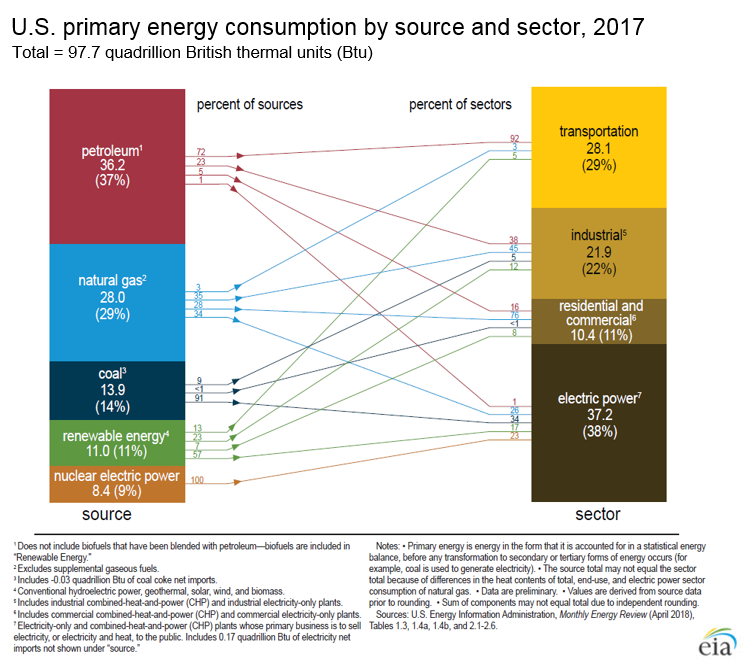
Local power generation can displace some residential and commercial demand, but at best that’s only 10% of the picture:

consumption-by-source-and-sector

– For heavy industry—steel and cement for example—CO2 production is not just a matter of power consumption, it’s intrinsic to the industrial processes.  There are no simple solutions to change that.  Flue-based carbon capture just has to get better.  (Direct air capture of CO2—despite much enthusiastic press—is even farther off.)

Prospects for fixing all of this are good, but we’ve got to buy time to get there.  That means taking steps with what we’ve got now.  Here are a few examples:

– We should think more about hybrid cars.  That’s increasingly cheaper technology, it saves considerable gas, and recent plug-in hybrids save more (perhaps leading even to upgradeable batteries).   The biggest problem with the technology is that, despite improving sales, we’re still not selling enough of it.  Initial carbon pricing should be aimed at universal hybrid penetration.  Tesla is great, but it’s not going to have a big enough impact now.

– Replacement of coal by gas saves 50% of CO2 production.  There aren’t always alternatives, for the reasons listed above.  Furthermore, lumping all fossil fuels together makes it easy to excuse coal.  When Germany and Japan closed nuclear plants, they didn’t go to gas, they went to coal.

While we’re currently seeing more growth of CO2 emissions with gas than with coal, it’s easy to draw the wrong conclusion.  Coal and oil still represent the vast part of CO2 production, and any replacement is a win.

s20_2019_Coal_Oil_Gas_Cement

– Carbon capture is unavoidable.  The first focus is on flue-based technologies, even if direct air capture is sexier.  This needs real money, because the industrial sector is huge worldwide.

To those items we should add one more difficult bit of reality:  the US needs a vastly improved national electric power network as a near-term prerequisite for much future work.  That means more high-voltage power interconnections.  That in turn means dealing with environmental issues and protection for the poorer neighborhoods that normally bear the brunt of such things.  One way or another this has to be made to happen, even though it involves competing concerns.

All of this underlines the need for a real plan—with both domestic and international aspects.  That needs to be a step-by-step prescription for what we should do about climate change.  That is what money needs to be spent on what technologies when and where.  For all their strengths, neither the Green New Deal nor the CCL’s carbon pricing is anything like a comprehensive plan.

Carbon pricing in particular remains a source of considerable confusion.  Since it is a critical component, we end with a few comments to avoid misunderstanding.

– Carbon pricing has to be a clear signal to industry of where the world is going.  It may start relatively low (as we’ve just discussed), but planned increases must send the message that the fossil fuel world is ending.  We need to get to at least $100 a ton in 5-10 years.  As such, proposals of $40 a ton with only nominal increases (coming from oil industry sources among others) are dead on arrival.  Carbon pricing is not good or bad in the abstract; it’s good or bad based on the numbers.

– Carbon pricing is not a tax, it’s killing a silent subsidy.  Carbon in the atmosphere costs all of us money in current and future climate change disasters.  Keeping it free represents an annual subsidy to the fossil fuel industry in the US of approximately $1T yearly (lower numbers are based on flawed cost models and just plain wrong).  That huge perversion of the economy has to end.  The money belongs to the public; it’s not there for the taking.  It needs to be given back in a way that mitigates the regressive effect of higher oil prices.  If we need more money for climate change or anything else, that needs to be done through the tax and budgeting system.  That’s where we make decisions about who pays.

– Carbon pricing will not solve all problems.  Government has many active roles to play, for example in putting together the new national electric power infrastructure that will be critical for progress.  Also government will need to address the enormous social consequences of remaking the economy.  We need to have carbon pricing to prevent perversion of the economy, but it’s only one element in a comprehensive plan.


The True Cost of CO2

It seems perfectly reasonable.  Each ton of CO2 added to the atmosphere causes damage.  We can estimate that damage by looking at what’s happening.

The Obama administration went through that exercise in some detail to justify environmental protection measures—and came up with $42 per ton.  The Trump administration people reduced that number to less than $7 and increased the future discounting factor from 3% to 7%.  That’s certainly a problem.

However the $42 figure is also wrong, and the whole notion of a dollar cost of CO2 undermines much of the discussion of the costs of climate change.

One way to see that is to look at the language we use to talk about hurricanes.  For starters I’m going to reference the usual storm class definitions:

hurricanes

As the wind speed increases, the damage rises by orders of magnitude.   At each stage the damage rises to such a degree that damage at the previous level becomes negligible.  There is no single number that tells you how much extra damage you’re going to get from a 5 mph increase in wind speed—it gets dramatically worse with each stage.  This is basically an exponential model; it is certainly not multiplication of windspeed by a number appropriate for category 1.

You can see how this argument plays with climate.  Starting with hurricanes, we have a basically linear relation of CO2 concentration and water surface temperature:

sea-surface-temp-download1-2016

And essentially the same is true for water surface temperature and maximum windspeeds. To that gets added the exponential relation of windspeed with damage.  Put it all that together and you get an exponential relationship between added CO2 and hurricane damage.

The same kind of relationship holds for almost any kind of climate damage you can think of.  Sea level rise first affects marginal districts but then more and more of mainstream society.  Droughts first affect marginal areas and gradually more and more of the breadbasket.  Health threats first affect the most vulnerable but eventually everyone.   Accelerating costs are the rule, not the exception.

How does this affect how we think about costs of climate change?  In fact we’re missing most of the damage.  The cost of a ton of carbon today has two components:  the costs that we measure today and the extra damage incurred by raising the CO2 level for all subsequent tons of CO2.  That second part is what you won’t get with any fixed value for the cost of CO2.  It may be harder to calculate, but it’s ultimately the main thing—because it’s adding CO2 that gets us to catastrophe.  We’re missing the step-ups in the hurricane example.

There’s a weird dichotomy between the science and the cost models.  On one hand we have scientific studies about truly catastrophic consequences of going beyond a global temperature increase of 1.5 degree C—even to 2.0 degrees C—and on the other hand we have the fixed value of $42 per ton.  In the second case we’re not charged for contributing to glacial melting that can’t be stopped before inundating both Bangladesh and Manhattan.  It’s beyond ludicrous that we’re applying discounting factors to future costs but not charging for the long-term consequences of that ton of CO2 that remains in the atmosphere!

For now the only viable number for the cost of a ton of CO2 in the atmosphere is actually how much it will cost to take it back out.  That number is currently about $1000 a ton. There are many people trying to do better; the current (undoubtedly overoptimistic) estimate is about $150 per ton.  That’s the lower bound.  And even that low-ball estimate says we’re currently subsidizing the fossil fuel companies by about a trillion dollars a year.

Believe the scientists.  A catastrophe is a catastrophe.  You can’t make it go away with cost models that sweep it all under the rug.