Regulation

27981970171_ba4af4c88b_b

“Boeing 737-8 MAX at BFI (N8702L)” by wilco737 is licensed under CC BY-NC-SA 2.0

I was struck by an article in today’s NY Times about a new scandal around the Boeing 737 MAX.  Apparently there was another Boeing 737 crash in 2009 where similar issues (for an earlier 737 version) were hushed up under US pressure.

The scandal was shocking enough, but what provoked this piece was the discussion of cultural issues at Boeing—specifically the attitude toward the FAA.   There were many quotes from emails talking about regulators as barriers to be overcome by any means necessary.  If you believe the project manager emails, there was no recognition of any legitimate concern at all.

That’s horrifying.  It’s a serious problem with Boeing’s culture. However, it’s important to recognize that the situation is not unique.  The relationship of a regulator with the regulated company is always adversarial and difficult.  The issue goes beyond Boeing.

I worked for some years for telephone companies, at Bell Labs and later at GTE.  We were a regulated utility.  The role of the regulator was less critical—what was at stake was service quality and cost—but they did have a significant influence on what happened.  We didn’t regard them as hostile exactly, but overall the culture was that we provided good service more despite them than because of them.  From the inside that’s what happens.  Even at a working level, you see your side of the picture.  And phone companies are anything but angels.

That’s precisely why regulation is important.  You can’t let the regulated companies tell you in all sincerity that the regulators are idiots and the process is nuts.  They always will.

At the EPA and elsewhere we’ve now decided that the only people worth listening to are the regulated.  We’re all passengers on a 737 MAX.

Irrelevance

2405334516_8e05bd7dcb_b

“P1040738” by frederique.baggio is licensed under CC BY-NC-SA 2.0

I find I can’t watch British TV series anymore without a post-Brexit shudder.

Those programs are no longer studies in quirkiness from a historically-great country that is almost us.  That country is gone.   It can’t even keep its own pieces together.  The solid core of the country has evaporated.  All that’s left are the quirks, and many of those are rather sordid.

Britain is a land possessed by dreams of lost empire, unwilling to accept either the now-visible reality of that imperial past or the self-evident fact that it is gone.  Ready to slap the face of anyone who reminds them of either.  What could be more preposterous?

We’re in the running.

We had our own years of empire.  By virtue of geography we were the last country left standing at the end of World War II, so we put together the world afterward.  And we ran it.  And we got comfortable with the idea that was the only way the world could be.  God chose the United States of America to rule the world.  The Brits had the same idea.

Those were the good old days.  Not only did America rule the world, but American products reigned supreme.  And notions of common effort left from the war drove broad-based prosperity through measures like the GI Bill.

Things aren’t quite the same anymore.  The rest of the world grew up.  We can’t just order everyone else around, and our products don’t automatically win everywhere.  And we seem to have forgotten those notions of common effort, with sad consequences for the spread of wealth in the population.

Unfortunately, like Britain, we haven’t forgotten empire.  That’s what we have to get back.  Rule the world.  Same population.  Blacks under control.  Winning everything.  Pot of gold for everyone.  God said so.

We have even more to lose than the Brits.

The United States is a prosperous country, in many respects the richest in the world.  We’ve messed up our social contract, but that’s ours to fix.  In the same way, there are no insurmountable problems in making worldwide growth good for everyone.  Even climate change, a monumental problem, has the technological basis for a solution.

We stand ready to sacrifice all of that to a fantasy of empire as vaporous as the British one.  It’s scary as hell that we seem ready to repeat history.  Their Brexit vote presaged Trump—what does the Boris Johnson vote say now?

Symbolism to the contrary, we have a better chance.  In Britain the vagaries of their electoral system prevented a legitimate revote on Brexit.  Regardless of who gets the Democratic nomination, we will get a chance a to vote on the future of the country and the planet.  History doesn’t repeat, people do.

But history will certainly judge.

What Matters for Climate Change

Last year this blog had an overview of the major factors involved in fighting climate change.  Most of that is still current, but it has also become clear that there is a lot of confusion—even in the climate movement—about consequences.  So this piece is not about the basics; it’s about the reality of what it takes to combat climate change.

To start with, Here is a list (off the top of my head) of widely-believed nonsense.  There is probably something to annoy everyone.  You can see if I’ve made a case for it by the end.

– Conservation is a primary issue

– It’s important to get solar cells on rooftops everywhere

– Recycling is important

– Local initiatives are important

– State initiatives are important

– The main game is getting our house in order

– We don’t need to do anything, since technologists will solve it by themselves

– We’re ready for electric cars to take over the transportation sector

– Current solar and wind are ready to take over everything

– Winning is simple, we just have to stop the oil companies and start deploying the good stuff.

– For climate change employment, we need local communities to decide what they really need

– The private sector is doing it all by itself

– Carbon pricing is optional

– Carbon pricing is all it takes

– We need to get a better deal than the Paris Agreement

– We’re in control of our own destiny

– We all need to change our lifestyles

– Fighting climate change will tank the economy

– Economic dislocation means taking care of miners

– Since poor people get hurt worse, climate action is a matter of charity—for social justice

– Same thing for racial justice

– Same thing for regional justice

– Internationally, this is a matter of everyone taking care of their own

– With China and India, the important thing is to stand tough to get what we want

– We have to insist that any new technology developed here gets manufactured here


Let’s start this off with item #1—conservation.  From within the US it’s easy to believe the fight against climate change is all about conservation.  After all, we’re up against a hard limit on tolerable levels of carbon dioxide in the atmosphere, so we’ve just got to cut down on burning in all ways.  And we’ve got to learn to behave differently in the future.

However that logic breaks down quickly.  What about all the people in China and India?  Our conservation is a blip compared with them, but we share the same atmosphere.  Do they just have to get used to the idea that cars and air conditioning aren’t for them?  They should accept permanent sacrifice for the good of mankind?  Even in the US, no amount of conservation will move people to electric cars or eliminate the CO2 production from heavy industry.

So even for the near-term we have to recognize that the fight against climate change is not primarily about conservation but about alternative energy sources.  Worldwide, we need to evolve energy sources, so that there will be enough to take care of people everywhere.  As noted in the prior piece, there is in fact no reason to fear we will ultimately lack for power.  This isn’t about learning to live with energy scarcity—it’s about creating a future for all people, all countries, and all life styles.

For that reason we need to focus on the transition to alternative sources of power.  There are two quite different types of problems to be solved:

– Generating and distributing power

The first thing to recognize is that (despite some obfuscation from the oil companies) the future is electric.  That’s the common currency for the energy to be used everywhere, in factories, in homes, in cars.  It’s what all the renewables produce today, and what will be produced by all future candidate technologies.  Electricity is easily transmitted over long distances, and can be stored for later use (although there is much still to be done for high-volume, in-network storage).

So this work includes the electrical network, the sources of energy, and the means to store it.  Since everything will move to the electrical grid, its capacity will need to grow significantly and fast.  This is a huge project, but this is ultimately just a matter of national will.  That makes it the easier part.

– Adapting applications to use it

For that you need to work through the major sectors of energy usage.  Here is the chart for the United States.

consumption-by-source-and-sector

This is a larger and more complex undertaking, requiring careful planning for each sector.  Carbon pricing is one of the few actions that can be done across the board.   As we noted previously, assuming the atmosphere is free amounts to an annual subsidy of $1 T to the US fossil fuel industry.  Even low-level initial pricing (as with CCL) sends a message for corporate planning.  However, it is naïve to believe that carbon pricing will just take care of all sectors in time to avert disaster.  Note also, for priorities, that the residential and commercial sector is the smallest by far.

We also have to think about this problem not just for the US but for the rest of the world as well.  The US Energy Information Agency has released a document that helps in thinking about that task.  (A short summary of conclusions is available here.)  It has projections of energy use throughout the world going out to 2050.  With that it includes variants of the US energy use chart (just given) for other countries.  A significant fact is that many developing countries have a proportionally much larger industrial segment than we do, as high as 70%.

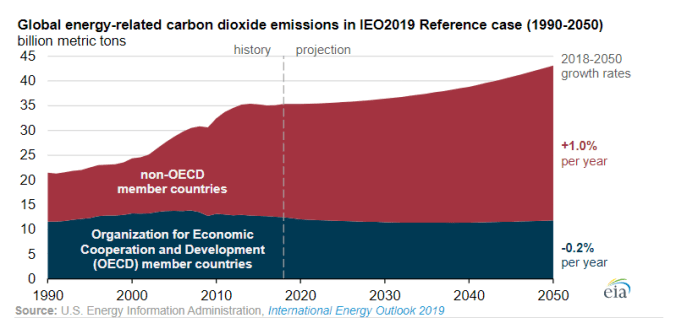
The report shows some influence of climate concerns, particularly in the US and China, but overall it describes the dimensions of a disaster.  The following chart taken from the report shows a continuing growth of CO2 emissions for the entire period.   While the report itself doesn’t explicitly call out the bottom line, the numbers from the report imply that the world will hit a point of no return already by 2035—with a CO2 concentration of 482 ppm and a temperature rise of 1.6 degrees C.
eia1

In the EIA scenarios, the world does a pretty good job of migrating electric grids to renewables (or to some extent gas)—but a terrible job of moving applications to electricity.  In developed countries this translates to business as usual, but in the developing world it’s much worse.  India, for example, is seen as growing exponentially with much of the increase powered by coal.  This isn’t just a question of forcing them to meet our standards.  Heavy industry is a particular problem everywhere.

So the application area is a big job with many industry-specific issues.  The world desperately needs focused research efforts with results that can be applied large-scale worldwide.  This can’t be a matter of everyone guarding discoveries for national advantage.  Cooperative international arrangements will be key to meaningful progress.


Even at this high level there are a number of conclusions to be drawn:

– There is no do-nothing alternative.

Technology will deliver a viable future, but we’ll have to work to get there.  There’s no silver bullet that makes it all go away.

– Technology development is important and has to be figured into any planning, but technology concerns are not the barrier to success.

It is perfectly possible to put together a plan to get the US where it needs to be by 2030.  That’s not saying all technology problems have been solved (after all electric cars are still much too expensive), but we can see a path to success.  We shouldn’t trivialize the effort and sophistication required, but based on where we are, and given financing, it appears that the technical side can get done.  The next point is less clear.

– Changes are huge and have to be dealt-with politically.

This isn’t just a matter of coal-miners losing their jobs.  Electric cars alone will have pervasive consequences.  We have to understand that worries about change are rational, so an important part of domestic climate policy has to be an assurance everyone will be made whole.  Otherwise we will continue to face the push back seen most recently in the Australian election.

In the US there is every reason for the less advantaged to distrust the political powers that be.  In the developing world it’s even worse—you’re talking about giving up on the benefits of development for some unknown duration.  The situation is necessarily difficult.   It’s only going to work if wealthy people and wealthy countries realize it’s in their own interest to come up with the goods.  No one will escape the consequences otherwise.

– The international side is unavoidable.

There is only one atmosphere.   Every country in the world has to cooperate, or we all lose.  When the US opts out, everyone loses faith in the future—as was evident in the recent Madrid meeting.  We have to restore international unity in order to make progress.  And that will only come when every country sees a just role for itself individually.  As for the terms of the Paris Agreement—it is only a first step and actually better for rich countries than will ultimately be workable.

We cannot go into this with the attitude that the objective is to come out a winner at the expense of everyone else.  If everyone doesn’t win, we all lose.

– This is not a matter for incrementalism.

We’re not going to get there with well-meaning people insulating their houses or businesses putting solar cells on the roof.

It’s worth putting some numbers on this.  With current technology, the power output of a solar cell is 20 watts per square foot.  From that you can calculate how many solar cells would be needed to meet current US electrical demand.  The answer is about 2500 square miles, assuming they’re all in brilliantly-lit, weather-free Arizona.  (And there are serious problems in managing that one too.)  All of it gets an order of magnitude worse if we decide to go piecemeal in random, less promising locations–and that’s just for today’s electrical grid, not where we have to get to.

That’s not to say that Arizona is necessarily the solution.  The point is that there has to be a rational national policy that will actually get the job done.


Greta Thunberg is right—there is no substitute for major political action.  Anything less is delusion, regardless of who says it.  The 2020 election is the single, deciding climate issue today.

Perhaps we need the right metaphor.  The fight against climate change is a war.  We’re all in it together—losing is losing for everyone.  The countries of the world are allies in the sense that each of them is necessary for success.  National economies will be affected, but through national climate efforts with no shortage of jobs.

Right now we’re like the US in mid 1941.  We can see and understand the enemy, but we’re not convinced we really have to be involved.  That situation only got resolved when the Japanese attacked Pearl Harbor, and it was clear there was no other choice.  You can make a case we were lucky that it wasn’t too late.  Without the Nazi’s disdain for “Jewish physics”, they might even have gotten the bomb.

For climate, if we act today we have the elements of victory.   We also have ample evidence it’s a near thing.  A climate Pearl Harbor may well be too late—and beyond anything we want to live to see.

Lessons From the British Election

55ddfb60723389.5a56f216db0a1

“Boris” by Raymond Wang is licensed under CC BY-NC-ND 4.0

There is no way to avoid talking about the horrors of the British election.  With the confirmation of Brexit and the triumph of Boris Johnson, we have all stood witness to the disgraceful demise of a nation now left only with dreams of past glory.

For us though the important question is about what it means for our own election.  On that point the discussion has been generally limited to one question:  Does it say we should worry about the Democrats going too far to the left?  That one is hard to decide, since Labor leader Jeremy Corbyn was so unpopular for his own sake. 

However, that being said, there is still much to discuss.   We propose three points:

  1. Catastrophes not only can happen, but will happen if we don’t watch out for them.

The Democratic debates thus far have played out largely as conflict between the center and left wings of the party.  That means essentially all of it has been fought in the never-never land of post-Trump.  That’s not the same as working on viable strategies to win.

This will be a very tough election, fighting the Fox News, the Electoral College, incredible amounts of Republican money, and all the (legal and illegal) powers of incumbency.  Most candidates have done a reasonable job in providing position papers for what they stand for.  They need to tell us how they’re going to win.

  1. We need to recognize that the electorate isn’t convinced of the urgency of change.

In Britain, Corbyn’s big socialist revival was not so much wrong as a non sequitur.  What actually was all this trying to solve?  Why was it an argument for change?  It was ultimately a declaration of irrelevance.

We have a similar problem.  The very first question of the very first debate has never been adequately answered.  Elizabeth Warren was asked (more or less): “Why are you proposing all these changes when—by all polls—the vast majority of Americans think the economy is doing fine?”  That’s a question for all Democrats—what is it that’s so bad that we need change?

Warren’s answer—about radical inequality—was nowhere near strong enough.  It essentially said that all those people who answered the polls were just wrong.  But no one else has done better.  Healthcare was a great issue for the midterms—that’s something broken that we’re going to fix.  But it’s not enough to unseat Trump.  Impeachment doesn’t touch peoples’ lives directly—it’s about an abstraction called democracy.  Even climate change comes across as an abstraction, although it’s part of what’s needed.  Democrats need a short, clear reason why people need to worry that there is something that needs fixing.

That’s a bar to be passed before we can begin to get traction with specific plans for change.  Until then, like it or not, “fundamental structural change” will be a negative.

  1. We have to keep this a referendum on Trump.

Corbyn pretended Brexit wasn’t the main issue and went off with his own program.  The public was unwilling to follow.

Regardless of how broadly we see the issues, this election is about where Trump is taking the country.

We need a well-defined Trump story to challenge Republican claims of a great rebirth of the American economy.  Even on trade they’ll do what worked for George Bush on Iraq—we’ve been through all the pain, don’t miss out on the rewards!

That means we need to show what four more years of Trump will actually mean.  And how to meet the real challenges for our future.  It seems helpful to think in terms of personal and national issues for the voters:

Personal well-being

Healthcare (complete failure of vision)

Decline in good jobs (manufacturing, good jobs in general)

Education (no initiatives, no funding)

Income inequality (all growth for the rich)

Guns (unsafe to be in school!)

Climate change (what world for our children?)

Women’s rights trampled (bodies owned by the government)

Worse life for everyone but the protected few

National well-being

Eroding technology dominance (science marginalized)

New businesses sacrificed to old (Net Neutrality)

Losing out with climate change denial (ceded primary position to China)

Weakness with China and North Korea (situation is worse than ever before)

Nuclear proliferation (a danger in all directions)

Racism and divisiveness undermine our strengths (just what Putin ordered)

Demise of democracy (our major source of prosperity and power)

=>  Welcome to the Chinese century


That’s where we’re going.  For our own dreams of past glory.

The End of Democracy

14387714597_9d026aa844_b

“STATUE OF LIBERTY” by airlines470 licensed under CC BY-SA 2.0

Who knew it would be so easy?  In Sinclair Lewis’ “It Can’t Happen Here,” he needs real violence for a fascist takeover of the country.  In fact it took almost nothing at all.

We were lulled into complacency.  The institutions setup at our founding had lasted hundreds of years.  They weren’t perfect, but at least we had regular changes of power.

It turns out there was much we overlooked.  It’s easy to make a list now:

–  The Constitution functions only as it is interpreted by the Supreme Court.  A Court majority willing to exercise power can do almost anything.  For starters:  corporations are people; the first amendment precludes any control of money in politics; voting rights are not guaranteed.  Appointments are for life, and reasons for decisions are arbitrary and non-reviewable.

– The President and Senate have complete power over lifetime appointments of judges.  There are no controls on job requirements or procedures for appointment.

– The Attorney General is a creation of the President and can interpret laws in any way that the Supreme Court allows.  He, together with the Court, can quite legally be the President’s enforcer.

– Going one step farther, the impeachment process has laid bare the biggest threat of all, that there is no Constitutional check on a President whose party controls the Senate and will support him as a matter of principle.  Who is left to enforce the law?  In such a case the Constitution becomes a dead letter, supplanted by the whim of the dictator.

There is an old and probably apocryphal story that the mathematician Kurt Gödel, on reading the Constitution to prepare for his US citizenship interview, told Einstein that he was shocked to discover a path for a fascist takeover.  Einstein told him to shut up and get on with it.  It seems Gödel was right.

However institutions are only a part of what we missed.  Apparently the founding fathers were well-aware that in human history democracies have been rare and short-lived.  However as creatures of the Enlightenment, they were rather optimistic about the workings of the human psyche.

With that too there is much to go wrong.

– It turns out that people aren’t terribly rational.  They are intensely tribal and unwilling to change opinions based on facts.  Both advertising experience and economic theory have shown that there are many techniques to successfully manipulate opinions.  Two examples:  the brain confuses ease of access with truth, so that repetition works great; people process issues in bunches, so that opinions about abortion translate conveniently to opinions about tax rates.

– It turns out that even perceptions of factual reality are easily manipulated.  We no longer directly perceive reality; reality is what we glean from the information streams around us.  In the US we already made a terrible mistake (deliberately pushed through under Reagan) to remove the fairness doctrine on television—clearing the way for Fox News and other propaganda channels.  Now we have an even more serious problem with social networks.

– Finally and most fundamentally we’ve misjudged people’s commitment to democracy and fairness.  What we’ve found is that there may have been a commitment out of habit, but it was no more than skin deep.  If you can be sure of winning all the time, why even consider giving it up?  Democracy is just one more item on the list of things where “I just don’t have to care.”

Is there a way back?

Based on history, it seems we need two things:

– A unifying figure as President, to function as a creature for change.  It helps if the person is not too directly tied to factions.

– A renewed commitment to the non-legal underpinnings of democracy.   That is, to the unstated rules of cooperation that made democracy work for 200 years.  Much as you might like to, you just can’t legislate everything.

We like to think about Athenian democracy as a model (ignoring that Athens was in fact a quite unrecommendable imperialistic power).  After the rise of demagogues, they did in fact take the first step back, but they never managed the second.

We’ve been a much more successful democracy than they were, but we’re now at the same juncture.  The 2020 election is perhaps our last chance.

This is not just about an abstract idea of democracy.  With Athens it was the end of economic dominance and everything they stood for.  Same for us too.

Reasons For Pragmatism

44590252562_fa8baf6626_b

“COD Volunteers Give Back to the Community During COD Cares: Roll Up Your Sleeves Service Day 103” by COD Newsroom is licensed under CC BY 2.0

Ideology can be inspiring, but it’s never the same as a plan to get a job done.  For now it’s getting in the way on many issues.  Here are a few examples:

  • Healthcare

ACA is an imperfect compromise with known issues—in part because it was a non-final version enacted in the wake of Scott Brown’s Koch-funded victory for Ted Kennedy’s Senate seat.  All attempts since then to improve ACA have been blocked by anti-healthcare Republicans.

That being said ACA has enabled tens of millions of people to be covered for the first time, and it is supported by a non-regressive tax—the ACA surcharge.  It also attempts to get around some of the worst problems private insurance by covering pre-existing conditions and regulating how much of premiums must be paid out in benefits.  In fact insurance profit margins in healthcare are well-below margins in every other insurance category.

The most critical issues today are to improve coverage, pricing, and the range of offerings for ACA plans.  Some of this is just a matter of rolling back Trump efforts to destroy ACA.  The rest is more complicated, but nonetheless well-studied.  This needs to happen independent of long-term plans.

“Medicare of All” is an ideological choice—to get healthcare away from the insurance companies.  It’s a good slogan but something of a misnomer, because the changes from Medicare are decidedly non-trivial.  The Sanders bill optimistically assumes all private insurance will be gone in four years, but without a real plan to make it happen.  While virtually all developed countries have some form of universal healthcare, the systems are dramatically different from country to country, and many keep some form of private insurance.  Even current Medicare has many roles for private insurance.

Focusing on Medicare for All does nothing for current problems, and puts us in an ideological battle for the future.  As Krugman recently pointed out “Not many people love their insurance companies, but that doesn’t mean that they’re eager to trade the coverage they know for a new system they don’t.”  Additionally—for current Medicare recipients—Medicare for All is easily posed as a threat to Medicare itself.  That worked (using ACA) in the Scott Brown election and could well work again.

The long-term objective is affordable, universal coverage.  And the first steps start now.

  • Climate Change

If anything should ever be non-ideological it’s climate change.  Facts are facts, and the solutions are primarily matters for science and engineering.  The main political issues are how much money to spend and who is going to pay for it.

Both sides, however, have turned this into a culture war.  That the Kochs have dishonestly challenged the basic science is by now almost beside the point.  “Bad science” is just an epithet thrown out in the culture war.

We need to stop the culture war and make sure we take care of the people who will be hurt as the economy goes off fossil fuels.  Green New Deal makes some things better and some things worse.  There’s so much political deal-making thrown into it, that it can’t possibly be viewed as anything other than a left-wing grab bag.  Maybe that helps in defeating Trump—which is of course necessary for any progress—but there are too many distractions from the climate change goal.

We need to make sure that everyone realizes that the new post-climate-change world is a good world for all—even people who want to drive AV’s and Chevy Suburbans.  And we need to commit to protect everyone—coal miners, car mechanics, people hit by carbon pricing—who might otherwise be hurt in the process.  That’s the objective.  We can refuse to play the Koch’s culture war game.

We have to get away from the notion that we need to create a kind of “socialist new man” of conservation.  We’re not repealing the industrial revolution.  We just changing the technological underpinning of how things work.  That’s not to say there aren’t other environmental issues, but they’re not the same.  We shouldn’t expect fixing climate change will put the EPA out of business.

  • Jobs

This whole area is filled with so many wrong and misleading ideologies that we can start with a catalog of wrong ideas.

Manufacturing is the basis of economic strength.

The Chinese have gutted manufacturing in the US.

Balance of payments is a good measure of economic strength.

A strong private sector will provide everything necessary for economic success.

Tariffs protect and strengthen the domestic economy.

Low business tax rates build national competitiveness.

Taxing businesses hurts everyone.

Strong unions and strong anti-trust enforcement will preserve the middle class.

Public sector jobs aren’t real jobs, they just pull money out of the private sector.

In the future there just won’t be jobs for everyone.

From the list it’s clear this isn’t a matter of left versus right (even if you discount the lunatic fringe running things today).  The world is moving into new territory (more and more companies with 0 cost of production, tighter and more automated international links).  So the challenge is to see things as they actually are.

Ideologies can get in the way of understanding.  No candidates seem willing to talk about the transition from a manufacturing to a service economy.  Unions and antitrust enforcement are still good ideas, but they buy less than they used to.   As the last of the points indicates, futurists tend to provide more ideology than reality, so nothing beats experience and pragmatism.

For ourselves we see government challenges as:

Supporting education and research to keep ahead of technology change.

Managing the continuing transition from a manufacturing to a service economy.

Taxing and regulating dynamic international corporations with monopoly power.

Building and maintaining a bigger public sector to provide necessary services the private sector won’t.

Maintaining quality of life for all who live here.

Consciously working at creating and managing the international institutions that make the world work.  We used to recognize this responsibility (and avenue to exercise power), and no one else is stepping into the gap.

Overall we need to recognize the problems we do have—not the ones of the 1930’s—and look what will actually be effective to fix them.

There are many other areas where the same kind of story plays out—where an ideological war masks a more tractable, practical problem.  I’d even put immigration in that category.

It’s hard, given the daily atrocities of the Trump era, to focus on anything less than epic changes.  But if we’re going to put the pieces back together afterwards, it’s pragmatism that will get the job done.

Thinking About Manufacturing

There seems to be a lot of confusion about manufacturing.

We’ll start with a few slogans that pass for generally-accepted truth:

  • Manufacturing is the core of the US economic base.
  • Restoring manufacturing is key to the viability of the US working class.
  • The Chinese have gutted manufacturing in the US.
  • The continuing decline of manufacturing is another indication of the failure of Trump’s economic policies.

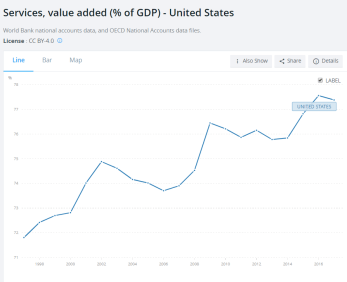
One indication that something might be fundamentally wrong in all of that comes from looking at trends in the service and manufacturing sectors over the past twenty years:

mfg_in_gdp_wbsvcs_in_gdp_wb

To say the least, it looks like there is something more fundamental going on than politics or even globalization.   Manufacturing has been declining relative to services for many years and in a big way.  It’s not just because of China, and it’s not even just in the US:

mfg_in_gnp

The US has been undergoing a massive migration from a manufacturing-oriented economy to a services economy. One problem is that we don’t really have a good vocabulary to talk about that situation.  The term “services” goes from McDonald’s to Google.  But in any case manufacturing is no longer the core of national economic success.  Think about television.  The sets have become so cheap that only huge volumes can cover the low margins.  But every major company you can think of wants to get into content to run on those sets.  There are hardly even any DVD’s manufactured for that stuff anymore!

We’ve talked here before about software.  All of the leading high tech companies (including Apple) are software companies.  Software companies produce product without manufacturing.  And that’s only one of the reasons such companies can be very profitable:

– They typically sit on top of the value chain (or even, like Facebook, have only software as output)

– They tend to have monopoly power (because dominant players can afford to spend more on R&D)

– They tend to have high barriers to entry and effective customer lock-in

The world economy today has increasingly many highly-profitable dominant software companies.  Some like Google produce software; others like Apple rely on a world-wide agglomeration of highly-competitive businesses producing to their specs.  Our current national success is that we have lots of them.  Our military strength depends on their technology.  The Chinese are sensible enough to understand that’s where they want to be too.  Even in biotech—where there has to be manufacturing—you’re still talking about largely high-skilled operations in companies with a large emphasis on R&D.


It’s a little strong to say it, but it’s closer to reality than most of what we hear:  mass employment in manufacturing is like mass employment in agriculture—it has had its day.  The migration is as extreme as what happened a hundred years ago.  And we’re better off thinking about the consequences than blaming it all on the Chinese or trying to outdo each other with promises to make it go away.

That point of view is widely held (based on the figures), but somehow it hasn’t managed to penetrate public discussion.  That’s not surprising for the Trump people, since they’ve been making it all up from the beginning.  For the left it’s different.  Traditional socialism has always had an industrial flavor that is hard to give up.  Unions and trust-busting are good, but they won’t bring back the past.  Forcing businesses that take federal research money to do manufacturing here will help some but not enough to reverse the trends.

(For the left, one particular paper has been frequently cited to show manufacturing job loss is reversible.   That paper concluded that the large manufacturing job losses from 2000 to 2010 were not due to automation here.  However, for its purposes it only examined companies that remained here and checked how many robots they had.  Nothing was said about the reasons any single company had left.)

The question then is what we should do.  The key is to start considering what we see around us as reality:

  • A long-term trend of decline in manufacturing
  • Very profitable, highly technical, non-manufacturing monopolies
  • Complete neglect of domestic services for the public good

We’ve talked about those trends here before.  As we’ve noted, some of the monopoly power is structural, so it’s not clear how far we’ll get with breaking them up.  However, monopoly power means companies are far from cost-sensitive, so the last thing we need to give them is more tax breaks.  On the contrary what’s crucial is learning to tax them, and we’ve got Apple as proof of how tough that can be.

In this picture the public sector has two important roles:

  1. Preparing the country for success in the world economy. That means infrastructure of all kinds, including education and child care as much as roads and bridges. The private sector won’t do it.  But—with an appreciation for the role of government derived from the second world war—we used to do a better job of it ourselves.
  2. Making sure the wealth of the monopolies gets translated into benefits for the population. This is another case where the private sector can’t act for its own good. Henry Ford famously wanted his employees to be able to buy his cars, but that’s certainly not the ethos of today. This doesn’t mean free money, it means employing people for the unfilled tasks needed for the public good.

We need the public sector to be the means of addressing the country’s unmet needs with resources from gilded-age inequality.

It’s worth pointing out that we have been wasting resources on a spectacular scale.  Under George W. Bush we fought a $3T war with no identifiable benefit and underwent a privatization effort (including tax cuts) that ultimately produced a near-depression.   Under Obama the Republican Congress shut down government, retarding recovery and preventing the public sector from doing any of the jobs just described.  Under Trump the primary achievement has been another $2T of tax cuts, with a jump in inequality and a deficit big enough to prevent any of the infrastructure work from getting done.  That the tax cuts went straight into stock buybacks is a clear indication of irrelevance.

It is instructive to think back to the time when the country underwent the last such a drastic economic change, when we went from an agrarian to an industrial society.   People had a hard time then thinking about it.  They got tied up in an irrelevancy—the silver monetary standard—and it took a long time before the real problems of corporate power and inequality were addressed.  A contemporary Henry Demarest Lloyd expressed his frustration this way: “The free silver movement is a fake. Free silver is the cow-bird of the reform movement. It waited until the nest had been built by the sacrifices and labor of others, and then it lay its own eggs in it, pushing out the others which lie smashed on the ground.”

We have something of that problem today.  The long-standing decline in manufacturing is a continuing but unacknowledged reality.  Instead we spend our time blaming it on the immigrants, or the Chinese, or the elites, or some combination of everyone else.  Until the blame game stops we can’t begin to decide how our economy really needs to work in the world we’ve got.  For climate actions we worry about coal miners, but there are many others in the same boat.  There is an international aspect too:  we’re too busy looking for villains to spend time on making the system work for global prosperity.

For our part we think it’s time for the public sector to come in from the cold.   In any case it’s time to stop talking about free silver.


Some Points on Climate

This touches a number of recent climate issues—some new, some familiar.

Background

  1. The primary issue for climate change is alternative energy sources.

We’re not repealing the industrial revolution.

This shouldn’t be a partisan or a lifestyle issue

We need good science and the will to fight entrenched special interests

  1. Conservation is important for now but not the main focus

Alternative energy will do the job if we do ours.

Chevy Suburbans are not the issue—we just need to power them differently

 “Respect for nature” by primitive peoples is irrelevant (but coming from all directions!)

  1. This is a fundamentally international problem where what we do for the rest of the world is as important as what we do domestically.  We will need to spend money on parts of the world who can’t.

s11_2018_Projections

  1. The fossil fuel companies have an evil influence on progress, but outrage at what they knew 50 years ago is a distraction.

Oil isn’t unclean—we just went too far with it.

The Carter era thought the world was running out of oil in less than 50 years

               The key issue is influence of fossil fuel companies now.

  1. Conversions of coal power plants to gas are still important—they buy time

We’re up against a carbon budget limit—any saving buys time

Progress is still rapid for alternative energy technologies—even electric cars aren’t ready for everyone yet.

Coal plants, especially new ones, continue to be a problem.

  1. We should stop calling a carbon pricing a tax.

We need to stop the huge fossil fuel subsidy—$1 T per year in the US—that comes from using the atmosphere as a free carbon dump.

We need a plan to make the population whole—and earn the trust we will do it

History and politics

  1. Obama actually did quite a lot for climate

International unanimity (after many years of failure)

A process to do more in the future

Turning China around (look at China’s line on the emissions chart above)

               Seed funding for Tesla and subsidies for electric cars

Note—the US was the primary beneficiary of the Paris Agreement.  We’re not being told to stop emitting at twice the rate of anyone else!

s12_Top_FF_Emitters_percapita

  1. Trump’s effect on progress is far worse than acknowledged

Reversed progress on all environmental issues in the US

Broke international unanimity—okay for everyone including China, Japan, and Germany to backslide with coal power plants

Legitimized attacks on climate action everywhere (Australia)

Continues to block any international cooperation on any issue

Going forward

  1. The single most important action is to defeat Trump

He is a roadblock to progress by anyone’s definition.

Any of the Democratic candidates would be good—no one has a real plan yet anyway

  1. The Green New Deal delivers a necessary coalition for progress

Makes clear that the new world is a good place to be.

Unites all constituencies

Must eventually add carbon pricing.

Not yet a plan

  1. The youth climate movement is helpful but a little worrisome

Non-partisanship makes it easy to co-opt—speakers at rallies dismiss all establishment parties.

               Trump was (in part) elected by young people who thought voting didn’t matter.

  1. If we can get past Trump, then we all need to get serious about a real plan

consumption-by-source-and-sector

Needs to address our current usage

Make sure it happens–what to fix when and by whom

               Minimize the hurt (particularly for the disadvantaged)

Recognize full international responsibilities

Don’t expect climate efforts to fix everything.  Broader issues include:

Easing workforce disruptions from technology, globalization, etc. (not just from climate)

Education

Infrastructure (much more than climate)

Jobs and wages (unions, minimum wage, role of the public sector)

Racism and sexism (need rules for everywhere)

Inequality overall (need a tax plan)

Other environmental issues will still be there to be solved