The True Cost of CO2

It seems perfectly reasonable.  Each ton of CO2 added to the atmosphere causes damage.  We can estimate that damage by looking at what’s happening.

The Obama administration went through that exercise in some detail to justify environmental protection measures—and came up with $42 per ton.  The Trump administration people reduced that number to less than $7 and increased the future discounting factor from 3% to 7%.  That’s certainly a problem.

However the $42 figure is also wrong, and the whole notion of a dollar cost of CO2 undermines much of the discussion of the costs of climate change.

One way to see that is to look at the language we use to talk about hurricanes.  For starters I’m going to reference the usual storm class definitions:

hurricanes

As the wind speed increases, the damage rises by orders of magnitude.   At each stage the damage rises to such a degree that damage at the previous level becomes negligible.  There is no single number that tells you how much extra damage you’re going to get from a 5 mph increase in wind speed—it gets dramatically worse with each stage.  This is basically an exponential model; it is certainly not multiplication of windspeed by a number appropriate for category 1.

You can see how this argument plays with climate.  Starting with hurricanes, we have a basically linear relation of CO2 concentration and water surface temperature:

sea-surface-temp-download1-2016

And essentially the same is true for water surface temperature and maximum windspeeds. To that gets added the exponential relation of windspeed with damage.  Put it all that together and you get an exponential relationship between added CO2 and hurricane damage.

The same kind of relationship holds for almost any kind of climate damage you can think of.  Sea level rise first affects marginal districts but then more and more of mainstream society.  Droughts first affect marginal areas and gradually more and more of the breadbasket.  Health threats first affect the most vulnerable but eventually everyone.   Accelerating costs are the rule, not the exception.

How does this affect how we think about costs of climate change?  In fact we’re missing most of the damage.  The cost of a ton of carbon today has two components:  the costs that we measure today and the extra damage incurred by raising the CO2 level for all subsequent tons of CO2.  That second part is what you won’t get with any fixed value for the cost of CO2.  It may be harder to calculate, but it’s ultimately the main thing—because it’s adding CO2 that gets us to catastrophe.  We’re missing the step-ups in the hurricane example.

There’s a weird dichotomy between the science and the cost models.  On one hand we have scientific studies about truly catastrophic consequences of going beyond a global temperature increase of 1.5 degree C—even to 2.0 degrees C—and on the other hand we have the fixed value of $42 per ton.  In the second case we’re not charged for contributing to glacial melting that can’t be stopped before inundating both Bangladesh and Manhattan.  It’s beyond ludicrous that we’re applying discounting factors to future costs but not charging for the long-term consequences of that ton of CO2 that remains in the atmosphere!

For now the only viable number for the cost of a ton of CO2 in the atmosphere is actually how much it will cost to take it back out.  That number is currently about $1000 a ton. There are many people trying to do better; the current (undoubtedly overoptimistic) estimate is about $150 per ton.  That’s the lower bound.  And even that low-ball estimate says we’re currently subsidizing the fossil fuel companies by about a trillion dollars a year.

Believe the scientists.  A catastrophe is a catastrophe.  You can’t make it go away with cost models that sweep it all under the rug.

The Coronavirus and the Limits of Capitalism

23035851695_0ddbaae4c9_b

“Lankenau Hospital” by Montgomery County Planning Commission licensed under CC BY-SA 2.0

It’s easy to look at the coronavirus as a one of a kind.  After all, who expected this cataclysm that came from nowhere?   How could anyone have predicted it?

In fact the world is full of low-probability events that you have to care about.   The coronavirus is on a par with airplane crashes and oil-rig explosions.  Capitalism is not good at dealing with any of them.

There’s a myth about that sort of thing.  Of course we don’t need airline or aircraft regulation, because the companies in question know what a disaster would mean and will take care that such things don’t happen.  That’s a nice story, but it’s false.   People don’t get promoted because of events that didn’t happen.  They do get promoted by saving money wasted on something that’s never going to occur.

If you’re going to stop that sort of thing from happening, you need a different mindset.  Government has to spend money on regulation and public health and safe, comprehensive infrastructure.   No one else is going to do it.  We now know unequivocally that we decided we didn’t have to care about the CDC.  It has come back to haunt us.  There’s more where that came from.

In fact there’s a whole bunch of other things we’ve decided we don’t have to care about.  After all, “I don’t have to care” has been the liberating elixir of our age.  Many of these we’ve talked about before, but it’s worth recalling some here:

Climate change

Avoiding a depression (clearly relevant now)

Nuclear proliferation

Losing our edge in science and technology

We’ve washed our hands of all of this, blithely punting to a private sector that is no more prepared than for the coronavirus.

The message from the coronavirus is that bad things really can happen, no matter how much we may want to avoid thinking about them.

The coronavirus is the canary in the mine.   We’ll get over it somehow, but we’ve had our warning.

What Matters for Climate Change

Last year this blog had an overview of the major factors involved in fighting climate change.  Most of that is still current, but it has also become clear that there is a lot of confusion—even in the climate movement—about consequences.  So this piece is not about the basics; it’s about the reality of what it takes to combat climate change.

To start with, Here is a list (off the top of my head) of widely-believed nonsense.  There is probably something to annoy everyone.  You can see if I’ve made a case for it by the end.

– Conservation is a primary issue

– It’s important to get solar cells on rooftops everywhere

– Recycling is important

– Local initiatives are important

– State initiatives are important

– The main game is getting our house in order

– We don’t need to do anything, since technologists will solve it by themselves

– We’re ready for electric cars to take over the transportation sector

– Current solar and wind are ready to take over everything

– Winning is simple, we just have to stop the oil companies and start deploying the good stuff.

– For climate change employment, we need local communities to decide what they really need

– The private sector is doing it all by itself

– Carbon pricing is optional

– Carbon pricing is all it takes

– We need to get a better deal than the Paris Agreement

– We’re in control of our own destiny

– We all need to change our lifestyles

– Fighting climate change will tank the economy

– Economic dislocation means taking care of miners

– Since poor people get hurt worse, climate action is a matter of charity—for social justice

– Same thing for racial justice

– Same thing for regional justice

– Internationally, this is a matter of everyone taking care of their own

– With China and India, the important thing is to stand tough to get what we want

– We have to insist that any new technology developed here gets manufactured here


Let’s start this off with item #1—conservation.  From within the US it’s easy to believe the fight against climate change is all about conservation.  After all, we’re up against a hard limit on tolerable levels of carbon dioxide in the atmosphere, so we’ve just got to cut down on burning in all ways.  And we’ve got to learn to behave differently in the future.

However that logic breaks down quickly.  What about all the people in China and India?  Our conservation is a blip compared with them, but we share the same atmosphere.  Do they just have to get used to the idea that cars and air conditioning aren’t for them?  They should accept permanent sacrifice for the good of mankind?  Even in the US, no amount of conservation will move people to electric cars or eliminate the CO2 production from heavy industry.

So even for the near-term we have to recognize that the fight against climate change is not primarily about conservation but about alternative energy sources.  Worldwide, we need to evolve energy sources, so that there will be enough to take care of people everywhere.  As noted in the prior piece, there is in fact no reason to fear we will ultimately lack for power.  This isn’t about learning to live with energy scarcity—it’s about creating a future for all people, all countries, and all life styles.

For that reason we need to focus on the transition to alternative sources of power.  There are two quite different types of problems to be solved:

– Generating and distributing power

The first thing to recognize is that (despite some obfuscation from the oil companies) the future is electric.  That’s the common currency for the energy to be used everywhere, in factories, in homes, in cars.  It’s what all the renewables produce today, and what will be produced by all future candidate technologies.  Electricity is easily transmitted over long distances, and can be stored for later use (although there is much still to be done for high-volume, in-network storage).

So this work includes the electrical network, the sources of energy, and the means to store it.  Since everything will move to the electrical grid, its capacity will need to grow significantly and fast.  This is a huge project, but this is ultimately just a matter of national will.  That makes it the easier part.

– Adapting applications to use it

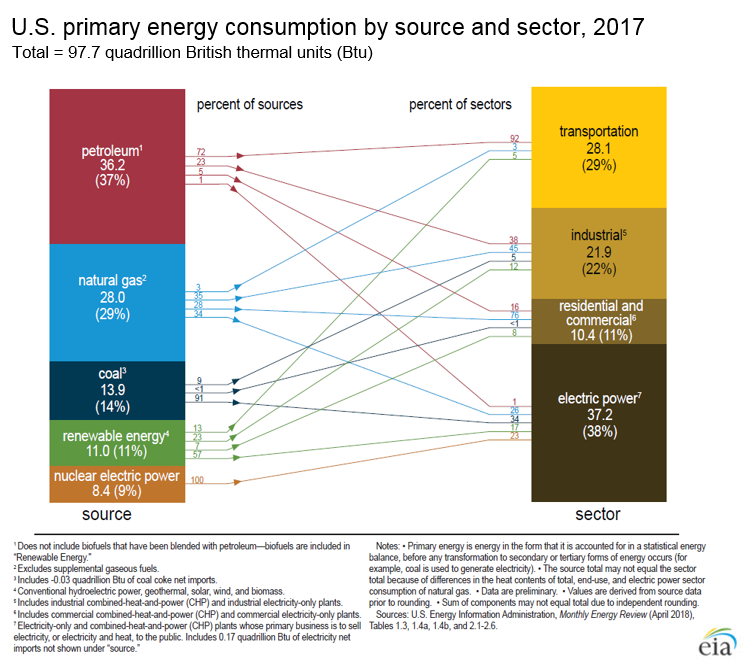
For that you need to work through the major sectors of energy usage.  Here is the chart for the United States.

consumption-by-source-and-sector

This is a larger and more complex undertaking, requiring careful planning for each sector.  Carbon pricing is one of the few actions that can be done across the board.   As we noted previously, assuming the atmosphere is free amounts to an annual subsidy of $1 T to the US fossil fuel industry.  Even low-level initial pricing (as with CCL) sends a message for corporate planning.  However, it is naïve to believe that carbon pricing will just take care of all sectors in time to avert disaster.  Note also, for priorities, that the residential and commercial sector is the smallest by far.

We also have to think about this problem not just for the US but for the rest of the world as well.  The US Energy Information Agency has released a document that helps in thinking about that task.  (A short summary of conclusions is available here.)  It has projections of energy use throughout the world going out to 2050.  With that it includes variants of the US energy use chart (just given) for other countries.  A significant fact is that many developing countries have a proportionally much larger industrial segment than we do, as high as 70%.

The report shows some influence of climate concerns, particularly in the US and China, but overall it describes the dimensions of a disaster.  The following chart taken from the report shows a continuing growth of CO2 emissions for the entire period.   While the report itself doesn’t explicitly call out the bottom line, the numbers from the report imply that the world will hit a point of no return already by 2035—with a CO2 concentration of 482 ppm and a temperature rise of 1.6 degrees C.

eia1

In the EIA scenarios, the world does a pretty good job of migrating electric grids to renewables (or to some extent gas)—but a terrible job of moving applications to electricity.  In developed countries this translates to business as usual, but in the developing world it’s much worse.  India, for example, is seen as growing exponentially with much of the increase powered by coal.  This isn’t just a question of forcing them to meet our standards.  Heavy industry is a particular problem everywhere.

So the application area is a big job with many industry-specific issues.  The world desperately needs focused research efforts with results that can be applied large-scale worldwide.  This can’t be a matter of everyone guarding discoveries for national advantage.  Cooperative international arrangements will be key to meaningful progress.


Even at this high level there are a number of conclusions to be drawn:

– There is no do-nothing alternative.

Technology will deliver a viable future, but we’ll have to work to get there.  There’s no silver bullet that makes it all go away.

– Technology development is important and has to be figured into any planning, but technology concerns are not the barrier to success.

It is perfectly possible to put together a plan to get the US where it needs to be by 2030.  That’s not saying all technology problems have been solved (after all electric cars are still much too expensive), but we can see a path to success.  We shouldn’t trivialize the effort and sophistication required, but based on where we are, and given financing, it appears that the technical side can get done.  The next point is less clear.

– Changes are huge and have to be dealt-with politically.

This isn’t just a matter of coal-miners losing their jobs.  Electric cars alone will have pervasive consequences.  We have to understand that worries about change are rational, so an important part of domestic climate policy has to be an assurance everyone will be made whole.  Otherwise we will continue to face the push back seen most recently in the Australian election.

In the US there is every reason for the less advantaged to distrust the political powers that be.  In the developing world it’s even worse—you’re talking about giving up on the benefits of development for some unknown duration.  The situation is necessarily difficult.   It’s only going to work if wealthy people and wealthy countries realize it’s in their own interest to come up with the goods.  No one will escape the consequences otherwise.

– The international side is unavoidable.

There is only one atmosphere.   Every country in the world has to cooperate, or we all lose.  When the US opts out, everyone loses faith in the future—as was evident in the recent Madrid meeting.  We have to restore international unity in order to make progress.  And that will only come when every country sees a just role for itself individually.  As for the terms of the Paris Agreement—it is only a first step and actually better for rich countries than will ultimately be workable.

We cannot go into this with the attitude that the objective is to come out a winner at the expense of everyone else.  If everyone doesn’t win, we all lose.

– This is not a matter for incrementalism.

We’re not going to get there with well-meaning people insulating their houses or businesses putting solar cells on the roof.

It’s worth putting some numbers on this.  With current technology, the power output of a solar cell is 20 watts per square foot.  From that you can calculate how many solar cells would be needed to meet current US electrical demand.  The answer is about 2500 square miles, assuming they’re all in brilliantly-lit, weather-free Arizona.  (And there are serious problems in managing that one too.)  All of it gets an order of magnitude worse if we decide to go piecemeal in random, less promising locations–and that’s just for today’s electrical grid, not where we have to get to.

That’s not to say that Arizona is necessarily the solution.  The point is that there has to be a rational national policy that will actually get the job done.


Greta Thunberg is right—there is no substitute for major political action.  Anything less is delusion, regardless of who says it.  The 2020 election is the single, deciding climate issue today.

Perhaps we need the right metaphor.  The fight against climate change is a war.  We’re all in it together—losing is losing for everyone.  The countries of the world are allies in the sense that each of them is necessary for success.  National economies will be affected, but through national climate efforts with no shortage of jobs.

Right now we’re like the US in mid 1941.  We can see and understand the enemy, but we’re not convinced we really have to be involved.  That situation only got resolved when the Japanese attacked Pearl Harbor, and it was clear there was no other choice.  You can make a case we were lucky that it wasn’t too late.  Without the Nazi’s disdain for “Jewish physics”, they might even have gotten the bomb.

For climate, if we act today we have the elements of victory.   We also have ample evidence it’s a near thing.  A climate Pearl Harbor may well be too late—and beyond anything we want to live to see.

Lessons From the British Election

55ddfb60723389.5a56f216db0a1

“Boris” by Raymond Wang is licensed under CC BY-NC-ND 4.0

There is no way to avoid talking about the horrors of the British election.  With the confirmation of Brexit and the triumph of Boris Johnson, we have all stood witness to the disgraceful demise of a nation now left only with dreams of past glory.

For us though the important question is about what it means for our own election.  On that point the discussion has been generally limited to one question:  Does it say we should worry about the Democrats going too far to the left?  That one is hard to decide, since Labor leader Jeremy Corbyn was so unpopular for his own sake. 

However, that being said, there is still much to discuss.   We propose three points:

  1. Catastrophes not only can happen, but will happen if we don’t watch out for them.

The Democratic debates thus far have played out largely as conflict between the center and left wings of the party.  That means essentially all of it has been fought in the never-never land of post-Trump.  That’s not the same as working on viable strategies to win.

This will be a very tough election, fighting the Fox News, the Electoral College, incredible amounts of Republican money, and all the (legal and illegal) powers of incumbency.  Most candidates have done a reasonable job in providing position papers for what they stand for.  They need to tell us how they’re going to win.

  1. We need to recognize that the electorate isn’t convinced of the urgency of change.

In Britain, Corbyn’s big socialist revival was not so much wrong as a non sequitur.  What actually was all this trying to solve?  Why was it an argument for change?  It was ultimately a declaration of irrelevance.

We have a similar problem.  The very first question of the very first debate has never been adequately answered.  Elizabeth Warren was asked (more or less): “Why are you proposing all these changes when—by all polls—the vast majority of Americans think the economy is doing fine?”  That’s a question for all Democrats—what is it that’s so bad that we need change?

Warren’s answer—about radical inequality—was nowhere near strong enough.  It essentially said that all those people who answered the polls were just wrong.  But no one else has done better.  Healthcare was a great issue for the midterms—that’s something broken that we’re going to fix.  But it’s not enough to unseat Trump.  Impeachment doesn’t touch peoples’ lives directly—it’s about an abstraction called democracy.  Even climate change comes across as an abstraction, although it’s part of what’s needed.  Democrats need a short, clear reason why people need to worry that there is something that needs fixing.

That’s a bar to be passed before we can begin to get traction with specific plans for change.  Until then, like it or not, “fundamental structural change” will be a negative.

  1. We have to keep this a referendum on Trump.

Corbyn pretended Brexit wasn’t the main issue and went off with his own program.  The public was unwilling to follow.

Regardless of how broadly we see the issues, this election is about where Trump is taking the country.

We need a well-defined Trump story to challenge Republican claims of a great rebirth of the American economy.  Even on trade they’ll do what worked for George Bush on Iraq—we’ve been through all the pain, don’t miss out on the rewards!

That means we need to show what four more years of Trump will actually mean.  And how to meet the real challenges for our future.  It seems helpful to think in terms of personal and national issues for the voters:

Personal well-being

Healthcare (complete failure of vision)

Decline in good jobs (manufacturing, good jobs in general)

Education (no initiatives, no funding)

Income inequality (all growth for the rich)

Guns (unsafe to be in school!)

Climate change (what world for our children?)

Women’s rights trampled (bodies owned by the government)

Worse life for everyone but the protected few

National well-being

Eroding technology dominance (science marginalized)

New businesses sacrificed to old (Net Neutrality)

Losing out with climate change denial (ceded primary position to China)

Weakness with China and North Korea (situation is worse than ever before)

Nuclear proliferation (a danger in all directions)

Racism and divisiveness undermine our strengths (just what Putin ordered)

Demise of democracy (our major source of prosperity and power)

=>  Welcome to the Chinese century


That’s where we’re going.  For our own dreams of past glory.

Reasons For Pragmatism

44590252562_fa8baf6626_b

“COD Volunteers Give Back to the Community During COD Cares: Roll Up Your Sleeves Service Day 103” by COD Newsroom is licensed under CC BY 2.0

Ideology can be inspiring, but it’s never the same as a plan to get a job done.  For now it’s getting in the way on many issues.  Here are a few examples:

  • Healthcare

ACA is an imperfect compromise with known issues—in part because it was a non-final version enacted in the wake of Scott Brown’s Koch-funded victory for Ted Kennedy’s Senate seat.  All attempts since then to improve ACA have been blocked by anti-healthcare Republicans.

That being said ACA has enabled tens of millions of people to be covered for the first time, and it is supported by a non-regressive tax—the ACA surcharge.  It also attempts to get around some of the worst problems private insurance by covering pre-existing conditions and regulating how much of premiums must be paid out in benefits.  In fact insurance profit margins in healthcare are well-below margins in every other insurance category.

The most critical issues today are to improve coverage, pricing, and the range of offerings for ACA plans.  Some of this is just a matter of rolling back Trump efforts to destroy ACA.  The rest is more complicated, but nonetheless well-studied.  This needs to happen independent of long-term plans.

“Medicare of All” is an ideological choice—to get healthcare away from the insurance companies.  It’s a good slogan but something of a misnomer, because the changes from Medicare are decidedly non-trivial.  The Sanders bill optimistically assumes all private insurance will be gone in four years, but without a real plan to make it happen.  While virtually all developed countries have some form of universal healthcare, the systems are dramatically different from country to country, and many keep some form of private insurance.  Even current Medicare has many roles for private insurance.

Focusing on Medicare for All does nothing for current problems, and puts us in an ideological battle for the future.  As Krugman recently pointed out “Not many people love their insurance companies, but that doesn’t mean that they’re eager to trade the coverage they know for a new system they don’t.”  Additionally—for current Medicare recipients—Medicare for All is easily posed as a threat to Medicare itself.  That worked (using ACA) in the Scott Brown election and could well work again.

The long-term objective is affordable, universal coverage.  And the first steps start now.

  • Climate Change

If anything should ever be non-ideological it’s climate change.  Facts are facts, and the solutions are primarily matters for science and engineering.  The main political issues are how much money to spend and who is going to pay for it.

Both sides, however, have turned this into a culture war.  That the Kochs have dishonestly challenged the basic science is by now almost beside the point.  “Bad science” is just an epithet thrown out in the culture war.

We need to stop the culture war and make sure we take care of the people who will be hurt as the economy goes off fossil fuels.  Green New Deal makes some things better and some things worse.  There’s so much political deal-making thrown into it, that it can’t possibly be viewed as anything other than a left-wing grab bag.  Maybe that helps in defeating Trump—which is of course necessary for any progress—but there are too many distractions from the climate change goal.

We need to make sure that everyone realizes that the new post-climate-change world is a good world for all—even people who want to drive AV’s and Chevy Suburbans.  And we need to commit to protect everyone—coal miners, car mechanics, people hit by carbon pricing—who might otherwise be hurt in the process.  That’s the objective.  We can refuse to play the Koch’s culture war game.

We have to get away from the notion that we need to create a kind of “socialist new man” of conservation.  We’re not repealing the industrial revolution.  We just changing the technological underpinning of how things work.  That’s not to say there aren’t other environmental issues, but they’re not the same.  We shouldn’t expect fixing climate change will put the EPA out of business.

  • Jobs

This whole area is filled with so many wrong and misleading ideologies that we can start with a catalog of wrong ideas.

Manufacturing is the basis of economic strength.

The Chinese have gutted manufacturing in the US.

Balance of payments is a good measure of economic strength.

A strong private sector will provide everything necessary for economic success.

Tariffs protect and strengthen the domestic economy.

Low business tax rates build national competitiveness.

Taxing businesses hurts everyone.

Strong unions and strong anti-trust enforcement will preserve the middle class.

Public sector jobs aren’t real jobs, they just pull money out of the private sector.

In the future there just won’t be jobs for everyone.

From the list it’s clear this isn’t a matter of left versus right (even if you discount the lunatic fringe running things today).  The world is moving into new territory (more and more companies with 0 cost of production, tighter and more automated international links).  So the challenge is to see things as they actually are.

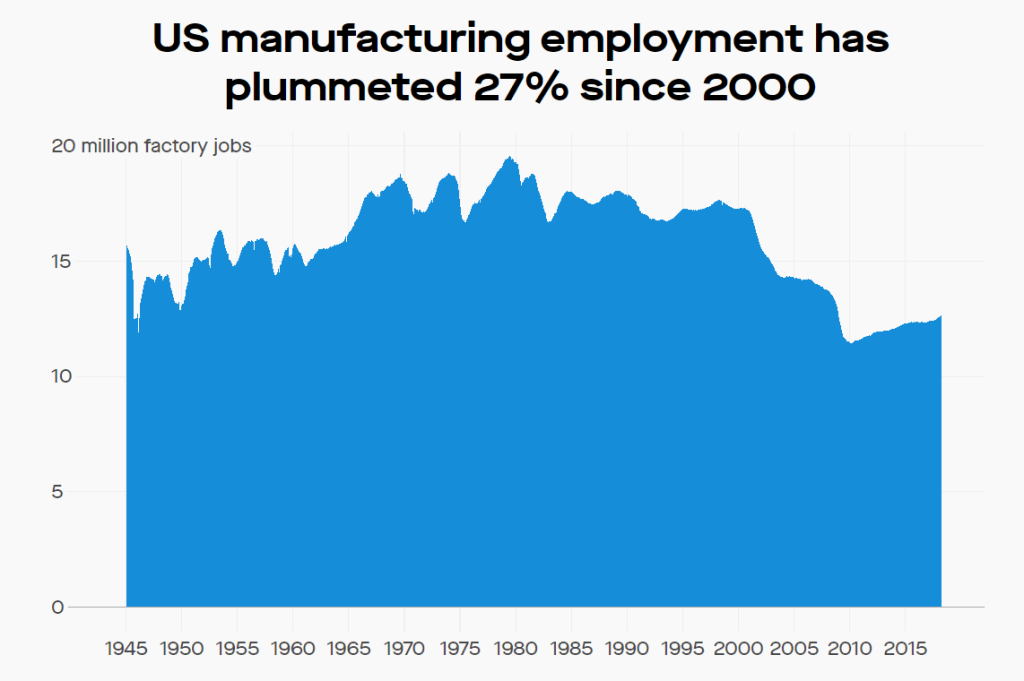
Ideologies can get in the way of understanding.  No candidates seem willing to talk about the transition from a manufacturing to a service economy.  Unions and antitrust enforcement are still good ideas, but they buy less than they used to.   As the last of the points indicates, futurists tend to provide more ideology than reality, so nothing beats experience and pragmatism.

For ourselves we see government challenges as:

Supporting education and research to keep ahead of technology change.

Managing the continuing transition from a manufacturing to a service economy.

Taxing and regulating dynamic international corporations with monopoly power.

Building and maintaining a bigger public sector to provide necessary services the private sector won’t.

Maintaining quality of life for all who live here.

Consciously working at creating and managing the international institutions that make the world work.  We used to recognize this responsibility (and avenue to exercise power), and no one else is stepping into the gap.

Overall we need to recognize the problems we do have—not the ones of the 1930’s—and look what will actually be effective to fix them.

There are many other areas where the same kind of story plays out—where an ideological war masks a more tractable, practical problem.  I’d even put immigration in that category.

It’s hard, given the daily atrocities of the Trump era, to focus on anything less than epic changes.  But if we’re going to put the pieces back together afterwards, it’s pragmatism that will get the job done.

Some Points on Climate

This touches a number of recent climate issues—some new, some familiar.

Background

  1. The primary issue for climate change is alternative energy sources.

We’re not repealing the industrial revolution.

This shouldn’t be a partisan or a lifestyle issue

We need good science and the will to fight entrenched special interests

  1. Conservation is important for now but not the main focus

Alternative energy will do the job if we do ours.

Chevy Suburbans are not the issue—we just need to power them differently

 “Respect for nature” by primitive peoples is irrelevant (but coming from all directions!)

  1. This is a fundamentally international problem where what we do for the rest of the world is as important as what we do domestically.  We will need to spend money on parts of the world who can’t.

s11_2018_Projections

  1. The fossil fuel companies have an evil influence on progress, but outrage at what they knew 50 years ago is a distraction.

Oil isn’t unclean—we just went too far with it.

The Carter era thought the world was running out of oil in less than 50 years

               The key issue is influence of fossil fuel companies now.

  1. Conversions of coal power plants to gas are still important—they buy time

We’re up against a carbon budget limit—any saving buys time

Progress is still rapid for alternative energy technologies—even electric cars aren’t ready for everyone yet.

Coal plants, especially new ones, continue to be a problem.

  1. We should stop calling a carbon pricing a tax.

We need to stop the huge fossil fuel subsidy—$1 T per year in the US—that comes from using the atmosphere as a free carbon dump.

We need a plan to make the population whole—and earn the trust we will do it

History and politics

  1. Obama actually did quite a lot for climate

International unanimity (after many years of failure)

A process to do more in the future

Turning China around (look at China’s line on the emissions chart above)

               Seed funding for Tesla and subsidies for electric cars

Note—the US was the primary beneficiary of the Paris Agreement.  We’re not being told to stop emitting at twice the rate of anyone else!

s12_Top_FF_Emitters_percapita

  1. Trump’s effect on progress is far worse than acknowledged

Reversed progress on all environmental issues in the US

Broke international unanimity—okay for everyone including China, Japan, and Germany to backslide with coal power plants

Legitimized attacks on climate action everywhere (Australia)

Continues to block any international cooperation on any issue

Going forward

  1. The single most important action is to defeat Trump

He is a roadblock to progress by anyone’s definition.

Any of the Democratic candidates would be good—no one has a real plan yet anyway

  1. The Green New Deal delivers a necessary coalition for progress

Makes clear that the new world is a good place to be.

Unites all constituencies

Must eventually add carbon pricing.

Not yet a plan

  1. The youth climate movement is helpful but a little worrisome

Non-partisanship makes it easy to co-opt—speakers at rallies dismiss all establishment parties.

               Trump was (in part) elected by young people who thought voting didn’t matter.

  1. If we can get past Trump, then we all need to get serious about a real plan

consumption-by-source-and-sector

Needs to address our current usage

Make sure it happens–what to fix when and by whom

               Minimize the hurt (particularly for the disadvantaged)

Recognize full international responsibilities

Don’t expect climate efforts to fix everything.  Broader issues include:

Easing workforce disruptions from technology, globalization, etc. (not just from climate)

Education

Infrastructure (much more than climate)

Jobs and wages (unions, minimum wage, role of the public sector)

Racism and sexism (need rules for everywhere)

Inequality overall (need a tax plan)

Other environmental issues will still be there to be solved

Prosperity in Today’s Economy

14145037140_53a399bf56_z

The title of this article sounds rather ordinary, but in fact there’s more to say than you might expect.   There aren’t a lot of new facts here, but we bring together several strands of argument that don’t tend to be followed to conclusion.  It’s useful to think step-by-step about prosperity today and going forward.

  1. Our national standing today is largely determined by technology.

There are many aspects to this.  The most obvious one is the role of high-tech companies in the economy.  The NYTimes had an article a few months ago (on the occasion of Apple’s becoming the first $1 T company) with graphic displays showing the size of Apple (as well as Google, Microsoft, Amazon, and many others) in the US economy.  The dominance of high-tech is unmistakable. That’s what supports our standard of living and always has. Railroads, steel, automobiles were all high-tech in their day.  (Note this is not saying that Google or Facebook are angels, it’s our national strength in technology that matters.)

It is only because we are on top of that heap that we have the money that supports the rest of the economy.  That includes much of small business and service industries.  It is from the strength of our competitive economic position that we can pay for the non-competitive industries we choose to support.  The aluminum and steel tariffs are being paid by us from the industries that don’t need them.  To state this somewhat differently—we are not going to build a dominant economy by selling each other stuff anyone can make at artificially high prices.

It’s also worth pointing out, given all the discussions of the military budget, that the technology argument applies in spades for the military.  Building new aircraft carriers is not going to make us safe.  One only has to think, theoretically of course, about the effect of a North Korean virus disabling the military’s command and control.  From the chart below, it is obvious that our level of military spending ought to quash everyone else hands down if money were the only object.  But it’s not doing the job, because that’s not the game anymore.  And it’s not just AI, it’s across the board.

20170424_Military_Expenditure

What all this means is that the people who support our technology position are critical resources who matter to all of us.

This is a lot less elitist than it sounds, because it’s not saying we shouldn’t care about or value everyone else (more on that later).   The point is that we shouldn’t be spending our time worrying about who is or isn’t supplanting whom.  Our success depends on nurturing and exploiting the best and the brightest—at least for these skills—and we had better spend our time trying to find them and encourage them, regardless of race, gender, or sexual orientation.  And if foreigners choose to come here and establish successful startup companies—mostly in high tech—we should be happy they do.  It is a major strength of the US economy that people find the US to be the best place to realize their ambitions.  We erode that strength at our peril.

Anger at elite technologists may be natural, but they are the wrong targets.  Their effect on the rest of us is positive.  What we need to avoid is a two-tiered society of haves and have-nots, as we’ll discuss later.

  1. Businesses today are different from the past in important ways.

Since we’ve identified the key role played by the tech sector, it’s worth thinking about what kind of businesses those are.  So let’s take a quick look at Google, Apple, Amazon, Microsoft, and Facebook.

– A first point to notice is that they are all some form of monopoly.  This is not surprising as they are all (even Amazon and Apple) essentially software companies.  Software businesses invite monopoly, because costs of production are minimal. In such cases, research and development costs become primary, and the company with largest market share can afford to offer products with more features than a smaller competitor can.  As automation continues, particularly with AI, similar arguments will apply to much of the rest of the economy.

Managing monopolies is a serious issue:

Monopolies squelch competition.   It is imperative for our success that established companies can’t limit the innovative power of new entrants.  That has been our historical advantage over foreign competitors and is a major factor in any discussion of how we deal with the rise of China.  This is not just a problem with Google, etc.  The demise of Net Neutrality is a classic case of giving in to established players, in this case the major telecom carriers.

Monopolies take more than their share of our money.  Monopoly power limits price sensitivity. Since the determining feature of competition is more often uniqueness more than price point, products are priced at what the market will bear—as with the iPhone or patented drugs.   Furthermore, through manipulation of assets including intellectual property, hi-tech monopolies have been tough to tax.   Apple’s success in this is legendary.   Their windfall from the recent corporate tax cuts is something to behold (and unnecessary as a spur to investment).  It is imperative we learn how to tax monopoly-level profits.

– Next, personal success in these companies requires a high-level of technical competence.   Amazon is obviously a case in point, with two completely different populations:  the mass of box fillers versus the corporate staff.  Note that technical competence is not just a matter for developers, but is also required for the many people in management, support, administration, and even sales.  As just noted, as automation proceeds, this trend will extend well outside of high-tech.

This represents the threat of a two-tiered society, as discussed earlier.  As a country this implies at the very least a basic responsibility for broad-based solid education and a livable minimum wage.

It should be emphasized that strengthening of education is required for both national success and personal prosperity.   Regardless of what advantages we have for staying on top of the heap, we cannot succeed if we don’t have the people to do it.

– Third, all of these business are intrinsically international.  With the growth of the world economy (and China in particular) economies of scale are such that we have to think in global terms.

– Finally our fourth and last comment for this section is about a different trend not limited to high-tech—the institutionalized irresponsibility of business.  It has become gospel that businesses have responsibility only to their investors, and all other considerations are more or less theft.  Businesses used to care about retirement, healthcare, training, even local charity.  But current reality is that if someone is going to care about those things, it’s out of the question for it to be them.

In addition, because of the sheer size of the country, the US more than anywhere else has to deal with the phenomenon of towns or regions where the economic base can just disappear. Company town are the obvious example. In an age of accelerating technology change, we can’t stop such things from happening.   And we can’t expect rescue to happen by all by itself.

However we emphasize this isn’t just about charity.  In the current state of affairs, the private sector is not be doing what’s necessary even to provide the environment for its own success.

That leads to the next topic—what do we need for national success?

  1. Our infrastructure problems mean more than we thought.

Infrastructure has to be thought of as whatever is necessary for national success and personal welfare.  I.e. much more than roads and bridges.  The educational system fits in this category as it is required for both personal and national success.  Declining upward mobility and the student loan crisis are two indications that there is a lot that needs to be done.

Support for theoretical research is in the same category.  It is precursor work for new technologies before they are ready for business. A point worth stressing it that it is not only the research itself that is important—research work assures that there will be a population ready to exploit new opportunities as they arise.

Continuing on, we list a few more significant infrastructure projects needing immediate attention.

– The American Society of Civil Engineers keeps a web site with a break down of national infrastructure requirements.  We currently rate a D+.

– To that we add the urgent needs of combatting climate change, which will be considerable, regardless of how the final plans work out.

– Healthcare is currently in flux with ACA under attack and nothing to replace it.

– Finally we have the general specter of a two-tiered society, with all the misery and threat of conflict that represents.  That too needs to be dealt with as a national problem, and there’s no one in this picture other than government to do it.

Government’s role in this picture is three-tiered:

i. Government needs to make sure everyone has the education and access to the opportunities to succeed.

ii. Government needs to support what is necessary for national infrastructure, much of which will not happen spontaneously in the private sector.

iii. Government needs to supply a last-line safety net for those who fall through the cracks.

This is a non-trivial task, and we emphasize that the biggest part of it is not charity.   We have a current mismatch between a dearth of good jobs and a growing backlog of infrastructure needs of all kinds.

From the point of view here our much-discussed infrastructure needs—back to the roads and bridges—have to be viewed as bellwethers.  The fact that we can’t deal even with roads and bridges means that we have a fundamental problem funding the common good, and we have to take that head on.

  1. There is a mismatch between the needs of our country and the forces that currently control it.

The governing ideology of this country is simple to summarize:  let the private sector do it and get out of the way.  All government regulation is bad, and taxes are just a brake on the private sector’s ability to make everything great.

The chief beneficiaries of this policy are the ultra-rich funders of the Republican Party, although the problem of money in politics (especially after Citizens United) transcends parties. In this enterprise Trump is largely a front man for the real forces running things.

For these people, with fortunes going back even into the nineteenth century, it’s natural to regard the country as a money-machine.  Taxes, regulations, and government services—except for the military—are deductions off the bottom line.

The problem with that view, even for them, is that it is the wrong model for the world we just described.  That set of policies would make sense in an extractive economy, where all that is necessary for success is a cadre of imported experts to arrange for pumping oil with purchased technology.  In that case you don’t need much from the national population in order to collect the proceeds.

That’s not our situation.  As described, we live in a technology-dominated world where the population must earn our national success.  For that world we’re currently going in the wrong direction.  Devaluing education, denying climate change, cutting research, encouraging xenophobia will get to us sooner than we’d like to think.  China is a formidable challenger.

However, it not so hard to be optimistic if we can just be serious about what needs to be done.  We have all the tools for success:  the money, the work to be done, even the means to avoid a two-tiered society.

The story is not complicated.  If we can return to exploiting our strengths, then we should be able to remain in the technological forefront for our chosen areas of focus.   If we can control the monopolies, then the associated margins in an expanding world economy should yield money enough (if we can collect it) to produce a workable society for everyone ready to participate.

There is certainly no shortage of work in the infrastructure area, and it needs all kinds of people.  In this respect the Green New Deal may be too glib in pinning everything on climate change, but their basic idea is correct.   If we play our cards right, the high technology future will provide the funds to support the infrastructure for its own success and for the prosperity of the nation.

We should not underestimate the job.  Careful and transparent planning is critical—defining exactly what needs to be done to support both the economy and the population.  And then determining how that work can be best supplied.

It should be emphasized is that we’re NOT talking about socializing away the free market economy.  If there’s one bad misconception that needs to be hammered down everywhere, it’s the idea that the private sector is magic for all problems.  We’ve just gone down a long list of things it’s not going to do.

Even Adam Smith was clear about this from the beginning.  The private sector is a participant in the public economy, but that economy will deliver the benefits of a free market only if #1 government keeps the private sector from corrupting the markets (e.g with monopolies and bribes) and #2 government provides the resources (e.g. education and other infrastructure) necessary for success.  That’s the definition of our job.

This will necessarily require a renewed focus on government and public service.  It’s interesting that a couple of recent mainstream books (Volker, Lewis) have recognized public service as an important issue.  In that respect “Green New Deal” isn’t a bad term:  we need to be as serious as Roosevelt’s brain trust in planning for the next stage for our country’s future.

This is a battle both old and new.   In Smith’s words, “The interest of [businessmen] is always in some respects different from, and even opposite to, that of the public …The proposal of any new law or regulation of commerce which comes from this order, ought always to be listened to with great precaution, and ought never to be adopted till after having been long and carefully examined, not only with the most scrupulous, but with the most suspicious attention.”  Wealth of Nations is only achieved when government does its job.

Climate Change is Not Complicated

The reason for this note is that discussions of climate change have splintered into so many directions that the subject appears more daunting than it ought to be.  Neither the current status nor the path to success is actually hard to see.  The main things we need are commitment and a real plan.

  1. Current status

– Evidence for climate change is clear and unambiguous.

The increase in global temperature levels goes back decades, as shown in the following chart (Temperature Anomaly just means the temperature increase over 19th century levels).

noaa_temp

Further the relation of temperature and CO2 in the atmosphere is unmistakable (see the straight line below) and pushing up inexorably toward the identified 1.5 ºC danger zone:

temp_ppm

Scientists have even demonstrated (using isotopes of carbon) that the increased carbon dioxide in the atmosphere is due to burning of fossil fuels, not some natural process.  Arguments to the contrary have been largely funded by the Koch organization or the oil companies themselves and typically involve doctored data.  Accusations of conspiracy have been debunked, but are still repeated by interested parties.

– Problems are already happening.

There are two kinds of examples.   For temperature alone, as the first chart showed, we’re continuing to set new records for average global temperature.   The effect on sea ice has been dramatic, and farmers are becoming well-aware of changes in growing seasons.

Individual catastrophic events are harder to pin down, just because it’s hard to develop statistics around rare events.  However, scientists have been able to work through the statistics to show the extent to which extraordinary storms, such as hurricane Harvey, were made worse by climate change.

– Role of climate models.

We don’t need climate models to say there is a problem.  We do need climate models to assess specifically what is going to happen.  For example, we can see that glaciers in Greenland and Antarctica are melting, but we need to figure out how quickly this can happen and what the effects will be on weather and ocean currents.  Since the earth hasn’t been here before (i.e. rapid C02 increase like this has never happened), we have to try to figure it out.

A particular concern is that climate change feeds on itself to accentuate the effects of CO2.  An example is melting of permafrost in the arctic.  That releases methane, which is also a greenhouse gas and adds to the increase expected with CO2.  Climate models are extremely detailed to deal with such effects.  The modeling work is supported by a global effort to get data on what is happening now.  This is a major effort by many independent researchers worldwide to get the best possible handle on what’s coming.

– It’s going to get a lot worse unless we start acting now.

An important fact to be emphasized is that carbon dioxide in the atmosphere just adds up.  So even if we stabilize global production of carbon dioxide, things will just get worse as we add to the total.  For a few years 2014-2016 it looked like CO2 production was stabilizing, but then the trend turned worse, and last year accelerated it.  Here is the current chart.

s09_2018_FossilFuel_and_Cement_emissions_1990

As we just noted, even a stable value of CO2 emission means things are getting worse, because it is the total amount of CO2 in the atmosphere that drives temperature change.  The stable value was attractive, because it seemed to indicate that CO2 had finally peaked and might start to decline.  And the decline might mean the total CO2 could be bounded.  We’re now back to worrying about the peak, with no idea how bad things will get.

Scientists have given us a so-called carbon budget—the maximum amount of CO2 we can add to the atmosphere and still escape dangerous, irreversible changes.  Every bit we add counts against the budget.  We have to find a way to get carbon dioxide production down toward zero, and things will continue getting worse until we get all the way there.   According to the last international climate study, CO2 production needs to drop 45%  by 2030 and reach 0 by 2050 if we want to keep the temperature increase under 1.5 ºC.

– Can’t we just pull the carbon dioxide back out later?

There is currently a lot of work in progress on how to capture and store carbon dioxide.  For now, capturing carbon dioxide even in exhaust flues is expensive—it can double the cost of electricity from a coal power plant.  Pulling it out of the air is substantially harder.  Further some effects, like movement of glaciers, are hard to stop even if we pull out the carbon dioxide later.  Sea level changes are irreversible.

Earliest use of this kind of technology would be for flue-based solutions in particular industries.  That’s getting cheaper, but it’s no miracle solution.  Large-scale pulling carbon out of the air is not yet available, and the cheapest estimates for a worldwide solution would cost on the order of 10 trillion dollars annually.  Nonetheless, current climate models assume that some use of this technology (expensive or not) will be needed if we are to keep the temperature increase under 1.5 ºC.

– What about geoengineering?

This approach, which gets sporadic publicity, involves adding chemicals to the atmosphere to block the sun—cutting temperature by putting the whole world in the shade.  A number of different substances have been investigated to do this, and any of them would need to be constantly injected into the atmosphere under supervision by some international body.

As an approach this is much cheaper than carbon capture, but it is regarded as a dangerous last resort even by the people who do the research.  All photosynthesis worldwide would be affected. The closest natural phenomenon, the Mount Pinatubo volcanic eruption in 1991, resulted in a worldwide drought.  It does not address acidification of the oceans, which would continue to disrupt life in the seas.  Further it is a time bomb, as carbon dioxide concentrations would continue to build up, so that the shading and its effects would have to keep increasing, and any interruption would be catastrophic.

The bottom line is that there is no silver bullet here; we have to get off burning carbon.   However it’s worth pointing out that this is NOT a death sentence (as we’ll see) and it is also NOT committing us all to a grim world of scarcity.  Even today people buy Teslas because they like them—among other things they’re performance cars—not as sacrifices for the good of mankind.  That’s the right way think about the whole transition.

  1. What to do about it

To understand what we need to do about climate change, we first have to think about the kind of world we would be going toward.

A point worth emphasizing is that the future is electric.  If we’re getting off fossil fuels, we’re not going to have people burning stuff all over the place.  So we will be generating power by suitable technology (more on that in a minute), and electricity is the means of storing and distributing that energy.  All renewable sources today generate electricity as the common currency of power.

Since the electric grid is the core for what we need to do about energy, we have two primary tasks:  strengthening the electric grid and getting all users of energy on that grid.  Each needs to be discussed separately.

– Strengthening the electric grid

This is about generating and distributing power.   We of course need a grid that is reliable and safe, but for climate change we’ll need more.  There will have to be considerable growth in electrical power generation (since we’re taking on new roles), and we will want to optimize opportunities for renewables even in the near-term.

At present there are ongoing activities to strengthen our current patched-together national electric infrastructure, but these are long-term projects and not primarily driven by climate change.  Power generation is largely a per-state matter and is quite literally all over the map.  For climate change we have benefited from the near-term improvement of substituting natural gas for coal, but there are still many coal plants and nothing says we have optimized opportunities for renewables.  Ideally we should have a nation-wide plan for growth and modernization that would allow renewable power to be generated where appropriate and used wherever needed.

It’s also worth saying something about the longer-term picture.  Ultimately this is not a story about scarcity and conservation; it’s about alternative power.  Renewables will improve, and there will be other significant new sources of power.  Fusion power in particular has been slow to develop, but should be taken seriously.  It has had a recent impetus with higher-temperature superconductors (for the magnets that contain the fusion reaction), and current international projects target 2033 for a demo system and 2050 for commercial system deployment.  Initial systems will be heat-based, like conventional power plants, but later generation systems may generate electricity directly —a mind-boggling concept.  (Interestingly, this may even involve mining on the moon.)  We have a near-term job to do in saving the planet, but there’s no reason to fear we will ultimately lack for power.

– Making electricity the universal power source

The point of departure here is the following chart showing energy use by sector and energy source.  Our task is a prioritized migration to renewably-generated electricity in all sectors, with the maximum possible bang for the near-term buck.  In this transportation is an obvious target. It is a large consumer of energy (28% of US energy usage) with negligible current penetration of renewables.  Electric cars can be a big win.

consumption-by-source-and-sector

Given the complexity of energy usage overall, the single most important step to encourage migration is to stop pretending that carbon dioxide production is free, i.e. to stop subsidizing the fossil fuel industry.

We can be pretty specific about what CO2 costs us.  We are rapidly reaching the point where each new ton of CO2 in the atomosphere is a ton that will have to be removed.  The cheapest estimates of what it takes to remove CO2 from the air (average of upper and lower bound estimates) is $163 per ton.  Multiply that by the US annual production of CO2 = 5.4 B tons, and the silent subsidy to the fossil fuel people falls out as $880 B annually.  That’s no small distortion of our economy.  Essentially a trillion dollars a year.  Another way to say the same thing (when you work out the math) is that every gallon of gasoline sold gets a silent subsidy of $1.47.

The usual approach to this subject goes by the name of a carbon tax, but that’s actually a misnomer.  A tax is money collected to fund some government activity, and that’s not the point here.   We’re stopping a government-funded subsidy of products that produce CO2, and any money raised should be used to mitigate the effect of fuel price increases on the population.

Because raising fossil fuel prices is regressive, balancing costs and benefits is tricky and has led to voter rejection (spurred by massive Koch campaign spending) of several carbon tax proposals.  (The yellow-vest protest in France was from something worse, a budget-balancing regressive tax masquerading as a climate measure.)  The magnitude of the silent subsidy is such that it is necessary to get this right.

One example proposal worth discussing is the Carbon Fee and Dividend from the Citizens Climate Lobby.  They start with a low fee of $15 per ton of generated CO2 at fuel production or port of entry, but raise the value $10 per year afterwards.  That money gets returned per adult with an added allowance for children.  The gradual increase is in part a low entry but it also allows for increasing maturity of competing technologies.

That proposal is now a bill in Congress, and there was a recent endorsement by a number of economists and other public figures.  It may or may not become part of the Green New Deal from the Congressional Democrats.  One way or another carbon pricing is so fundamental it just has to be fixed.

  1. Outline of a plan

The energy use chart from the last section says a lot about how this has to work.  Going down the chart, we can say the following:

– Transportation

Thus far this sector has had virtually no penetration of renewable energy sources, so its importance cannot be overestimated.   The only alternative is electric power, so we need incentives to finally get a non-trivial market share.  Carbon pricing will help, but we may need more. We’ve had incentives in the past to help electric car makers get into business.   Now the issue is the continuing cost of carbon.

– Industrial

The ongoing migration to natural gas shows the price sensitivity of this sector.  That trend toward gas should continue, and we need to start more movement onto the electric grid.  Carbon pricing should help here too, and there should be active discussion with industry to determine what form it should take.  Flue-based CO2 capture may also be appropriate in some cases.

– Electric power

We already noted the major contribution from this sector in the conversion from coal to natural gas.  That should continue with the non-trivial number of remaining coal plants, but we still have to get to renewables.   Everything that happens in this sector should flow out of a national plan for evolution of the power grid, as discussed before.  Coal plants and also gas-powered plants may be supplanted by renewables elsewhere.

– Residential and Commercial

We should recognize that this sector is significantly smaller and with many subsectors to be considered.  The conversion to natural gas is already well-underway and the remaining petroleum sectors (e.g. New England) may not be easy to change.  So we need to map out conversion to electric or possibly even flue-based CO2 capture.   The first step is a more detailed plan.

We also need to call out the need to support research, as it is an unavoidable part of the picture.  That applies both for new energy sources and storage, and to the various activities underway to understand climate change and how we will have to adapt.

  1. International coordination

Thus far our discussion has focused on the US, but we’re only one piece of the puzzle.  Despite the nationalist rhetoric, there is only one atmosphere for everyone.   Helping other countries helps us, and poorer countries have fewer resources.  The following chart underlines the importance of that effort—the “others” are becoming the biggest piece.

s11_2018_Projections

There are actually two points to be made.   First, the Paris Agreement included an initial arrangement between rich and poorer countries, so that progress could be made.  That codified a fund (trashed by Trump) to help poor countries meet their targets.  However the issue will continue to be contentious, and one way or another we will have to contribute.  The just-completed Madrid meeting ended without agreement.

Second, our contribution may turn out to be more than just money.  Other countries will have energy use charts that won’t look anything like the one we’re been considering.  They may need different forms of technology to support different evolution plans.  We should use our resources to see what can be done.

In the past the US recognized a responsibility to lead this process.  With the US now firmly committed to cheating, it’s hard to keep things going.

The world needs our contribution to leadership. That means it is doubly important to put our own house in order .  We need to know where we’re going for ourselves, and so that we can help the rest of the world in this effort to preserve our common future.