Down with Monotheism

Monotheism amounts to an imperialistic assertion of primacy.  That sounds like one of those wild-eyed slogans from the radical left or right.  But in fact it is a simple statement of what drives quite a lot of policy, both domestic and international.

Let’s start close to home.   In both Britain and the US there is a big problem with past imperial grandeur.  The Brits just can’t get over their lost empire, and they keep doing completely illogical and crazy things (e.g. Brexit) in hopes of getting it back.  The fact that the world has changed since then, with new powers and new bases for strength doesn’t register.  Since the empire is taken to be an expression of British superiority (and of God’s grace raining down on Britain) there is no reason why it can’t just happen again.  There is only one God and he’s ours.

The US has a similar problem, just a little later in time.  We had the 1950’s and even 60’s when in the years following the destruction of the World War II the US was unquestionably the world’s only remaining superpower.  If anything we were more dominant than the British as their peak.  And we’re just as blind in looking back to it.  Our dominance was a result of national superiority and God’s grace.   We are the chosen rulers of the world and there’s nothing that ought to stop that.

The Chinese and the Russians have similar issues.  Having lived in Italy at one point, there’s more than a bit of it (going back several centuries) there too.

The Old Testament (as I understand it) had a more limited notion of monotheism:  each nation had it’s own god or gods and international struggles were also struggles of those gods.  That sounds a little more accurate.  Contemporary monotheism amounts to assertions of primacy.  An astounding percentage of Americans are ready to talk about God’s protective shield over the US and our God-given role in running the rest of the world.  That gets in the way of any notion international cooperation or any workable national objectives.  With God on your side, reality just doesn’t matter.

The Brits have already driven themselves to at least a short-term future of poverty.  It is relevant to notice—although seldom mentioned—that the pre-EO version of Britain was much slower than the continent in recovering from World War II and generally poorer per capita. 

The US is on the brink of doing the same thing.  We’ve got a dictatorial theocracy going, as well as a “we don’t need anyone” ethos on the right that denies any need to interact with the rest of the world except under terms of dominance.  Furthermore the pervasive xenophobia denies the (currently enormous) contribution of foreigners to the economic strength of the US.

However the biggest problems are not even that.  As climate change and also Covid and the Ukraine crisis show us, we have only one world.  All the national gods are going to have to cooperate if we’re going to get out of this mess.  Enough with national monotheism.

Ukraine in Our Future

The dangers in Ukraine are enough to make one wonder about the current world order.  We’d like to believe that it’s beyond the pale for one country to invade and take over another on the flimsiest of pretexts.  Despite some current rhetoric, Crimea was not that:  it had been an essential part of the Russian military infrastructure for centuries.  Ukraine is different—what does it mean?

Regardless of how the Ukraine affair ends, the change it signifies is enormous.  In the wake of the horrors of World War II, the US as remaining unscathed power helped put together a system of rules and organizations aimed at preventing another one.  The idea was to prevent economic collapse and to resolve conflicts before they became wars.  We got a UN, an IMF, and rules to govern international trade.  The result was an extended period of world prosperity.  The communist bloc stood outside all of that, but even in the days of the Cold War overt seizures of other countries were avoided.

Over the intervening years much of that liberal economic system remained, even as the world became much more complicated.   Standards for permitted behavior lived on.   In some sense, the Paris climate agreement was a kind of last hurrah.  There was no enforcement mechanism, but the idea was that unanimity would shame the cheaters into compliance.

Trump broke that idea in a way that only an American President could.  He asserted that there was no reason to obey any of those (US-initiated) international rules, and he got away with it.  Until Trump people cared about WTO trade rules, climate progress, and democracy worldwide.  Now essentially all of that is off the table.  And the powerlessness behind many international institutions has been laid bare.  If Putin decides to invade Ukraine, we’re in a world where the only consequences are the ones we manufacture for the event.  The UN is manifestly irrelevant. Shaming has no force. There are no rules, and your friends can cover for you.  It’s just the way things are. Military threats can be the first not the last of options.

This is a problem generally and for us in particular. Under Trump we developed adversarial relationships with just about everyone, with the view that they were all against us, and we had to show who’s boss. That limits our power. Most serious is what happened with China. Xi may be a megalomaniac and an autocrat, but we empowered Chinese hardliners and contributed to his nationalistic program by delivering threats echoing the imperialist past. When Trump said he would destroy the Chinese economy they took it seriously. The newly-revived alliance with Russia—a thorn in our side for Ukraine—was at least in part our own doing.

We have replaced our successful efforts for peace and stability with a new world view where we need no one, and any constraint on our ability to act is unacceptable. It’s easy to say (and many do say) so much the better. Every country needs to stand up for itself, and all of that international stuff just gets in the way. That’s an appealing slogan. It wasn’t just Trump’s line; it was behind Brexit and all the populist movements of the both the left and the right. However we’re not the only ones playing that game. That “freedom” is a freedom for any country to do anything, and the Ukraine affair is an early indicator of where that goes. We seem to have forgotten World War II and the Depression, and that’s just for starters.

Our own history gives an excellent example of what happens. That ocurred after the American Revolution, under the so-called Articles of Confederation.  It took only a few years for the American states that had fought the British together to be at each other’s throats, torpedoing economic progress for everyone.  Things got so bad that the states had no choice but to give up power to a new Constitution and a national government.  In Europe there were centuries of wars that only ended when cooperation became manditory in the post World War II recovery.

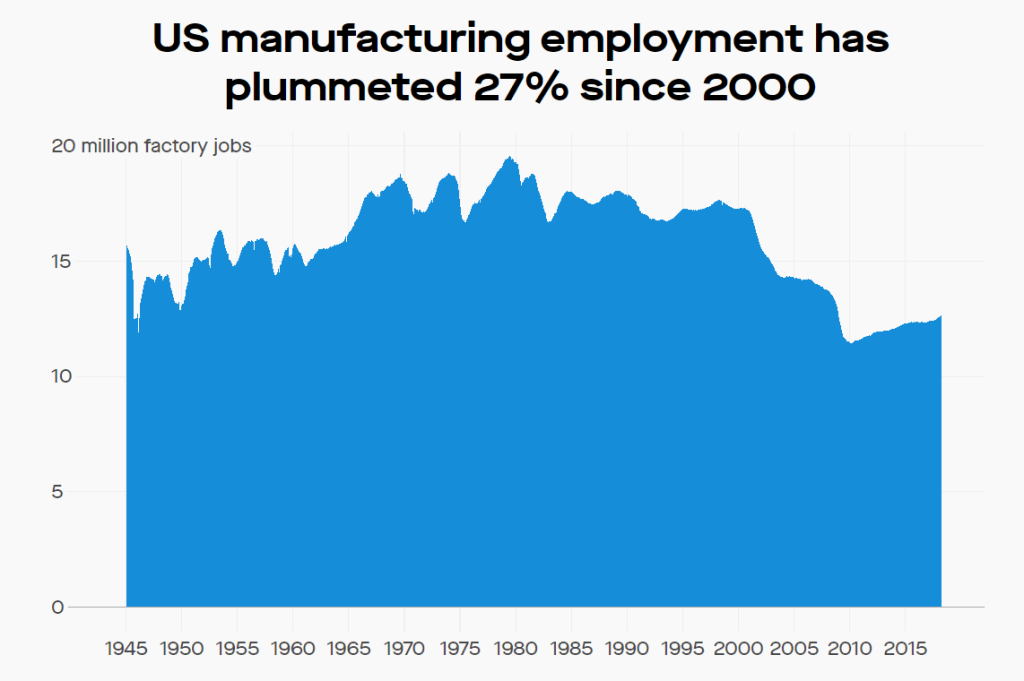
It’s a fact that the liberal economic system has gotten a bad name in this country—”Bill Clinton let China in the WTO and there was nothing we could do about the Chinese assault on American jobs”—but that universally-repeated story is false. (It’s one example of what you might call bipartisan revisionist history—the left and right united against the center!)  The main issue raised with China’s behavior has always been currency manipulation, which was in no way permitted under WTO rules.  And as the following job loss chart makes clear, the loss of American jobs was 100% a phenomenon of the George W. Bush presidency:

That’s no accident.  The radical neocons had us preoccupied with fighting a $3T war, and the same deregulation mania that produced the 2008 crash had us actually encouraging outsourcing abroad.  For the business-friendly Bush people cheap off shore labor was good. All subsequent efforts to help the people hurt by that process were blocked by Congressional Republicans bent on sowing dissatisfaction ahead of the 2016 election.  The liberal order conspiracy is a convenent fiction for both the right (to cover its tracks) and the left (to attack the center).

If we’re going to avoid economic and even potentially military disaster, we’ve got to get past the electoral propaganda and understand what we’ve done right and wrong.  In particular we’ve got to wean ourselves from the siren-call of nationalism.  We’re not going to “win” the future, but we can certainly all lose it.   The real challenge is getting internationalism right, so that everyone has a stake in the action.  We built unprecedented peace and prosperity after World War II.   That job needs to be done again before we give it all up—in a way that has happened many times before. Both prosperity and peace are in question.

One important lesson of history is that economics precedes politics.  The EU, for all its imperfections, is a vast improvement over centuries of status quo.   What got that going was a step-by-step economic union, long before there was anything political on the table.  In that sense, strangely enough, you can argue that the WTO is more important than the UN.  Getting the WTO back on track is going to take considerable doing, but it has to happen. And perhaps climate change can yield an appropriate model.

Climate change is an unusual situation in that practically every country has veto power of the result.  We all share the same atmosphere, and the CO2 concentration is only controlled when everyone cooperates.  So the solution has to get a buy-in from everyone, rich countries and poor.  In fact it can only work when rich countries recognize that—like it or not—they’re going to have to help the poor ones.  Everyone will have to get used to the idea of an international project where the focus is less on who gets the best deal than on whether it delivers the necessary benefit for all.

A functioning WTO is a similar balancing act.  As starting point there is one basic reality to be acknowledged:  self-sufficiency is not a desirable or realizable goal even for large countries.  Despite all the discussion of the evil Chinese, we would be vastly worse off if they just went away.  Just in general, we are not always going to be the best at making everything, and our own industry will be crippled if we can’t build on what’s best.

Furthermore discussions of self-sufficiency tend to include a strong dose of the always-dangerous delusion “my people aren’t like that.”  In fact domestic manufacture does not guarantee availability, quality, price, or appropriate technology.  The single worst problem during the first stage of the Covid crisis was a lack of testing equipment—because the American manufacturer with a CDC contract to produce the tests had decided they could make more money doing something else.  Similarly, self-sufficiency can do little to guarantee the well-being of the national workforce, as there is no substitute for government dealing with all relevant labor issues. Trade is more like climate change than it seems—it’s something we’ve got to make work.

The balancing act is in the many factors that have to be taken into account for fair trade:  labor conditions, environmental rules, government involvement, and so forth.  Those are both impediments and opportunities—they make the negotiations harder, but they are also leverage opportunities for a better world.  Elizabeth Warren in her Presidential campaign made a long list of items she wanted to make as preconditions for trade with the US.  Her standards were very high—it was pointed out at the time that no country met them—but her list was an indication of potential opportunities. Also, it is important that these rules should apply to everyone—including to us.

What this comes down to is that globalization, despite the rhetoric, is only anti-labor if we make it so—which is precisely what happened under George Bush. Instead of using it to establish worldwide labor standards, we used it deliberately to undermine workers everywhere. In other words thus far we’ve had globalization exclusively for the rich. If we don’t step in to control it, it will stay that way—populist movements or not. And if we don’t start learning how to create a world order for the benefit of humanity, no amount of national chest-beating will save us.

The Ukraine affair is dangerous in its own right, but even more dangerous as a symbol of a world out of control.  What the world needs now is neither uncontrolled chaos nor world government, but a set of mutually-agreed rules to forestall a fight to the bottom.  As with climate change, there is no way out other than to acknowledge we are now one interconnected world, and we will all either stand or fall together.

Lessons not Learned in Afghanistan

Much of the blame-seeking around Afghanistan is not only off-base, but damaging to our national interest.  It’s incredible that even the comparisons with Vietnam talk about the final evacuations, not the failed enterprises.  By concentrating all attention on an asserted “manageable” withdrawal, we’ve given the real perpetrators a pass.

In the last couple of days the NY Times has finally published two good articles.  One by Ezra Klein has the apt title: “Let’s Not Pretend That the Way We Withdrew From Afghanistan Was the Problem”.  In it the author goes over the real options we faced and why.  It’s a good job. My only concern is that while he is exhaustive about the options, he stops short of all the conclusions I’d like to draw.

For that, the other article is essential.  That one was by Sami Sadat, commander of the Afghan Army.  His title is “I Commanded Afghan Troops This Year. We Were Betrayed”.  His point—that the loss was not just the Afghan army’s fault—is not the main point here.  What is important is that he gives a detailed description of the reality faced by the Afghan forces, and that says quite a lot about how much had gone wrong.  There are three points to make:

1.  The war was lost the moment Trump signed the Taliban agreement.

Here’s the quote from the general:

“The Trump-Taliban agreement shaped the circumstances for the current situation by essentially curtailing offensive combat operations for U.S. and allied troops. The U.S. air-support rules of engagement for Afghan security forces effectively changed overnight, and the Taliban were emboldened. They could sense victory and knew it was just a matter of waiting out the Americans. Before that deal, the Taliban had not won any significant battles against the Afghan Army. After the agreement? We were losing dozens of soldiers a day”.

The last bit is particularly important.  Defeat is an exponential process—the likelihood of attrition depends on how bad things look, i.e. on the losses of all kinds beforehand.  Once the process starts it accelerates.  It was an astonishing mistake of US intelligence to believe we had many months, a year and a half even, before a Taliban takeover.  There was no stability once defeat took root. Biden’s late withdrawal of 1200 US troops is not even mentioned by the general, as it was never the issue.

2. There was NO exit plan ever.

Again from the general:

“The Afghan forces were trained by the Americans using the U.S. military model based on highly technical special reconnaissance units, helicopters and airstrikes. We lost our superiority to the Taliban when our air support dried up and our ammunition ran out.

“Contractors maintained our bombers and our attack and transport aircraft throughout the war. By July, most of the 17,000 support contractors had left. A technical issue now meant that aircraft — a Black Hawk helicopter, a C-130 transport, a surveillance drone — would be grounded.

“The contractors also took proprietary software and weapons systems with them. They physically removed our helicopter missile-defense system. Access to the software that we relied on to track our vehicles, weapons and personnel also disappeared. Real-time intelligence on targets went out the window, too”.

The key point is that none of these functions are transferable in weeks or even months to the Afghan army.  This is a rebuke of the entire war effort. That this gap existed means that there was no serious attempt to make the Afghan army self-sufficient.   As for the contractors, the general’s language makes clear that they had no intention of making their valuable, proprietary expertise available to anyone.

3. The Afghan government had lost the support of the population

On this the general’s comment is specific to the military:

“… there was only so much the Americans could do when it came to the well-documented corruption that rotted our government and military. That really is our national tragedy. So many of our leaders — including in the military — were installed for their personal ties, not for their credentials. These appointments had a devastating impact on the national army because leaders lacked the military experience to be effective or inspire the confidence and trust of the men being asked to risk their lives. Disruptions to food rations and fuel supplies — a result of skimming and corrupt contract allocations — destroyed the morale of my troops.”

More generally, Fareed Zakaria cites a US government poll of Afghans in 2018 that “showed that Afghan support for U.S. troops was at 55%, down from 90% a decade earlier”. That’s saying almost half the population was ready to choose an unknown Taliban regime as better than what they had.  With the rampant corruption, participation in the last Afghan election dropped to less than 25%.  The Afghan President Ghani reportedly fled through Kabul to the United Arab Emirates with $169 million in cash.

So, with all of that why were we still in Afghanistan?  That answer is not complicated.

Getting out was always going to be some variant of the mess we’ve just seen.  And there was also a moral argument:  leaving was going to hurt a lot of people in Kabul (though fewer elsewhere).  So people in government wanted to believe a fantasy—that there was a solution.  That is, the Afghan military would defend the state against the Taliban, and everyone would live happily ever after.  That fantasy trumped reality all the way down to the end. 

What can you say about Biden? 

There’s no evidence he could have done much to delay the military defeat.  He has gotten more people out thus far than has happened in other comparable situations, but he should have started sooner and that would have reduced some of the chaos.  He has not given in to the many proposals for last-minute military actions that would have undoubtedly made things worse.  (To be clear, there was no Afghan army, the US couldn’t possibly take on that role itself, and any serious military action would have put all evacuees at risk. Talks of retaining a second military airport are particularly fanciful, as the evacuees weren’t there.) He might have gotten some of the military equipment out earlier, but doing so would have undercut the Afghan army even more.  (And the Afghan President Ghani pleaded with him not to do it.) 

So you can give him a B.  It was certainly embarrassing, but it could have been quite a lot worse.

Even more important, all Biden could do was manage the exit from a failed war. You’d never guess it from all the bluster, but there was no hiding the US defeat. For real responsibility it’s worth quoting a succinct recap of US policy failures from former anti-terrorism officer Ali Soufan:

“Every administration made a lot of mistakes in this. The Bush administration made a lot of mistakes in moving much-needed resources to focus on Iraq and then focusing on Iraq. The Obama administration even sent more troops in and, for eight years, was hoping that something miraculous would happen. The Trump administration is responsible for not understanding the situation at all and opening negotiations only with the Taliban and disregarding the Afghan government and releasing 5,000 Taliban fighters without asking the Taliban for anything in exchange. Unbelievable.”

Of that list it is important to recognize that primary responsibility rests with Bush and the Iraq war. In our eagerness for the neocon-inspired invasion of Iraq, we never even tried to take the opportunity to help create a viable state in Afghanistan. Our current media-fed collective amnesia about both Bush and the Iraq war shows how little we’ve learned from our own recent history.

Lessons

1. Don’t believe in “benevolent” colonialism. 

Neither Afghanistan nor Vietnam was a special American phenomenon.  Whatever our original motivations, these were ultimately colonial wars.  Once you take over a country, the motivation of the occupier is stability at all cost.  That leads to wholesale corruption at the expense of the population and even the war effort.  The Afghan general described that situation exactly. You can get a more detailed picture here. Vietnam was the same. The classic on this subject was written in 1860—we should have figured it out by now.

We got into Afghanistan as a follow-on to 9/11.   It was up to us to help rebuild the country, schedule elections, and get out.

2. Watch out for fantasies. 

Something has to be done about an intelligence establishment that was so eager to please, that it couldn’t recognize that the fantasy had no basis in reality.  Remember there was NO exit plan.

3. Watch out for complacency, the idea that the future will just be a continuation of the past.

There is no other obvious reason why Biden was being told that the Afghan army would hold off the Taliban for six months to a year and a half!

4. Finally, going back to Eisenhower, watch out for the military industrial complex. 

For that, it’s worth thinking about who won this twenty-year war.  Not us, just forced to leave.  Not the Afghans who had to live with the fighting and corruption, and now are stuck with the Taliban. The real winners were the contractors.

Over the last 20 years of war in Afghanistan, the U.S. spent $89 billion in taxpayer dollars to fund the building and training of the Afghan National Army with an estimated $2.26 trillion in total operating costs funded by U.S. taxpayers. Ever since the U.S. government began keeping track, contractors have made up more than half of the military personnel working for the United States in Afghanistan and Iraq.  This is all the more remarkable since—as we’ve seen—their objectives were not even aligned with our national goals!

The contractors are said not to be worried at all about the end of the Afghan war.  There’s a whole new round of military modernization coming.  And we’ve never been short of wars.

How We Won the Cold War

Map-Flag_of_the_Soviet_Union

“File:Map-Flag of the Soviet Union.svg” by NuclearVacuum is licensed under CC BY-SA 3.0

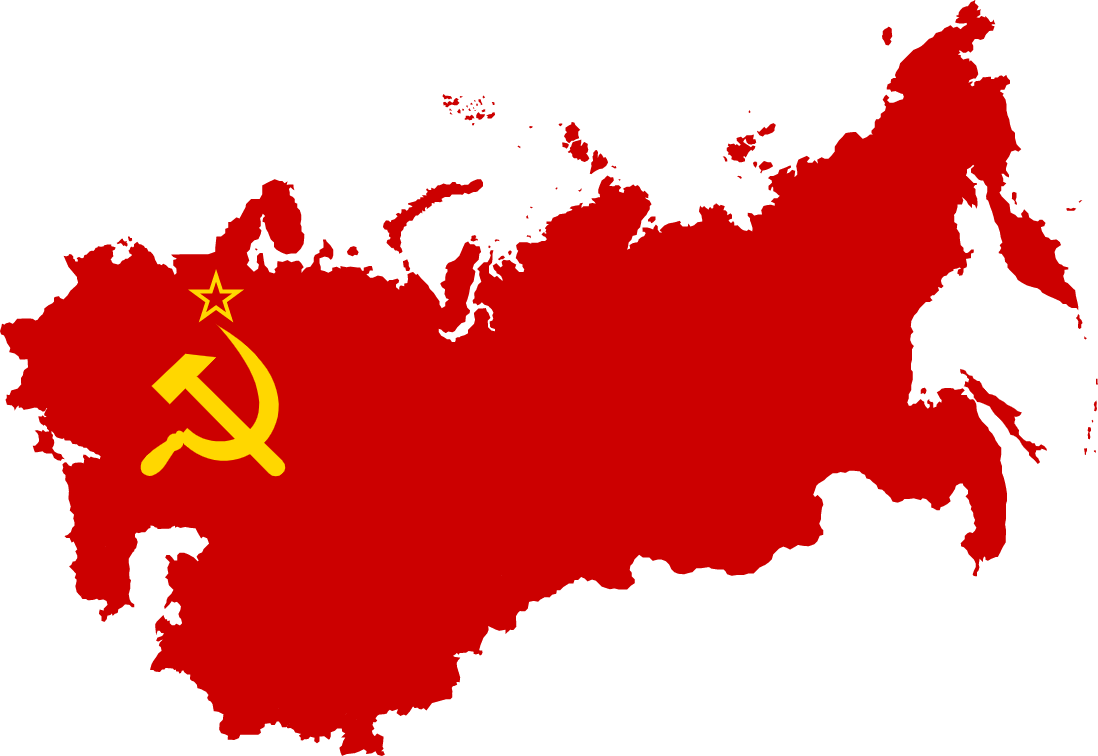
We hear every day how we need to get tough for our new cold war with China.  The unstated subtext is that threats and bluster are the “getting tough” that’s going to win. In fact we know exactly what won the last Cold War.  It’s worth paying attention to what that was.

The dynamism of our economy won the last cold war.   Our technological base reinvented itself many times over, and the top down economy of the USSR just couldn’t match it.  There were many individual factors behind the collapse—low growth, corrupt state enterprises, spending on defense, oil price collapse, Chernobyl.  But what it all came down to is that the Soviet economy collapsed because it just couldn’t find the resources to keep up.

Many factors made the difference—the historical strengths of the United States:

– A free market for new technologies.  A venture capital industry supported by anti-trust enforcement to protect new companies from powerful old ones.

– The US as world’s best destination for entrepreneurs from everywhere to realize their dreams.

– Openness to ideas from everywhere and active participation in international organizations of all kinds.

– Government support for pure research–to be on the forefront as new developments translated to opportunities.

– Expanding equality of opportunity, so ideas can come from everywhere.

The USSR had a well-trained population of elite engineers and scientists, but ultimately they couldn’t compete with the ability of the US model to reinvent itself and grow.

What can we say about the current situation with China?  There are three points:

  1. The rise of China actually followed the US model.

One part of this is familiar—China invested in its people:  education, infrastructure, health care, etc.  The regime tolerated no disagreements, but it put money (as we used to) into the environment necessary for success.

However the bigger part is less-discussed—what kicked off the Chinese miracle was an accidental surge of free enterprise.  As a weakening of collective economic control, Chinese municipalities were freed to carry out their own businesses once obligations to the state had been met.  That minor bit of freedom took over the economy.  Independent municipal businesses became dominant to the point that they dwarfed the hugely-corrupt state-run enterprises.  Municipal businesses grew into the independent private sector.

  1. Under Xi, China is abandoning that approach in favor of a return to central planning and control.

Xi is a princeling—a child of former revolutionaries brought up to believe he was born to rule.  All of his recent actions have been directed at crushing independent forces in the Chinese economy.  Appointments have been based on loyalty above all.

China is back to the old Soviet and Chinese world of massive state enterprises and a dictated economy.   That won’t change the immediate future, but we have no reason to despair of our ability to compete.

  1. Under Trump we are similarly abandoning our strengths.

Trump, like Xi, is an autocrat who view himself as the all-encompassing genius who needs to run everything.  He picks winners and losers with tariffs.  He awards exceptions to supporters.  He ignores real problems (such as Covid) that he doesn’t want to deal with.  Job appointments are based on loyalty over competence.  Every one of the listed US strengths is at risk:

– New enterprises are sacrificed to the existing powers that be.

– Xenophobia and nativism are pushing entrepreneurs elsewhere.

– Global participation is discouraged.

– Science is discredited and only mainstream technologies (e.g. AI) or Trump whims are funded. Climate change can’t even be mentioned.

– A political strategy of divisiveness means we’re fighting internally rather than drawing on everyone for progress.


We didn’t beat the Russians by mimicking their authoritarian control and top-down economy.  We won because they couldn’t compete with our ability to reinvent ourselves over and over again.  We have that opportunity today, but we’re losing it to the false god of dictatorship.

Democracy is not a nicety but the core of our success.

Dictatorships lose.  All-powerful leaders make disastrous mistakes that cannot be remedied.  They can ignore the well-being of the population.  They create massive corruption that cannot be contained.  All these tendencies are visible today (Covid alone shows several), and the effect is—as always—accelerating.

We still like to talk about the power of democracy and free markets, but both are slipping away.  Voter suppression is an openly-discussed goal.  Anti-trust enforcement has effectively ceased to exist.  The power of corporate lobbyists has starved the public sector (including infrastructure of all kinds) and defended the economic status quo against all comers.

Our problems today are not weaknesses of democracy but an indication of how far we’ve strayed from it.  There’s no reason to despair for our competition with China—or for the country generally.  It’s just a sign we have to get back to doing what we’ve always done best.

The Coronavirus and the Limits of Capitalism

23035851695_0ddbaae4c9_b

“Lankenau Hospital” by Montgomery County Planning Commission licensed under CC BY-SA 2.0

It’s easy to look at the coronavirus as a one of a kind.  After all, who expected this cataclysm that came from nowhere?   How could anyone have predicted it?

In fact the world is full of low-probability events that you have to care about.   The coronavirus is on a par with airplane crashes and oil-rig explosions.  Capitalism is not good at dealing with any of them.

There’s a myth about that sort of thing.  Of course we don’t need airline or aircraft regulation, because the companies in question know what a disaster would mean and will take care that such things don’t happen.  That’s a nice story, but it’s false.   People don’t get promoted because of events that didn’t happen.  They do get promoted by saving money wasted on something that’s never going to occur.

If you’re going to stop that sort of thing from happening, you need a different mindset.  Government has to spend money on regulation and public health and safe, comprehensive infrastructure.   No one else is going to do it.  We now know unequivocally that we decided we didn’t have to care about the CDC.  It has come back to haunt us.  There’s more where that came from.

In fact there’s a whole bunch of other things we’ve decided we don’t have to care about.  After all, “I don’t have to care” has been the liberating elixir of our age.  Many of these we’ve talked about before, but it’s worth recalling some here:

Climate change

Avoiding a depression (clearly relevant now)

Nuclear proliferation

Losing our edge in science and technology

We’ve washed our hands of all of this, blithely punting to a private sector that is no more prepared than for the coronavirus.

The message from the coronavirus is that bad things really can happen, no matter how much we may want to avoid thinking about them.

The coronavirus is the canary in the mine.   We’ll get over it somehow, but we’ve had our warning.

Irrelevance

2405334516_8e05bd7dcb_b

“P1040738” by frederique.baggio is licensed under CC BY-NC-SA 2.0

I find I can’t watch British TV series anymore without a post-Brexit shudder.

Those programs are no longer studies in quirkiness from a historically-great country that is almost us.  That country is gone.   It can’t even keep its own pieces together.  The solid core of the country has evaporated.  All that’s left are the quirks, and many of those are rather sordid.

Britain is a land possessed by dreams of lost empire, unwilling to accept either the now-visible reality of that imperial past or the self-evident fact that it is gone.  Ready to slap the face of anyone who reminds them of either.  What could be more preposterous?

We’re in the running.

We had our own years of empire.  By virtue of geography we were the last country left standing at the end of World War II, so we put together the world afterward.  And we ran it.  And we got comfortable with the idea that was the only way the world could be.  God chose the United States of America to rule the world.  The Brits had the same idea.

Those were the good old days.  Not only did America rule the world, but American products reigned supreme.  And notions of common effort left from the war drove broad-based prosperity through measures like the GI Bill.

Things aren’t quite the same anymore.  The rest of the world grew up.  We can’t just order everyone else around, and our products don’t automatically win everywhere.  And we seem to have forgotten those notions of common effort, with sad consequences for the spread of wealth in the population.

Unfortunately, like Britain, we haven’t forgotten empire.  That’s what we have to get back.  Rule the world.  Same population.  Blacks under control.  Winning everything.  Pot of gold for everyone.  God said so.

We have even more to lose than the Brits.

The United States is a prosperous country, in many respects the richest in the world.  We’ve messed up our social contract, but that’s ours to fix.  In the same way, there are no insurmountable problems in making worldwide growth good for everyone.  Even climate change, a monumental problem, has the technological basis for a solution.

We stand ready to sacrifice all of that to a fantasy of empire as vaporous as the British one.  It’s scary as hell that we seem ready to repeat history.  Their Brexit vote presaged Trump—what does the Boris Johnson vote say now?

Symbolism to the contrary, we have a better chance.  In Britain the vagaries of their electoral system prevented a legitimate revote on Brexit.  Regardless of who gets the Democratic nomination, we will get a chance a to vote on the future of the country and the planet.  History doesn’t repeat, people do.

But history will certainly judge.

What Matters for Climate Change

Last year this blog had an overview of the major factors involved in fighting climate change.  Most of that is still current, but it has also become clear that there is a lot of confusion—even in the climate movement—about consequences.  So this piece is not about the basics; it’s about the reality of what it takes to combat climate change.

To start with, Here is a list (off the top of my head) of widely-believed nonsense.  There is probably something to annoy everyone.  You can see if I’ve made a case for it by the end.

– Conservation is a primary issue

– It’s important to get solar cells on rooftops everywhere

– Recycling is important

– Local initiatives are important

– State initiatives are important

– The main game is getting our house in order

– We don’t need to do anything, since technologists will solve it by themselves

– We’re ready for electric cars to take over the transportation sector

– Current solar and wind are ready to take over everything

– Winning is simple, we just have to stop the oil companies and start deploying the good stuff.

– For climate change employment, we need local communities to decide what they really need

– The private sector is doing it all by itself

– Carbon pricing is optional

– Carbon pricing is all it takes

– We need to get a better deal than the Paris Agreement

– We’re in control of our own destiny

– We all need to change our lifestyles

– Fighting climate change will tank the economy

– Economic dislocation means taking care of miners

– Since poor people get hurt worse, climate action is a matter of charity—for social justice

– Same thing for racial justice

– Same thing for regional justice

– Internationally, this is a matter of everyone taking care of their own

– With China and India, the important thing is to stand tough to get what we want

– We have to insist that any new technology developed here gets manufactured here


Let’s start this off with item #1—conservation.  From within the US it’s easy to believe the fight against climate change is all about conservation.  After all, we’re up against a hard limit on tolerable levels of carbon dioxide in the atmosphere, so we’ve just got to cut down on burning in all ways.  And we’ve got to learn to behave differently in the future.

However that logic breaks down quickly.  What about all the people in China and India?  Our conservation is a blip compared with them, but we share the same atmosphere.  Do they just have to get used to the idea that cars and air conditioning aren’t for them?  They should accept permanent sacrifice for the good of mankind?  Even in the US, no amount of conservation will move people to electric cars or eliminate the CO2 production from heavy industry.

So even for the near-term we have to recognize that the fight against climate change is not primarily about conservation but about alternative energy sources.  Worldwide, we need to evolve energy sources, so that there will be enough to take care of people everywhere.  As noted in the prior piece, there is in fact no reason to fear we will ultimately lack for power.  This isn’t about learning to live with energy scarcity—it’s about creating a future for all people, all countries, and all life styles.

For that reason we need to focus on the transition to alternative sources of power.  There are two quite different types of problems to be solved:

– Generating and distributing power

The first thing to recognize is that (despite some obfuscation from the oil companies) the future is electric.  That’s the common currency for the energy to be used everywhere, in factories, in homes, in cars.  It’s what all the renewables produce today, and what will be produced by all future candidate technologies.  Electricity is easily transmitted over long distances, and can be stored for later use (although there is much still to be done for high-volume, in-network storage).

So this work includes the electrical network, the sources of energy, and the means to store it.  Since everything will move to the electrical grid, its capacity will need to grow significantly and fast.  This is a huge project, but this is ultimately just a matter of national will.  That makes it the easier part.

– Adapting applications to use it

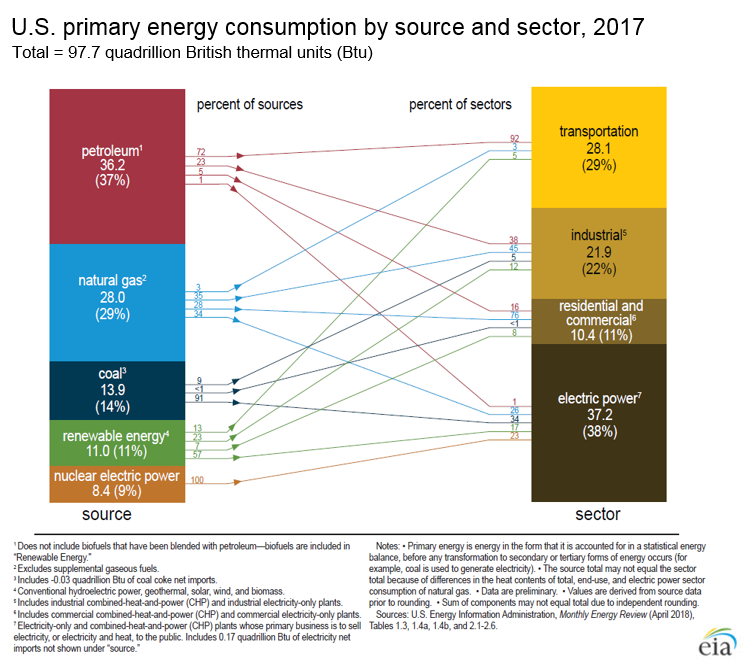
For that you need to work through the major sectors of energy usage.  Here is the chart for the United States.
consumption-by-source-and-sector

This is a larger and more complex undertaking, requiring careful planning for each sector.  Carbon pricing is one of the few actions that can be done across the board.   As we noted previously, assuming the atmosphere is free amounts to an annual subsidy of $1 T to the US fossil fuel industry.  Even low-level initial pricing (as with CCL) sends a message for corporate planning.  However, it is naïve to believe that carbon pricing will just take care of all sectors in time to avert disaster.  Note also, for priorities, that the residential and commercial sector is the smallest by far.

We also have to think about this problem not just for the US but for the rest of the world as well.  The US Energy Information Agency has released a document that helps in thinking about that task.  (A short summary of conclusions is available here.)  It has projections of energy use throughout the world going out to 2050.  With that it includes variants of the US energy use chart (just given) for other countries.  A significant fact is that many developing countries have a proportionally much larger industrial segment than we do, as high as 70%.

The report shows some influence of climate concerns, particularly in the US and China, but overall it describes the dimensions of a disaster.  The following chart taken from the report shows a continuing growth of CO2 emissions for the entire period.   While the report itself doesn’t explicitly call out the bottom line, the numbers from the report imply that the world will hit a point of no return already by 2035—with a CO2 concentration of 482 ppm and a temperature rise of 1.6 degrees C.

eia1

In the EIA scenarios, the world does a pretty good job of migrating electric grids to renewables (or to some extent gas)—but a terrible job of moving applications to electricity.  In developed countries this translates to business as usual, but in the developing world it’s much worse.  India, for example, is seen as growing exponentially with much of the increase powered by coal.  This isn’t just a question of forcing them to meet our standards.  Heavy industry is a particular problem everywhere.

So the application area is a big job with many industry-specific issues.  The world desperately needs focused research efforts with results that can be applied large-scale worldwide.  This can’t be a matter of everyone guarding discoveries for national advantage.  Cooperative international arrangements will be key to meaningful progress.


Even at this high level there are a number of conclusions to be drawn:

– There is no do-nothing alternative.

Technology will deliver a viable future, but we’ll have to work to get there.  There’s no silver bullet that makes it all go away.

– Technology development is important and has to be figured into any planning, but technology concerns are not the barrier to success.

It is perfectly possible to put together a plan to get the US where it needs to be by 2030.  That’s not saying all technology problems have been solved (after all electric cars are still much too expensive), but we can see a path to success.  We shouldn’t trivialize the effort and sophistication required, but based on where we are, and given financing, it appears that the technical side can get done.  The next point is less clear.

– Changes are huge and have to be dealt-with politically.

This isn’t just a matter of coal-miners losing their jobs.  Electric cars alone will have pervasive consequences.  We have to understand that worries about change are rational, so an important part of domestic climate policy has to be an assurance everyone will be made whole.  Otherwise we will continue to face the push back seen most recently in the Australian election.

In the US there is every reason for the less advantaged to distrust the political powers that be.  In the developing world it’s even worse—you’re talking about giving up on the benefits of development for some unknown duration.  The situation is necessarily difficult.   It’s only going to work if wealthy people and wealthy countries realize it’s in their own interest to come up with the goods.  No one will escape the consequences otherwise.

– The international side is unavoidable.

There is only one atmosphere.   Every country in the world has to cooperate, or we all lose.  When the US opts out, everyone loses faith in the future—as was evident in the recent Madrid meeting.  We have to restore international unity in order to make progress.  And that will only come when every country sees a just role for itself individually.  As for the terms of the Paris Agreement—it is only a first step and actually better for rich countries than will ultimately be workable.

We cannot go into this with the attitude that the objective is to come out a winner at the expense of everyone else.  If everyone doesn’t win, we all lose.

– This is not a matter for incrementalism.

We’re not going to get there with well-meaning people insulating their houses or businesses putting solar cells on the roof.

It’s worth putting some numbers on this.  With current technology, the power output of a solar cell is 20 watts per square foot.  From that you can calculate how many solar cells would be needed to meet current US electrical demand.  The answer is about 2500 square miles, assuming they’re all in brilliantly-lit, weather-free Arizona.  (And there are serious problems in managing that one too.)  All of it gets an order of magnitude worse if we decide to go piecemeal in random, less promising locations–and that’s just for today’s electrical grid, not where we have to get to.

That’s not to say that Arizona is necessarily the solution.  The point is that there has to be a rational national policy that will actually get the job done.


Greta Thunberg is right—there is no substitute for major political action.  Anything less is delusion, regardless of who says it.  The 2020 election is the single, deciding climate issue today.

Perhaps we need the right metaphor.  The fight against climate change is a war.  We’re all in it together—losing is losing for everyone.  The countries of the world are allies in the sense that each of them is necessary for success.  National economies will be affected, but through national climate efforts with no shortage of jobs.

Right now we’re like the US in mid 1941.  We can see and understand the enemy, but we’re not convinced we really have to be involved.  That situation only got resolved when the Japanese attacked Pearl Harbor, and it was clear there was no other choice.  You can make a case we were lucky that it wasn’t too late.  Without the Nazi’s disdain for “Jewish physics”, they might even have gotten the bomb.

For climate, if we act today we have the elements of victory.   We also have ample evidence it’s a near thing.  A climate Pearl Harbor may well be too late—and beyond anything we want to live to see.
Exported and Armed Prohibition

15766584947_c2dc1c0844

“Prohibition Repealed: New York Times, 5 December 1933” by cizauskas is licensed under CC BY-NC-ND 2.0

As a nation we seem to be baffled by the problems of drug-based criminality south of the border.  Why can’t those people live like us?  What makes us so superior?

For those questions it’s worth emphasizing that we used to have problems like that too.  Our problems were self-inflicted, but the phenomenon was similar.  Let’s talk about Prohibition.

Prohibition was a reactionary revolt much like what we’ve got with the Christian right today.   The heartland was able to stick it to the godless, immigrant-infested cities.  No more alcohol to corrupt our body fluids.

That repressive crusade was just too overarching to succeed.  It resulted in an immense network of criminality to meet demand.  Criminality pervaded every corner of the country, and the kingpins captured the news daily.  It could and did happen here.

Let’s compare with the situation in Latin American.  North of the border there is vast money to be made with illegal drugs, and the resources available to stop it are ludicrous by comparison.  Big surprise they’ve got a problem.  We have drug problems too, but we also have resources of the US.

What kind of help do they get?  They can’t even get us to slow down the sale of military-grade weapons underpinning the drug wars.

It’s like the wall.  Let’s just keep problems out.  We’ve exported and armed Prohibition.